
Chapter Six – Probing for Details and Confirming Information in The Middle of the Interview
Learning Objectives
After working through these lessons and practicing the skills presented, you will be able to:
- Structure fact-gathering to efficiently gather a complete picture of the client’s matter and keep the client on track.
- Use a variety of question-types to probe for details.
- Recognize conditions that inhibit a client’s willingness and ability to share information fully and accurately and be able to implement a variety of tactics to facilitate memory and disclosure.
In this chapter, we explore further the middle of the interview, particularly the ways in which one structures this portion of the interview and the iterative nature of detailed fact gathering. 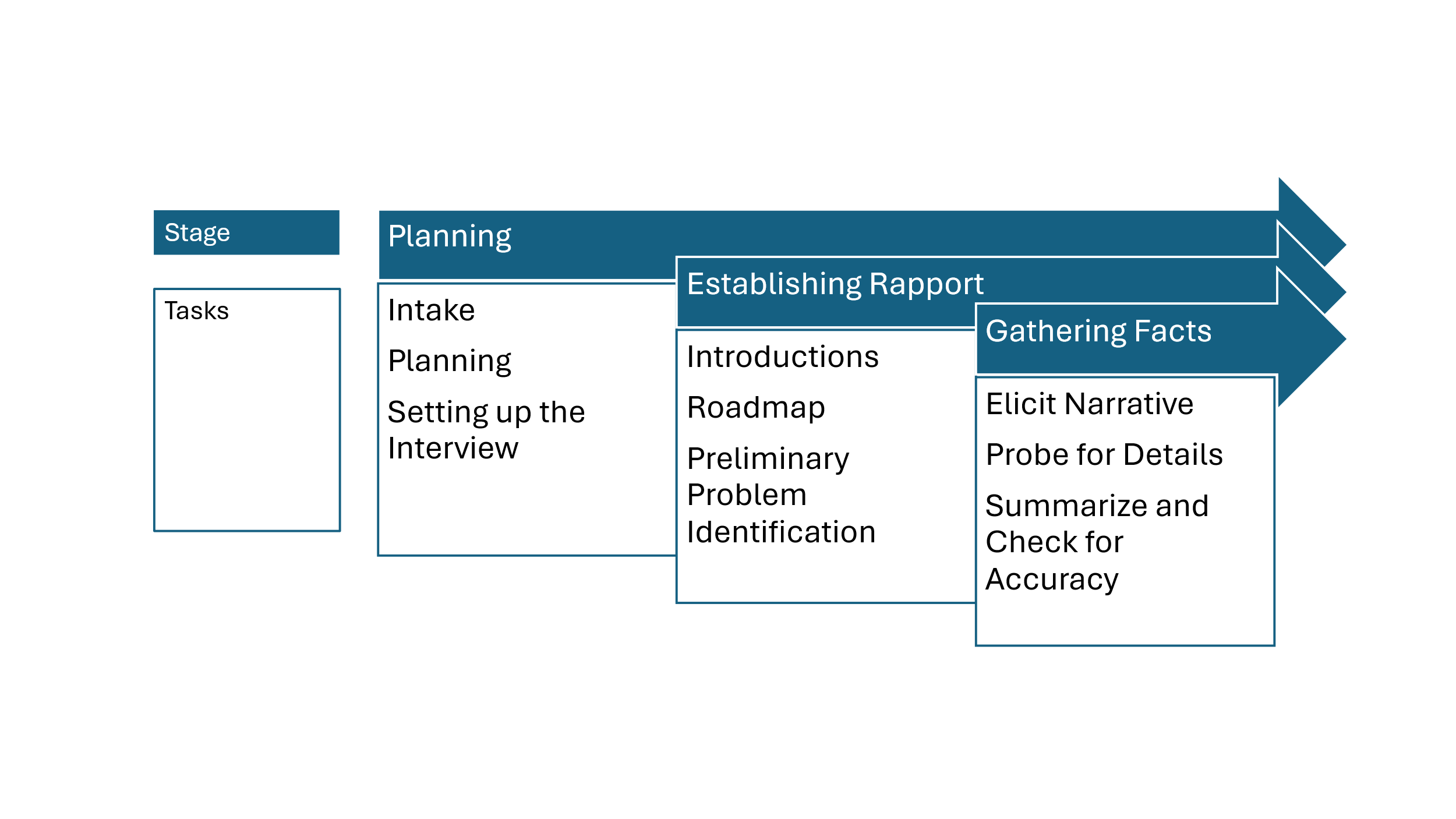
A. How do you use transitions to structure the interview?
Clear organization and transparency are important to trust and to effective communication. Throughout the interview, you should signal transitions to help the client understand the purpose of questions or dialogue and to forecast where you are in the overall interview process. While you will have provided an overall preview of the interview at the very beginning, you will need to continue to use these signposts as you move through the interview.
The transition from preliminary problem identification to detailed fact gathering is one such point at which a signal can be helpful. With the information provided in the intake form and the client’s initial description of their matter, you will have a general understanding of what has brought the client to you. Indeed, in some circumstances, when the prospective client presents a very narrow and specific problem, the intake form and the first “how can I help you?” question may be all you need to begin to analyze the matter and focus the interview. For most clients, however, you will need to probe for more details to truly understand the nature of the client’s matter.
Recall that by the end of the initial interview, both you and the prospective client need to have a good enough understanding of the client’s problem(s) and situation to make informed investment decisions about whether you want to represent the client, whether the client should hire an attorney, and if so, whether the client wants to hire you. Thus, you and the client need to have some idea of the cost-benefit factors in making these choices: the value of the matter, time demands, other costs, the client’s ability to pay something resembling your normal fee, whether you like each other enough to engage in an attorney-client relationship, and whether life circumstances for both of you are such that you have the energy, time, and resources needed to assist each other in trying to help the prospective client achieve their goals.
With this in mind, the heart of the interview involves sharing the information that both the attorney and client will need to make an informed investment decision. After summarizing the general nature of the client’s matter, you can bridge to the middle of the interview by describing the more detailed dialogue about their situation that is to follow. What might that sound like? In a family law matter: “So we need to discuss divorce, division of property and debts, custody, and child support. Does that sound right to you? (Pause for confirmation or explanation.) Ok, then I’ll need to get more details about each of these topics.” In a business transaction matter: “I understand you would like help in choosing the right business form and tax classification to begin your business today. Are there any other issues you’d like to discuss? (Pause for answer.) Well then, let’s get some more information to see which options will work best for you.”
As you proceed through the middle of the interview, continue to use “bridge phrases” and other signals to help your client transition from one stage to another or from one topic to another. Phrases such as “Next I’d like to address…” “Let’s revisit…” or “Are you ready to discuss…” help the client to orient themselves to the purpose of questions and respond more accurately and completely. Accordingly, don’t be reluctant to step out of the interview from time to time to not only reflect and summarize, but also to provide these signals.
Check your Understanding
B. How can you most effectively structure detailed fact gathering?
As you move from the client’s preliminary description of their problem to more detailed fact gathering, you will need to evaluate the topics you wish to explore and guide the client through each of these topics in a structured manner. The middle of the interview is the time to gain the details of the client’s situation, to explore gaps and inconsistencies, and to understand motivations and emotional context. To do so effectively, you must have a structure for this exploration.
If you think of an interview as building a house, the first information gathering part of the interview is when the structure of the house is built and the detailed fact gathering is when you furnish each room. Each room can be thought of as a discrete topic to explore in the client’s narrative. You will need a structure for how to proceed to “furnish the rooms” in gathering details.
If the client’s situation lends itself to a chronology, using the timeline to gather details can be effective. Chronological discussions provide a logical organization which allows a client to focus on discreet events. The timeline provides a useful tool for understanding the relationship between events and for storing information about a set of events. Many clients find it relatively easy to retrieve memories by using a chronology.
Alternately, the client’s matter might better lend itself to a thematic or topical content to organize the discussion. This will be especially true when working with clients planning transactions. Even for event-driven matters, however, for some clients this thematic orientation may present an easier means of recalling events than a chronology, as their brains may be less comfortable with the linear nature of chronology and more comfortable recalling things in relation to a given topic. A thematic organization can also help you to ensure that you gather details about each legally relevant category necessary to address the client’s issues. Note that in some circumstances, an attorney may find herself combining these structures—talking about a set of topics or themes but discussing each in a chronological fashion—at least with those clients comfortable with discussing things chronologically.
The point is not to adopt one or another approach but to have a transparent structure that best fits the client’s matter and the client’s comfort in relating their information. Gather details you need by signposting the topics as you move from one to the next. (“Next I’d like to explore…” “Let’s turn to the topic of…”) As you move through each topic, you can continue to use open-ended questions and prompts such as “You mentioned that X. Tell me more about that.” or “I’d like to hear more about X.” Other details may require more closed-ended questions, particularly regarding topics that a client is having difficulty in conveying. You can then move back to more open-ended questions to get the client back onto the chronological timeline.
Proceed one topic at a time and gather the necessary details before moving to the next topic. How do you know what topics are important for gathering more details? The content of the interview will depend in part on the legal theories you begin to develop as you learn more about the client’s issues. As you listen to the client’s information, you will need to begin to develop a theory about how the law frames those facts. In a litigation matter, you will begin to identify potential claims or defenses and then begin to look for facts that relate to legal elements. You will begin thinking about how you can translate facts into evidence. Likewise, in transactional matters, you will begin to develop options for structures or transactions that can accomplish the client’s goals. Those structures will then signal the need for additional information.
Do not let these legal theories constrain your detailed fact finding, however. Having the elements of a cause of action or the terms of a business transaction in mind should provide you with additional topics to explore more fully, but you should nonetheless explore topics simply to gain a full understanding of the client’s situation. In this process, you may find that additional legal issues emerge that you would not have recognized if you had prematurely narrowed your lens.
In addition to exploring details that address elements of potentially relevant legal issues, you should strive for a complete picture of the client’s situation. The law is very focused on “transactions and occurrences” but in the interview, you should expand the frame to include facts about before and after these legally significant incidents. Don’t overlook background facts. Ask about similar situations in the past. Ask about how a situation differs from how it would have been in the past. Ask about expectations for future steps. Don’t be afraid to ask about downsides. What if a business fails? What if the client does not prevail in a claim?
The journalist’s WWWWWH questions remains one of the best structures for gathering details. While you may not structure your interview based on these questions, you should always be sure that you have addressed all of these topics.
- Who: Ask for complete names and details of relationships to the client and to the matter.
- What: Fill out the details of events. Asking clients to recall details using sensory language (“What did that sound like?” or “What would that look like?”) can help some clients better generate the detail needed. Think not only in terms of facts but consider how those facts might be communicated to others—as evidence in litigation matters or as negotiation points in transactional matters. Ask for any documents, texts, emails, social media posts, or other corroborating materials.
- When: Try to gather details of dates and be clear on sequence of events. (“When did this start/change/worsen?”) If clients have difficulty remembering dates, often asking in relationship to other aspects of their lives can help jog memories. (For example, “Where we you working/living at that time? How old were your children? What season of the year? Etc.)
- Where: Jurisdictional facts are critical. Be sure you understand where events took place or are planned.
- Why: Do not neglect to ask about the client’s thoughts, emotions, or intentions. The “Why” questions can often uncover important additional facts. Asking “how did that make you feel?” can provide critical insights into the client’s perception of an event as it was happening.
- How: Consider explanations of cause, processes, and potential solutions. Invite your client to challenge their assumptions about cause or intent. “Could there be another explanation for this issue?” “What if our current understanding is incorrect?” “Have you considered a different approach to this plan?”
You will never gain perfect information even after the most effective of interviews. Gaps and ambiguities are inherent in any fact situation. However, you want to try to identify and fill or clarify as many of these as possible in the time available. When there is confusion or when gaps appear, it frequently becomes necessary to ask direct or closed questions in an effort to clarify some ambiguity, better understand details, or fill in gaps.
Filling the gaps is often not as difficult as recognizing the gaps in the first place. The psychological phenomenon of “filling” and “framing” causes us to assume facts instead of probe to fill gaps. The reluctance to be “nosy” limits our willingness to ask for more details. Effective interviewing requires a relentless curiosity driven by the need to understand the client and their situation fully. If you are wondering, ask! If you can’t picture the situation clearly, get more details. Be respectful but persistent. If a client is reluctant to provide details, explain why the details are important.
As previously noted, you should be especially aware of the difference between conclusions a client has arrived at and the underlying facts driving that conclusion. This is especially important for facts that relate to the mental state of an individual. If a client reports that another person intended or desired a particular result, ask why they have drawn that conclusion. Likewise for other conclusions such as causes for events, predictions for future reactions, etc.
The middle of the interview challenges your ability to both listen fully and analyze what you are hearing at the same time. As you are taking in information, you are beginning to identify some possible legal doctrines that might apply to your client’s matter. These preliminary theories will in turn influence your further fact gathering. The delicate balance to be achieved is to be able to conduct this legal analysis without coming to premature conclusions that will close off important additional fact finding.
C. How do you use questions and listening in the middle of the interview?
The questioning and listening techniques discussed earlier apply throughout the interview. However, to be efficient and organized, the attorney must be able to exercise these techniques with more flexibility as the interview moves toward more detailed information gathering.
Some commentators describe the middle of the interview as a “funneling” because the interview has begun with broad, open questions and then narrows—like a funnel—during a series of direct or closed questions that become more and more specific and precise in an effort to get a full and complete picture of a specific event or series of events along the chronology. While the image of a “funnel” can be helpful, we think the concept can be misleading in that one can assume that the purpose of the middle of the interview is to narrow the information down or that there is only one “funnel” of information one is pursuing. We prefer the concept of a cycle, in which one moves between open and closed or direct questions as one explores individual topic areas. This cycle concept reminds attorneys to return to open questions after exploring a topic with direct or closed questions.
The following graphic demonstrates how one might use this technique to gather details after having gained a client’s timeline or narrative.
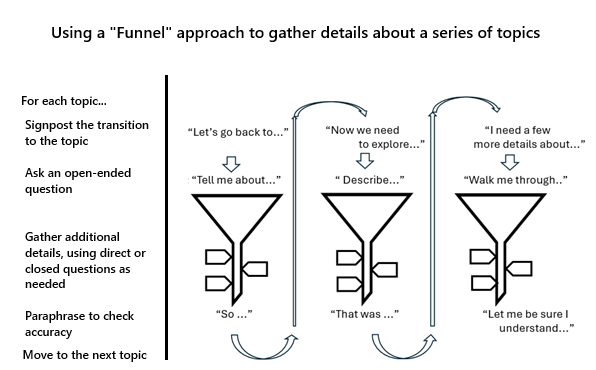
You should continue using active and reflective listening throughout the middle portion of the interview. Active listening assures that you remain attentive to ambiguities or gaps in the client’s presentation. Indeed, to succeed in the “cycling” or “funneling” process that comprises the middle of the interview, you need to be listening actively enough to catch the ambiguities in the client’s presentation, to identify the gaps in the client’s presentation, and to flesh out specific events that merit more detailed attention. You also need to listen for the client’s nonlegal and emotional concerns.
Reflective listening remains important also both as an organizational tool and a relational tool. During the middle of the interview, the attorney needs to gather a fair amount of information about the client’s situation and will need to organize this information. Reflective listening serves an important role in helping the attorney to summarize manageable chunks of information, verify understanding with the client, create transitions between specific event discussions and broader chronology, build rapport by acknowledging non-legal concerns, and demonstrate empathy by acknowledging emotional content.
In the middle of the interview, then, you will use active and reflective listening and the organizational device of cycling through topic “funnels” with a variety of question forms. For example, recall the interview involving the client Mr. Jones and his breach of contract dispute involving a failed delivery. Assume that the attorney obtained a complete timeline of Mr. Jones’s business dispute. One of the key concerns Mr. Jones has identified is that the services due under the contract were not provided as agreed. Consider how the attorney uses a series of specific questions to gain more detail about this aspect of the client’s situation.
Attorney: Mr. Jones, you mentioned the services weren’t as agreed upon. Could you give me an example of a time when you believe the service fell short of the agreement?
Jones: Sure, a good example is this summer when we were expecting a shipment of computer chips, and they were delayed six weeks. During that whole time, the company kept promising that the shipment was “on its way.”
Attorney: When were the chips originally due?
Jones: May 1.
Attorney: Ok, and when did you actually receive them?
Jones: The middle of July. I don’t remember the date exactly, but I can look it up for you.
Attorney: Great. That will be a helpful detail later. For now, tell me about how this particular delay impacted your business.
Jones: Well it threw our whole production schedule out of whack.
Attorney: Did you incur any specific financial losses as a direct result of this delay?
Jones: I wouldn’t say that. We always build some ‘give’ into our schedule and we always keep some reserve inventory so that we are able to meet all of our contracts. But, well, I guess there was the cost of the overtime once we got the shipment in order to build our reserves back up.
Attorney: We’ll want to get some details about those costs as we go forward. Any other costs?
Jones: Not financial, but boy it sure did make me question whether we should be looking for a different supplier.
Attorney: You lost trust in the supplier.
Jones: Yes, if they had just told us there was going to be a delay instead of saying “the check’s in the mail” so to speak, well, it would have saved a lot of headaches.
Attorney: Let me ask more about your communications with the company about the delay…
Notice how the attorney signposts the topic they are going to explore as they move from one “funnel” to the next (first, a specific example of a delay, then communications). Notice as well that the process of asking these specific questions causes the client to recall more details they may have omitted from the initial narrative (the overtime costs that resulted). Finally, notice that the attorney uses reflective responses to verify the client’s meaning (“You lost trust…”) Regardless of the type of question the attorney uses to gather details, the attorney continually uses active and reflective listening.
Skills Practice
Consider an initial client interview in an estate planning practice. Assume the preliminary part of the interview has taken place (introductions, explanations of interview, etc.). We pick up the interview at the point at which the attorney is getting the client’s description of their legal issue. Answer the question that follows.
Attorney: How can I help you today?
Client: Well, I want to make sure that my stepson, Daniel, gets my house when I pass away. I’m not sure how to go about it, and I want to make sure it’s done properly.
Attorney: That’s a thoughtful decision. I’d like to understand more about your situation so we can explore the best way to accomplish your goal. To start, could you tell me a little about your family and any other heirs or beneficiaries who might have a legal interest in your estate?
Client: Sure. My husband passed away five years ago. Daniel is his son from a previous marriage, but I’ve always thought of him as my own. I don’t have any biological children myself, and I don’t have any other relatives that I am close to.
Attorney: I see. And do you currently have a will or any estate planning documents in place?
Client: No, I’ve never done any formal estate planning.
Notice that you need not necessarily know a great deal about estate planning to generate a list of relevant questions. What you do need is curiosity and imagination.
D. What conditions might inhibit or facilitate gaining details?
No matter how deftly an attorney questions, listens, and reflects, a client may be inhibited from sharing information freely during an attorney-client interview. For example, as we have already seen, differences in personality, culture, or language can make it challenging for clients to communicate effectively. The client may believe it would be inappropriate to raise a subject or convey particular ideas or information to the attorney. Revisit the discussions of communication differences[1] and clients who pose particular challenges in gathering information[2] and consider how you might build bridges across these divides with your client.
Many of these inhibitors may even operate at a subconscious level as a consequence of the cognitive biases that pervade our fast-thinking processes. Being aware of these inhibitors and developing techniques to overcome them can improve the quality and quantity of information you can obtain in an interview. For example, recall the discussion in Chapter Four regarding the ways in which confirmation bias might cause an attorney to prematurely conclude information gathering or ignore certain information that contradicts preexisting judgments. This same cognitive bias can inhibit a client’s information sharing. Confirmation bias can operate to limit what a client may remember or how readily they will share information that contradicts their preconceived judgments about the matter they bring to the attorney. Selective memory or perception may lead clients to unintentionally omit or distort details. This selective perception will make it particularly difficult to obtain information that the client believes threatens their case or makes it harder to achieve their goal.
Another common cognitive bias is social desirability bias; that is, the tendency for individuals to present themselves in a way that will be viewed favorably by others. This bias stems from the desire to conform to societal norms and gain approval or avoid disapproval from others, especially those in positions of authority or perceived power such as attorneys. Consequently, clients may consciously or unconsciously omit or downplay negative information or they may exaggerate or embellish details that make them appear more responsible or virtuous. Social desirability bias can especially inhibit clients from disclosing highly stigmatized matters, such as mental health, substance use, or relationship problems. Especially if the attorney hasn’t established a strong rapport and created a safe, non-judgmental space, the client will not easily share sensitive information.
How can you facilitate information sharing when faced with these inhibitors? All of the basics of interviewing skills are critical for open and honest communication: building rapport and trust, explaining confidentiality, employing active and reflective listening skills, maintaining cultural sensitivity, and providing nonjudgmental responses. Additionally, you can employ a number of more specific facilitators to address a client’s reluctance to disclose negative information. Patience is a key facilitator. Trust takes time to develop, especially when there are barriers of culture, trauma, or perceived threat. Educating the client about the reasons that you need full information can create expectations that a client will want to fulfill. Consider this explanation:
I view our relationship as a partnership. I’m an expert in the law but you are the expert in your situation. The biggest help you can give me is to provide me with a complete picture of your matter. So, I’m going to ask you not to hold back—even if you think something is irrelevant or unimportant, even if you think it might hurt your case—it’s more important for me to fully understand your situation to help you find a solution to your situation.
Sometimes the best way to overcome a client’s reluctance to share negative information is not to ask the client directly but to ask what a third person might say. Bringing these virtual third persons into the room can reduce a client’s defensiveness and provide a face-saving way for them to disclose negative facts. Ask the client to place themselves in the shoes of another person who witnessed the event or who is viewing the transaction. Then ask the client to explain what they think that person would say. This can also be an effective technique for improving a client’s recall of past events.[3] You can then open up a discussion about that negative information by asking the client why they believe others might say something or how the client might want to respond to that information. When a client does disclose sensitive information, you can facilitate even more disclosure by recognizing the client’s contribution (e.g., “Thank you for sharing that.. That couldn’t have been easy to tell me…”).
If a client is having trouble remembering details, try getting at the information in a different way. A technique known as “cognitive interviewing” developed for forensic interviews suggests additional approaches to helping witnesses recall details accurately.[4] These techniques can be used in the initial client interview as well. One technique is to ask the client to place themselves in the scene of the event they are trying to recall, using all their senses to recall the context in which the event took place.[5] What was the weather like? How were they feeling? A second technique suggests asking about events in a different order, starting with the most important part of the events, or working from recent to past rather than chronologically.[6]
Sometimes the most powerful inhibitions are not those of the client but of the attorney. Asking about sensitive facts can be especially difficult. Some new attorneys are reluctant to probe for details as fully as is necessary to get all the facts needed to guide their own and the client’s decisions about the possible representation. For instance, a new attorney might hesitate when needing to ask a client detailed questions about their financial circumstances, such as sources of income or outstanding debts, fearing it may seem overly intrusive or judgmental. Similarly, some attorneys may become uncomfortable discussing emotionally charged or intimate personal matters, such as allegations of domestic violence, divorce details, or health-related issues. In criminal cases, attorneys may feel apprehensive about probing deeply into sensitive topics like substance use, prior criminal records, or difficult family relationships, worrying that these questions might embarrass or alienate their clients. These attorneys might feel protective or sympathetic toward their clients, making it difficult to fully explore potentially uncomfortable yet crucial facts. A good interviewer must overcome this reluctance and exercise vigorous curiosity, recognizing that the willingness to sensitively and professionally explore difficult topics is essential to fully representing the client’s interests and making well-informed legal decisions.
Monitor both your client’s and your own comfort level throughout the interview. Just as ego threat can limit a client’s answers, so too your own awkwardness, discomfort with topics, or concern that you will be perceived in a negative light can inhibit your questions. If the reason you choose not to ask a question is because of how it makes you feel, reconsider. You’ve likely identified a topic about which details may be especially important. On the other hand, if you are reluctant to follow a line of questioning because the client is showing signs of deep distrust or distress, it makes more sense to save that topic for a later time. In certain types of representation, where clients have experienced trauma or they must disclose deeply personal information, you are unlikely to gain all relevant facts in the initial client interview. You must balance your persistence with patience and plan for follow-up interviews.
Check your Understanding
Skills Practice
You are interviewing a new client, Ms. Davies, regarding a potential employment discrimination case. Ms. Davies alleges that she was unfairly passed over for a promotion. During the initial part of the interview, Ms. Davies focuses heavily on her qualifications. However, she is less willing to provide details about her employer’s justification for not promoting her. Given some of the ways Ms. Davies has characterized the situation—”I trusted him,” “I thought we had a professional working relationship”—and her reluctance to describe the details of the conversation that led to her dismissal, you suspect that there is much more to the story.
Consider each of the following tactics that you might use to increase the client’s willingness to discuss that conversation and the details of the reasons for the supervisor’s decision. Think about how you would approach each circumstance and answer the following questions.
Evaluating an Interview
The following transcript follows up on the West case interview, recording the attorney’s detailed fact gathering. Read the transcript and evaluate the use of structure and signals, prompts and questions, and reflective listening. Answer the questions that follow.
TRANSCRIPT OF INTERVIEW – LINDA WEST

A. Why don’t you just start at the beginning and tell me what happened.
C. Well, like I mentioned, I work at the stables and that’s where I keep my own horses that I train and show. Last March, Tammy and I were out riding our horses. She was riding a little bit in front of me. She rides a saddle bred horse, so she usually walked a little faster than my mare. So we are riding our horses along the side of the road, and I hear somebody yelling “Get out of my yard!” I stopped my horse and I looked and there was a man standing there on the south side of the house with his hands on his hip. And I looked at him and I said, “Sir, we’re on public right of way.” And he said, “I don’t care what it is, it’s my grass and I take care of it and you need to just get off.” He started coming across the yard towards us yelling. Tammy moved her horse to the side and more into the road. I don’t remember exactly what I said, but it was something about us having a right to be there and why was he so upset. He just keeps on coming at us and screaming about his property and my horse being a menace. All that yelling… yelling, loud voices excite animals. So Velvet was getting very fidgety. I’m trying to keep control of her and asking the man to please calm down. He just keeps coming at us and yells “I’II show you what I think of your horses!” He doubled up his fist and hit Velvet in the head. Well, Velvet just went crazy. She ran into the man’s yard and when I finally got her out of the yard and back to the stable, well, she was just too skittish to keep showing. I’ve done all kinds of work to help her to recover but she won’t ever be the same. I’ve lost a lot of money because of this, not to mention my reputation in training horses, and I am wondering if there’s anything that I can do to recover something from this guy because of this.
A. Wow! That sounds really frightening.
C. It was! An out-of-control horse is a really dangerous situation, especially if she’d thrown me on the road, it could have been deadly. We were close—the pavement’s right there. Horseshoes are very slick on asphalt. Horses can slip and fall. There’s cars going by. You can fall off, break your back, break your neck. It’s dangerous!
A. Let me get a few more details about this situation. Do you know the name of the man who hit your horse?
C. Yeah. Roland South. His name’s on his mailbox.
A. Okay, thanks. You mentioned that Velvet went crazy when Roland hit her. Tell me more about that.
C. She was out of control—I think any animal would be. When something like that happens, they jump around, they—they rear, they buck. So Velvet came off the front end a little bit, which we call rearing, somewhat coming off the ground. She was fidgety. She was bucking a little bit, twisting, turning. She immediately threw her head to the side and just went out of control.
A. Now, where’s Tammy while this is going on?
C. I presume she was still watching us. I – I was—had my hands full.
A. I guess so! What happened next?
C. Well, South is still yelling. He ran back into his yard and he started backing up and he yells that if we don’t get off of his property, he’s going to go in the house and get his gun and come back out and blow our goddamn heads off. Those were his exact words.
A. Where were you at that time?
C. Like I said, the yelling kept the horse excited. I had lost control of her and she did run into his yard. But I couldn’t help it. I got her to turn back and I was trying to get her back to the side of the road. There was a gravel driveway right there to our left. And as I recall, I think we got in the driveway and got back alongside the road that way.
A. Okay. Did South back off then?
C. No, we were leaving, he was running after us, after my horse, and he got to the driveway and picked up some rocks and threw them at us.
A. Did they hit you or the horse?
C. Both I guess. We were moving pretty fast getting out of there.
A. What happened next?
C. Well, we headed back down View High Drive to the barn. We were headed to the barn. We raced down the street to one of the neighbor’s houses. Her name is Norma McMillen. She was outside her house and we just stopped for a minute to get the horses to calm down. I’m not sure if she saw anything. She came out and asked us if everything was okay and I told her that the crazy neighbor down the street threw rocks at us. She asked if there was anything she could do to help. We told her we just needed to stop for a minute and then we went on back to the barn.
A. Okay. Tell me about how things went when you got back to the barn.
C. Well Velvet was real tight. She—I tried to take her bridle off and put the halter on so you can cool them down and put them back in their stall. And she was—her head was just, you know, she kept fIinging her head. It’s called being head shy.
A. So was she physically okay? Nothing broken or anything?
C. No she didn’t break anything, but she was a mess.
A. How about you? Were you hurt?
C. No. We were just both really shook up.
A. It sounds like it was a traumatic event for sure. This happened in March, right? How have things gone since then?
C. Not so well. I’d been showing Velvet and she was doing really well, but after this she became so head shy that I really couldn’t win any shows anymore. There was a kickoff show second or third week of April. I can’t exactly recall the exact date right now. I had been in a class and—I believe it was a horsemanship class, as I recall it was a horsemanship class. And after the class, a lot of times a judge will come up and he will touch part of your tack, your bridle, your saddle, your horse, and ask you what it is. Sometimes he’ll even see if you’ve kept your saddle clean. After we had performed our wall trot and canter, the judge started walking towards us. He raised his hand and she ran from him sideways. Well, that doesn’t look very good and you don’t—that’s part of it. That disqualifies you. So that was the end of that show for us.
A. Is there a way to cure a horse of being head shy?
C. Well, I tried. I tried to expose her to a lot of different people, you know, strangers. That’s what she was the most afraid of. It wasn’t so much me. She was still even leery of me, but, the worst thing she was, she had to be exposed to different individuals. There were some people that even would come up and wave their arms around her, but wouldn’t touch her, to let her know they weren’t going to hurt her, they weren’t going to hit her. There’s several times we’ve done that, different people, just get her used to motions. But she’s—I still can’t move real fast around her, especially someone she doesn’t know.
A. Did that work?
C. No. I wasn’t doing a very good job of getting her over being head shy. I didn’t know what to do exactly. I knew of a trainer that was very good, had a good reputation. His name is John Fox. He had seen her at a show and she was acting silly. And I approached him to see if there was some way he might help me. I asked him if there was a way I could work for him, if he would work with my horse and I would do what needed to be done at his place for help. I really couldn’t afford his help any other way. He charged $500 a month. Well he was really nice and agreed. So I moved her to his stables and began working for him in addition to the work I did at Deerhorn stables.
A. When was that?
C. Starting in about May.
A. And how did that go?
C. Well I started working for him in the middle of May and I left in the second week of August. I worked about 20 hours a week for him, a lot on the weekends. I helped feed the horses, hand-picked the stalls, put horses on the walker, groomed them—that sort of thing. Oh, I even helped mow the pasture with a tractor. Whatever needed to be done.
A. And Velvet?
C. Well I began training with Mr. Fox a few hours every week. And I took Velvet to shows. We went to maybe 18 or 20 shows and I would show Velvet in one or two classes. She did seem to get better for a while. She still—she wouldn’t keep her head in the right head set, she wouldn’t—in a pleasure class, you have to stay on the rail. A lot of times at the shows, people will hang on the fence and it was very embarrassing at first because she would come around the ring and someone would be on the fence and she would run away from the fence. But she got better over the summer. She even won a few in August.
A. Can you give me a little bit more background on Velvet. What kind of horse is she? How big? How old? That kind of detail.
C. Well, she’s seven years old now. I bought her in August 2018. She is a registered Black Leopard Appaloosa and her birthday is April 3, 2016. At the withers she stands about 15 hands and weighs about 1000 pounds, though she’s in foal right now so she weighs more. I had her bred to a Bay Appaloosa stallion for a May 2023 foal.
A. Ok, help me out here a little more. When you say she’s 15 hands at the withers, what does that mean?
C. A hand is how you measure a horse. It’s about four inches. She’s 15 hands from ground to withers.
A. Withers?
C. That’s the highest part of a horse’s back, just above the shoulders.
A. When you say she’s in foal, what does that mean?
C. She’s pregnant.
A. Oh, okay, well we’ll talk more about that in a minute. Let’s talk about when you first got her back in summer 2018. Did you start showing her as soon as you got her?
C. Oh heavens no. She’d never had a saddle on her. I had to break her, and that takes time. I worked her on the ground for several months, put a saddle on her back and off. I didn’t actually start riding her until Spring 2020.
A. Is that when you started showing her too?
C. Not really. COVID really shut down opportunities for a while. I really just started showing her in 2021.
A. And how often would you show her?
C. Well I’d take her to 15-20 shows a year and she’d be in one or two classes each show.
A. How did she do?
C. Oh she was great. She brought home a lot of ribbons. She’s been really easy to train and she has the right build and gait, so she’s kind of a natural. Well she was anyway. After she got head shy, not so much.
A. Did she ever get over being head shy?
C. Well, with me she did. She’s real good with me now. The lady I rent from, her boyfriend, Mark, we all take—he has a horse there too and we all take turns taking care of them. He cannot catch her, he cannot walk up to her, and she just—if she’s even in a stall, she’ll throw her head away from him. She just—he can’t do it. He can’t—he can’t do anything with her.
A. Did you ever have a veterinarian look at her?
C. Well, yes, of course. When a horse is with foal, they need regular care from a vet.
A. I meant about the head shyness.
C. No, that’s really more a trainer issue.
A. So do you think she’ll ever be able to be shown as successfully as she was?
C. No. That’s why I decided she’s better off as a broodmare.
A. A broodmare—that means you breed her?
C. Yeah.
A. So how much is a horse like Velvet worth?
C. Do you mean before or after she got hit? Because it’s a big difference I think.
A. Before and after.
C. Well, before she got head shy, she was winning a lot and I think she would probably would have brought $15000 then. Now, I’m not sure that I could get even $3000 for her.
A. What about her foal? Is she valuable as a broodmare?
C. Well, maybe, we’ll see, but I really don’t want to get into horse breeding. It’s really expensive. Whatever I might get for her foal will really only cover the costs of breeding her. But if she breeds well, I want to see if I can keep one of her foals. It’s the showing I really like.
A. Do you make any money from showing horses?
C. If they win. Not a lot though.
A. About how much did you make showing Velvet?
C. I really don’t know. I never kept any records. I keep the ribbons and trophies and such, but not any record of any prize money. The winnings were just a way to be able to afford to keep her.
A. OK, well we might need to dig into that a little bit more later, but for now, let’s talk about you. How has all this affected you?
C. Well, it’s hard to talk about.
A. Of course. Just take your time. It’s important that I understand how this entire matter affected you though.
C. Well, at first I really couldn’t sleep and I cried a lot. Especially seeing that Velvet didn’t trust me…. well that was just awful. I had a lot of nightmares. I would get up in the night a lot. I was very afraid for Velvet. A lot of times that first month or so, I would drive to the stable in the middle of the night just to make sure she was okay. I was nervous, upset. I am a very nervous person about eating, what I call a nervous eater. I gained a lot of weight and a lot of times I was nauseous.
A. How much work did you miss during this time?
C. I never miss work.
A. Never?
C. Yeah. I—I usually end up with strep throat at least once a year and I never miss work. I just get antibiotics and keep going. I’m—I just go.
A. So, you worked through all that sleeplessness, nausea, and stress. How are you doing these days?
C. I still have nightmares. Not quite as much as I did, but still pretty regularly. I didn’t sleep much at all last night thinking about coming in today to talk to you about this.
A. I’m so sorry to hear that. Unfortunately, it’s not uncommon in situations like this to experience significant distress. I always encourage clients to get some professional advice and assistance to deal with that distress. I’ll provide you a list of some fine, affordable counseling options my clients have found helpful in the past and, if you don’t have someone already, you might consider working with one of them.
C. Well okay yeah I guess.
A. So have you seen a doctor at all to address your trouble with sleeping and nausea?
C. No, I really don’t see doctors much.
A. Okay, is there any other aspect of this situation that has you concerned?
C. Yeah, this South guy, I just don’t understand what his problem is. I’ve seen him driving a few times since that day in March and, whenever I do, he honks his horn and gives me the finger. One time at 79th and Raytown Road, he cut me off. He was coming from the opposite direction on 79th and he turned right in front of me. No blinker. It was like he saw me and just decided to cut me off.
A. Was it your impression he did that deliberately?
C. Oh yeah, he was laughing and flipped me off.
A. So how does that make you feel?
C. Scared really. He seems not right to me. I sure don’t go by his house ever. But it makes me wonder what he might do if he ever saw me on a horse again.
A. Well that’s certainly concerning.
So let me just make sure I have the whole picture here. You were riding along the road in front of Roland South’s house when he aggressively confronted you and hit your horse, Velvet. This caused you to lose control of the horse and she ran into Roland’s yard. He chased you off and threw rocks at you. Since then, Velvet has become head-shy, which has resulted in significant financial losses for you, not to mention the emotional toll. Despite your efforts to rehabilitate Velvet with a reputable trainer, the horse’s value and showing potential significantly declined. You have continued to experience anxiety and fear due to subsequent hostile encounters with South, impacting your daily life and sense of safety.
Is there anything else that you’d like to share about this matter? Am I missing anything?
C. No that’s about it.
Chapter Six Endnotes
- What are some important differences among people that can lead to misunderstanding? Supra Chapter Three, Section C. ↵
- Who are some clients for whom active listening can be challenging? supra Chapter Five, Section E. ↵
- Julian Boon & Elizabeth Noon, Changing Perspectives in Cognitive Interviewing, 1 PSYCH., CRIME & L. 59 (Jan. 4, 2008) https://doi.org/10.1080/10683169408411936. ↵
- Fisher & Geiselman, supra n. 1. ↵
- Id. at 99-102. ↵
- Id. at 110-12. ↵