
Chapter Four – The Initial Phase of the Interview: Building a Relationship
Learning Objectives
After working through these lessons and practicing the skills presented, you will be able to:
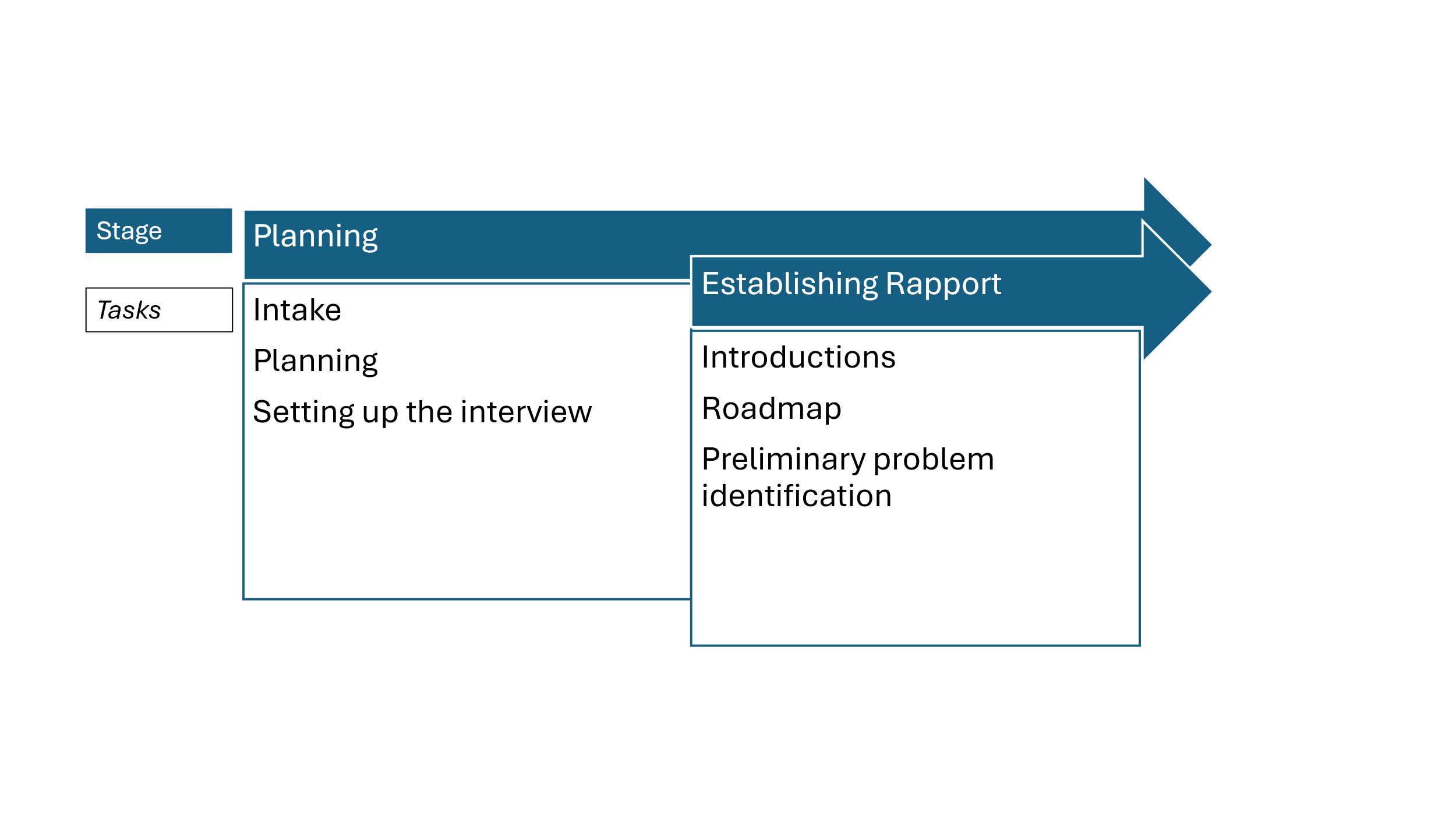
- Provide a structure for the initial consultation.
- Select and effectively use intake forms.
- Screen for conflicts, discuss fees, and explain the ethical duty of confidentiality.
- Employ techniques to manage assumptions and avoid premature judgment.

A. How does a transparent structure for the interview build trust?
As we read in Chapter Three, trust depends on many personal factors for both you and your client. One of the ways that you can help to build any client’s trust is to provide a clear structure that conveys your competence and caring and that reduces anxiety and fear of the unknown.
To begin your meeting with your client, introduce yourself clearly. When the client arrives, greet them warmly with a smile and a firm handshake (if appropriate). Speak slowly and clearly. Ask the client’s name. Repeat it. This initial interaction sets the tone for the meeting and helps the client feel comfortable. By addressing the client by name and introducing yourself, you begin to establish a personal connection. As we have discussed previously, depending on the client, you may want to start the conversation with some light, non-legal topics to build rapport. Asking about their day, mentioning something relevant to their interests, or discussing a neutral topic like the weather can be effective. These small talk elements help break the ice and show the client that you are approachable and interested in them as a person.
Before you dive into asking the client questions, take some time to provide a roadmap for how the meeting will proceed. By providing this structure, you set the client’s expectations and clear up uncertainties. For example, you might say something like “We have about 30 minutes for today’s meeting. In that time, I hope we will be able to decide we are a good match for working together on your matter. We’ll spend most of our time with me learning some more details about your situation and your goals. Then we can discuss some possible solutions and decide whether our firm can help you. How does that sound?”
We have previously discussed the value of asking whether the client has worked with an attorney before. Their answer can help to shape how much you need to orient them to the structure and function of the initial interview. Depending on the client’s prior experience with attorneys, you may want to describe a bit more about yourself and your practice. Avoid giving a “sales pitch” but do answer the implicit question that may be on many client’s minds: “Am I in the right place?” Again, for clients who do not regularly work with attorneys, explain the attorney-client relationship and how you work with clients. At a minimum, you will want to explain that you owe a duty of confidentiality to the prospective client, even if they decide not to retain your services. You will also want to clarify the charges, if any, for the initial consultation. We will explore more carefully the question of when and how to explain confidentiality and fees more fully in the initial interview in this chapter.
You may need to address some potential problems very early on. For example, a common scenario might have a client coming in to secure your services for someone else or for a business. If they are asking you to give them advice about a situation their business or employer or family member is involved in, you need to clarify whether they are speaking on behalf of that third party or whether they want advice for themselves personally. If they are speaking with you about a business issue, you will want to know if they want representation for themselves or for the business. If for the business, you need to know if they are authorized to speak on behalf of the business and engage legal representation for the business. Likewise, sometimes clients will come to the initial interview with a friend, family member, or other third person. Again, you need to take great care to quickly clarify the role that third person is playing in the possible representation. These are conversations that have to occur at the beginning of the initial client consultation.
Finally, give the client a chance to confirm their understanding or ask questions before you begin gathering details about their matter. By beginning the client consultation with these overviews and previews, you give the client important structure and context for the conversation that will follow.
Skills Practice
As you have seen, an important question to ask early in many interviews is “Have you worked with an attorney before?” Consider each of the following answers a client might give to this question. Think about what concerns the client’s answer might raise and how you would respond to these clients. Click on each example to compare your analysis.
B. How do you use intake forms as a reference and guide in the initial interview?
The intake form discussed previously should give you a fair amount of information regarding the client’s problem so you can begin the interview with a general idea of the likely focus of the interview. Indeed, you should begin the interview by referring to the intake form because doing so is efficient and provides an opportunity to show clients that you appreciate their effort in completing the intake form.
Consider how you would feel as a client in each of the following circumstances. In both situations, assume you spent roughly 10-15 minutes completing an intake form, either online or in consultation with a paralegal.
Ex. 1 – When you meet the attorney, he shakes your hand, and welcomes you to his office, saying “Tell me what brought you here today.”
Ex. 2 – When you meet the attorney, she shakes your hand, and welcomes you to her office, saying “I understand you have a domestic relations issue about which you want to consult with me. I’m anxious to hear more about the situation and see if I can help.”
Not surprisingly, in the first example, your client might be frustrated by your question. Think about times that you have had an experience with the automated service protocol during a call to a company. After spending a couple of minutes working your way through the automated service protocol—which included: “For faster service, please enter your 10-digit telephone number starting with your area code.”—you get to the customer service representative who asks for your 10-digit telephone number beginning with the area code. I imagine you have had this experience and may have thought (or even asked): “Why did I just enter the telephone number for ‘faster service’ if you are going to slow things down by asking me for it again?”
Similarly, clients who have spent time filling out an intake form are going to be puzzled (and possibly irritated) by the fact that you had them fill out the form but apparently paid no attention to it. Indeed, these clients may perceive that they are not very important to you (given that you did not take the time to review the intake form prior to talking with them). This presents another example of why you need to be attentive to implicit messages that you may communicate to clients, not only by what you say but by what you do not say.
By contrast, in the second example, the attorney implicitly communicates to you her appreciation for the time you took filling out the intake form by referencing the information in the intake form. (Indeed, there is no reason the attorney could not explicitly reference the intake form by saying, for example: “Thank you for taking the time to complete the intake form—I see that you have contacted me because of an auto accident in which you were involved approximately seven months ago. Why don’t you tell me a little more about the situation?”)
Some attorneys like to use the intake form to ease the client into the interview by asking if they can confirm some of the details on the form. However, asking a series of questions from the intake form can sometimes undermine the message that you are interested in the client as an individual rather than simply “a case.” If you choose to use the “confirming details” approach to opening the conversation, be sure to include other indications of interest and acceptance, such as asking questions about basic facts such as family or employment that show an interest in getting to know the client beyond the legal matter that has brought them into the office.
One cautionary note about using the intake form as the basis for starting the interview: beware of limiting yourself to the client’s stated problem. Clients lack legal training and often can’t accurately classify their issues. Just as a doctor needs to take care that the “presenting” illness of a patient is not masking a different or more serious problem, you should consider your client’s description of the matter as merely a presenting problem. You must thoroughly investigate to understand the complete situation, as the stated issue may obscure more significant legal concerns. One way to consider visualizing this is to think of the problem as described by the client on the intake form as a doorway. It is not a doorway from a large universe of potential problems to the client’s one small problem—rather it happens to be the doorway into the client’s life and the large universe of problems that may be implicated in the client’s life.
C. How do you talk about conflicts of interest in the initial interview?
As we have previously discussed in the context of intake forms, you may be able to identify some disqualifying conflicts of interests in the initial intake process. However, even if you do not appear to have a conflict from the intake, you have an ongoing duty to monitor for conflicts. In many instances, you can simply explain to the prospective client that this duty is the reason you need to have the names of all other persons and entities involved in their matter.
Some interviews require more in-depth explorations of possible conflicts of interest. A common situation in which conflicts must be addressed in the preliminary consultation is when you are asked to represent more than one person in the same matter. Two or more individuals might seek your assistance in starting a business, securing a patent, or making an investment, for example. How do you determine whether you can ethically represent all of these prospective clients?
First, you should speak with each of the prospective clients separately to determine whether they have compatible interests and are comfortable fully sharing information and decision-making. Second, if you believe that you can ethically represent both of these clients, you should obtain a waiver of your ethical duty of confidentiality from each client that would allow you to share information freely between these represented parties. If you don’t, and one tells you a secret they don’t want shared with another, you are in a very bad situation. You will breach your duty of confidentiality[1] with one client or your duty of communication[2] with the other. Your only answer is to withdraw,[3] but even that won’t solve the problem. You are simply in trouble. If they sue one another, one client cannot object based on attorney-client privilege if the other client wants you to testify or produce documents about your conversations with either of them. Make sure that these conversations are well documented and that the clients sign waivers before proceeding with the representation.
A related conflict problem that may arise during the initial consultation is when the individual who is seeking your services is not the actual client you will be representing. Perhaps a parent is seeking your representation for a child or an insurance company is seeking to hire you to represent an insured. You have two duties in these circumstances. First, you must make it very clear who your client will be and speak with that person separately. If a third person who is not necessary to a consultation is present in an attorney-client interview, the conversation is not considered private and so is not protected by the attorney-client privilege.[4] If both individuals are seeking your joint representation, you still will need to address with each one separately the implications of a joint representation and whether they are comfortable with that arrangement.
Second, you cannot accept payment from a third party unless you make it clear that they may not direct the representation and that they will not be entitled to have confidential information about the representation.[5] The prospective client may have an agreement with the third-party payor in which the client agrees to waive some of these latter protections, but you should not agree to such a waiver without proof of that agreement and without consulting with the client about the implications of that agreement. Both the client and their representative should understand this relationship.
Role Play Practice
The following clients present a challenge in being clear about the identity of the prospective client and whether the individual has the authority to secure that representation. Pair up with a classmate and practice the opening to the interview in each case.
Your professor will provide additional confidential information for the client whom you will be portraying. If you are working with this book independently, recruit a partner to play the role of the client and invent the facts that you will ask about.
|
|
Case #1 – Client Information |
|
|
Full Name |
Ann Bond |
|
|
Address: |
4803 Maple Street, Our City, Our State |
|
|
Phone Number (Work) |
(600) 567-8901 |
|
|
Phone Number (Cell): |
(600) 678-9012 |
|
|
Email Address: |
||
|
Preferred Method of Contact: |
|
|

|
Case Information |
|
|
Name of Arrested Individual: |
David Bond |
|
Date of Arrest: |
Three days ago |
|
Location of Arrest: |
City park near downtown |
|
Current Status of Arrested Individual |
In custody |
|
Relationship to Arrested Individual: |
Mother |
|
Incident Details |
|
|
Brief Description of the Issue Leading to Seeking Legal Assistance: |
David Bond was arrested during a peaceful protest at City Park. The protest was designed to raise awareness about gun violence in Our City. According to witnesses, the protest remained peaceful until a small group of individuals started causing disturbances. David was caught in the commotion and arrested, though he maintains that he was not involved in any illegal activities. David has been offered a public defender but Anne would prefer he have a “real attorney.” |
|
Charges Filed |
Disorderly conduct, resisting arrest |
|
Arresting agency |
Our City Police Department |
|
Has the arrested individual been assigned a public defender? |
No |
|
Has there been any court appearance yet? |
Yes |
|
If yes, provide details: |
David had an initial hearing two days ago, where bail was set at $5,000. He is in custody pending posting of bail, which his mother is attempting to arrange. |
|
Additional Information |
|
|
Are there any witnesses to the incident? |
Yes |
|
If yes, please provide names and contact information: |
Sarah Johnson, sarah.johnson@realmail.com, (816) 654-0987 Michael Lee, michael.lee@realmail.com, (816) 123-4567 |
|
Any other relevant information or concerns: |
David is a student with no prior history of involvement in protests or criminal activities. Ann Bond is concerned about the impact of this arrest on his future and is seeking legal advice on the best course of action and whether private representation is available and wise. |
|
Is the client seeking representation for: |
☒ Initial Consultation Only ☐ Full Legal Representation |
|
How did the client hear about our law firm? |
Web search |
|
Has the client previously worked with an attorney from our firm? |
No |
|
Financial Information |
|
|
Does the client have legal insurance? |
No |
|
Is the client currently employed? |
Yes |
|
If yes, please provide occupation and employer: |
|
|
Occupation: |
Nurse |
|
Employer: |
Our City Children’s Hospital |
|
Does the client anticipate any difficulty in paying for legal services? |
Unsure |
|
Consultation Scheduled: |
Yes – see calendar reservation |
|
Attorney Assigned: |
Yes – see calendar reservation |
|
Confirming email sent: |
Yes |
|
|
Case #2 – Client Information |
||
|
Full Name |
Michael Carter |
||
|
Business Name: |
Carter & Sons Books and Café |
||
|
Business Address: |
456 Commerce Avenue, Suite 3, Our City, Our State |
||
|
Phone Number (Work): |
(600) 567-8901 |
||
|
Phone Number (Cell): |
(600) 678-9012 |
||
|
Email Address: |
|||
|
Preferred Method of Contact: |
Phone |
||
|
Case Information |
|||
|
Primary Reason for Seeking Legal Assistance: |
Potential violation of an exclusivity clause in the lease by a new store in the mall |
||
|
Name of New Store: |
The Book Nook |
||
|
Date New Store Opened: |
Three months ago |
||
|
Location of New Store within the Mall: |
Suite 5 |
||
|
Nature of Business: |
Bookstore and café |
||
|
Relationship to the Mall: |
Tenant |
||
|
Does the client have a copy of the lease agreement? |
Yes |
||
|
Incident Details |
|||
|
Brief Description of the Issue Leading to Seeking Legal Assistance: |
Michael Carter owns Carter & Sons Books and Cafe, a bookstore and cafe located in a small mall. Recently, a new store called The Book Nook opened in the same mall. Michael is concerned that The Book Nook’s operation violates an exclusivity clause in his lease agreement, which stipulates that no other bookstore or cafe is allowed to open in the mall. Michael seeks legal advice on whether this new store is indeed violating the lease and what actions can be taken if it is. |
||
|
Specific Clauses or Sections of the Lease in Question: |
See attached excerpt from lease |
||
|
Have there been efforts to resolve the matter? |
Yes |
||
|
If yes, provide details: |
Michael contacted mall management about a week after the Book Nook opened, but has never received a satisfactory response. |
||
|
Additional Information |
|||
|
Are there any witnesses or other potential claimants? |
Yes |
||
|
If yes, please provide names and contact information: |
Lisa Wong, Owner of Lisa’s Boutique, lisa.wong@lisaswonders.com, (816) 789-0123 |
||
|
|
Tom Reynolds, Owner of Tom’s Tech Shop, tom.reynolds@realmail.com, (816) 890-1234 |
||
|
Any other relevant information or concerns: |
Michael is concerned about the impact of The Book Nook on his business, especially considering the exclusivity clause in his lease was a major factor in his decision to open the store in this location. |
||
|
Legal Representation |
|||
|
Is the client seeking representation for: |
☒ Initial Consultation Only ☐ Full Legal Representation |
||
|
How did the client hear about our law firm? |
Referred by a business associate |
||
|
Has the client previously worked with an attorney from our firm? |
No |
||
|
Financial Information |
|||
|
Does the client have legal insurance? |
Maybe business insurance might cover |
||
|
Is the client currently employed? |
Yes |
||
|
If yes, please provide occupation and employer: |
|
||
|
Occupation: |
Business Owner |
||
|
Employer: |
Carter & Sons Books and Café |
||
|
Does the client anticipate any difficulty in paying for legal services? |
Maybe. Depends on cost. Business has taken a severe hit from the competition. |
||
|
Consultation Scheduled: |
Yes – see calendar reservation |
||
|
Attorney Assigned: |
Yes – see calendar reservation |
||
|
Confirming email sent: |
Yes |
||
|
|
|||

D. When is the right time to talk about fees?
Many clients will be concerned about the costs of hiring an attorney. A common source for disciplinary complaints against attorneys relates to problems in communicating fees to clients. Since an attorney’s fee is not displayed on a menu at the front door, attorneys have a fundamental duty to communicate with their clients about fees. Model Rule 1.5(b) requires communicating your fee and the client’s responsibilities for expenses “before or within a reasonable time after commencing the representation.”
Clients who have not consulted with an attorney before—or have indicated that they have concerns about the fees—may be particularly anxious and nervous about consulting with an attorney. When a client has highlighted this information on an intake form, the office staff helping the client complete the intake form should work with the client to help them understand what is likely to happen in the initial interview and to provide them with information about fee structures. This information may help the client move past the anxiety that comes with “fear of the unknown.” Nonetheless, you should be sensitive to these concerns and how to address them briefly at the commencement of the interview to help set the client at ease before getting into the interview.
It is your responsibility to raise the issue of fees early on in the interview. Of course, the fee discussion need not be the first words out of your mouth, but clients should not be the ones to have to raise the issue. For many new attorneys, these are not easy conversations. Clients are often reluctant and fearful to discuss fees.
If the client seems especially concerned about fees, you should have a more extensive conversation at the beginning. At a minimum, you should confirm whether there is a charge for the initial consultation (and how much it is). You should also at least let the prospective client know when you will be discussing fees. Some clients may wish to learn about costs before proceeding. There is little to be gained by wasting your client’s time collecting extensive case information or explaining other aspects of your representation if the client ultimately cannot afford your services. In most instances, however, a client will appreciate that it makes more sense to defer the details of fees until it is clear that the client wants to hire the you and that you want to represent the client.
Whether at the beginning or end of the interview, discussing fees is a challenge. Clients want transparency and certainty of costs. However, even after understanding the nature of the client’s matter and their objectives, you may not be able to readily estimate the time and expense involved. Very experienced attorneys can sometimes provide prospective clients with estimated ranges of fees and attorneys offering flat fee services can provide costs for various services. However, very often, your most honest answer to “How much is this going to cost?” must be “I don’t know.” You can and should explain to your client factors that can increase or decrease costs and pledge to keep the client well informed of those costs as the representation proceeds.
Though not necessarily required by the rules of conduct (check your state for its approach),[6] you should think twice before ever undertaking a representation without a written agreement. Attorneys often use the fee agreement as a tool for communicating how fees and expenses will be charged and collected. A written fee agreement documents the client’s understanding of your fees, and it also can be an important tool for communicating other aspects of the representation, such as the scope and limits of representation and allocation of responsibility.
Skills Practice
In many areas of practice, attorneys have written explanations of their fee structures that they provide to prospective clients to help in explaining fees. Consider this sample fee schedule and answer the questions that follow.
|
ABC LAW GROUP Civil Litigation Fee Schedule Thank you for considering our firm for your legal needs. This fee schedule outlines our typical billing arrangements for civil litigation matters. During our initial consultation, we will discuss which arrangement best suits your specific situation. Hourly Fee Structure Our attorneys bill for their time at the following hourly rates: Senior Partners: $375-450 per hour Junior Partners: $300-375 per hour Senior Associates: $250-300 per hour Junior Associates: $200-250 per hour Paralegals: $125-175 per hour Billing Increments Time is billed in 6-minute (0.1 hour) increments. Retainer Requirement Most litigation matters require an initial retainer of $5,000-15,000 depending on the estimated complexity and scope. This retainer is deposited into our client trust account and applied to fees and costs as they accrue. Contingency Fee Options For certain cases, we may offer contingency fee arrangements: 33.33% of recovery if resolved before filing a lawsuit. 40% of recovery if resolved after filing a lawsuit. 45% of recovery if resolved after commencement of trial. Reimbursement of all case expenses is deducted after calculating percentages. Hybrid Fee Arrangements For some matters, we offer reduced hourly rates combined with reduced contingency percentages, structured as: Reduced hourly rate (60-75% of standard rates) Plus 15-25% contingency fee on any recovery Case Expenses In addition to professional fees, you will be responsible for case expenses, which may include: Court filing fees ($200-500) Service of process fees ($75-150 per defendant) Deposition costs ($500-1,500 per deposition) Expert witness fees ($300-500 per hour) Document reproduction ($0.15-0.25 per page) Electronic discovery services (varies by volume) Investigator fees ($75-150 per hour) Travel expenses (at cost) Mediation fees ($300-500 per hour, typically split between parties) Billing Procedures Monthly invoices detailing all time entries and expenses Payment due within 30 days of invoice Credit cards accepted (3% processing fee applies) Interest of 1.5% per month on unpaid balances after 60 days Consultation Fees Initial 30-minute consultations are offered at a flat rate of $150. This fee will be credited toward your retainer if you retain our firm within 30 days of the consultation. Fee Estimates While litigation is unpredictable by nature, we provide the following general estimates: Pre-litigation settlement: $5,000-15,000 Litigation through discovery: $15,000-40,000 Litigation through dispositive motions: $25,000-60,000 Litigation through trial: $50,000-150,000+ Each case is unique, and actual costs may vary significantly based on complexity, opposing counsel’s approach, and court requirements. We will provide updated estimates as your case progresses. We are committed to transparency in our billing practices. Please discuss any questions or concerns about fees during our initial consultation so we can find an arrangement that works for your specific needs. |
E. How do you explain confidentiality to the prospective client?
The lawyer’s duty of confidentiality is one of the defining features of the attorney-client relationship. The purpose? To facilitate a relationship of trust between attorney and client so that the attorney will be able to learn all the facts and counsel the client fully and ethically.
The duty of confidentiality, in most states, extends to any “information relating to the representation.”[7] This means that any information relating to the client’s matter is confidential—no matter what form (documents, things, observations, conversations), what source (the client, witnesses, even public documents), or even when the information is acquired (so that information in a prospective client interview is confidential even though it precedes a formal attorney-client relationship). To a certain extent, it does not even matter why you have gained the information. If you would not have received information but for the fact of the representation, you should consider it confidential.
The principle underlying this breadth is that the client’s information belongs to the client—not to the attorney. Just as you must safekeep a client’s money or property,[8] so too you have a duty to protect the client’s information and refrain from using it for personal gain or other prohibited purposes.
Exceptions to the duty of confidentiality permit attorneys to disclose information to further the client’s interests, and in a limited number of circumstances to protect the attorney or third persons.[9] There are only a very few circumstances in which you might be required to reveal harmful information about a client. The most common of these is when you have presented evidence to a court and then discover that the evidence is false. For example, suppose your client has testified that a particular event occurred or did not occur. If you later come to know that this evidence is false, you must take “reasonable remedial measures” to correct this false testimony.[10] If you cannot convince the client to retract and repair the document or statement, you may be required to reveal the falsehood to the court.
To complicate matters, a second doctrine, the attorney-client privilege, also protects client information. Unlike the duty of confidentiality, which is designed to protect the client from an attorney’s misuse of their information, the evidentiary privilege is designed to shield attorney-client communications from third persons who might seek to force disclosures. As a matter of evidence law, the details of the doctrine vary from jurisdiction to jurisdiction. In general, however, the scope of the attorney-client communication privilege is narrower than the attorney’s ethical duty of confidentiality. Rather than protecting any information relating to the representation, the privilege shields only private communication between an attorney and client for the purpose of seeking legal advice. Communication that is not private is not protected, which is why you must take care that interviews with a client do not include unnecessary third persons. Neither are communications that are not for the purposes of seeking legal advice protected, so that communications with a client who seeks an attorney’s assistance in committing a crime or fraud can often be discovered.
When and how much do you counsel a client about this very complex set of rules? Remember that the purpose of these protections is to help to foster trust and disclosure, so explaining the duty of confidentiality near the beginning of the fact gathering portion of the interview may often be the most effective way to approach this explanation. Saying something like, “Everything you share with me is strictly confidential, so I want you to tell me everything” is often sufficient for most types of representation.
However, given the exceptions to confidentiality, is it entirely accurate? What if anything should you say to your clients about your duty of confidentiality? Consider these two contrasting views on the question and think about your clients.
[A] study showed that many lawyers rarely fully advise their client of these rules [about exceptions to confidentiality] and that many clients significantly misunderstand [them]…. Lawyers owe it to the public to do a better job explaining confidentiality in light of the study’s findings of widespread public misunderstanding. The best place to do this is where the lawyer meets the public, i.e., during the initial interview. Because a proper client understanding of fees and confidentiality are important to establishing and maintaining trust and competence, we suggest that lawyers carefully plan how to explain them to their clients. It may be useful to distribute a written explanation of the rules on confidentiality and the lawyer’s fee structure before the initial interview. A written explanation of confidentiality allows the lawyer to cover both the ethical rule on confidentiality and the attorney-client privilege rule in that jurisdiction. This allows the lawyer to provide a full explanation to the client in a more efficient manner than a mini-lecture at the beginning of the interview, when the client may not be listening intently.[11]
Compare that statement with this view:
[S]uch a warning is going to impede, if not wholly frustrate, the already difficult task of establishing a relationship of trust and confidence with the client…. The question in the client’s mind is “Can I really trust you?” And the client will not be reassured by a lawyer who invites full disclosure and at the same time cautions the client about the possible betrayal of his confidences…. The lawyer who gives a Miranda warning is not the client’s champion against a hostile world; on the contrary, she presents herself at the outset as an agent of that hostile world…. [I]t is important to recognize that the frightened and confused client who is given a lawyer-client Miranda warning may well be innocent. As Professor Stephen A. Saltzburg has observed, “Good persons (or persons with good claims) may shrink from the attorney who gives Miranda warnings as quickly as bad persons (or persons with bad claims).” Note too that the lawyer-client Miranda warning must be given before any serious lawyer-client discussions can begin— that is, before the lawyer can possibly make an informed judgment about the client’s guilt or innocence.[12]
Which approach makes more sense to you? Do you think one approach better fits some areas of practice than others? To the extent many of the exceptions to confidentiality are discretionary, does the degree to which you describe these exceptions depend in part on how likely you would be to exercise this discretion to disclose?
If you do feel that you should explain the exceptions to confidentiality, do so in a way that is less likely to place the client in a defensive posture. Professor Marjorie Corman Aaron suggests avoiding direct eye contact that might suggest that you expect that these exceptions would apply to the client. Likewise, she suggests using the third person to describe these exceptions. For example, “If a potential client was meeting with my partner, the lawyer in the next office, and told him of his plan to rob a bank because of what the lawyer told him of bankruptcy laws, that would be a problem and he would have to disclose it.”[13]
Reminding a client of your duty of confidentiality can also be helpful if, during the interview, the client seems reluctant to reveal sensitive information. Likewise, at the end of the interview, additional reminders may be in order. You may wish to remind the client not to share the content of their conversation with others lest the client waive the attorney-client privilege. If you do not go forward with further representation, a reminder that you will nonetheless preserve the client’s confidences would be appropriate.
In certain circumstances, you may be required to ask a client to waive confidentiality. Most commonly this would arise when you represent multiple clients in the same matter. If you take on this type of representation, securing waivers of confidentiality among the clients should occur before any one of the clients discloses sensitive information.
In general, there is no right or wrong way or time to discuss confidentiality and privilege with clients but informing the client of these protections effectively can facilitate client trust and disclosure. You will want to consider carefully when and what you will say to clients about your duty of confidentiality and the limits of that duty as you approach each initial client interview.[14]
Skills Practice
F. Why is it important and difficult to avoid arriving at judgments too quickly in the initial interview?
Premature conclusions about a prospective client’s matter are one of the greatest barriers to gathering a complete and accurate picture of the potential representation. As we have previously explored,[15] our brains have a number of cognitive biases that make suspending judgment difficult. These biases affect the independent professional judgment that is the core of the lawyer’s value to clients.[16] You cannot eliminate the brain’s fast-thinking process of operating on cognitive biases (indeed the belief that knowing about bias is enough to eliminate it is itself a bias!). But you can work to counter these biases by using your slow-thinking rational processes.
One of the most powerful cognitive biases is confirmation bias, which is the tendency to look for and favorably evaluate information that confirms our prior beliefs and to ignore or discount that which undermines our conclusions. Confirmation bias will cause us to look for information that reinforces our judgments. Even if contrary information is available to us, confirmation bias will affect our perception so that we may not even notice that information. Certainly, our interpretations of information will be influenced by this confirmation bias. As you can see, an attorney who does not deliberately take affirmative steps necessary to counter this bias will inevitably have a skewed evaluation of the client’s case.[17]
Given our fast-thinking mind’s rush to judgment and the influence of confirmation bias to blind us to alternative ideas, how can we truly suspend judgment and prevent premature closure of our information gathering process? Being aware of our own thoughts and surfacing our assumptions is an important first step. Many attorneys find mindfulness techniques valuable for this ability to think about how we are thinking. Writing out our thoughts or speaking with others who have a perspective or experience much different than our own can be helpful. Much of our training as critical thinkers can come to our rescue here to help us ask questions and to generate alternative positions or interpretations. Understanding what we are thinking and where those ideas come from is essential.
Judgments about the reasons for another’s behavior are especially prone to biased thinking. Fundamental attribution error means that we are more likely to attribute the other person’s bad behavior to their personality, character, or ability.[18] Egocentric biases lead us to attribute more of our own bad behavior to situational or external factors. Attorneys often recognize this phenomenon in comparing their client’s explanations for their behavior with their explanations for the opposing party’s behavior. While attorneys might easily see attribution bias at work with clients, they may be less likely to recognize their own tendency to engage in this error.
Embracing an attitude of acceptance can be a challenge in any circumstance. Suppose your speaker is someone who holds a belief or position with which you differ strongly. Likewise, imagine listening to someone whose life experiences are very different from your own. Sometimes, reaching across those barriers of ideology and culture can require an extraordinary mental and emotional effort. For example, consider the client who arrives at an appointment late or has missed an appointment. This behavior can lead us to conclude that our clients are rude or do not value our services. However, we should stop and question this judgment. Time has different meanings in different cultures. A client whose culture is less likely to view time as a commodity may have a very different starting point when it comes to the meaning of being “on time.” The lived experience of some clients may lead them to interpret the meaning of appointment times differently. For example, a client living in poverty may “have frequent bureaucratic experiences in which a 9:00 a.m. appointment means being called at 10:30 a.m.” and “their lives will often be filled with more stresses and crises than we can imagine in our organized law firm world.”[19] Keeping the focus on the client and accepting their starting points may mean an attorney will need to set aside their own feelings about the tardy or missed appointment to take the perspective of the client.
One popular tool to understand how our fast thinking mind shapes our perceptions and judgments is the “ladder of inference.” The ladder helps you to separate out the steps in your process of coming to a conclusion about an observation.
Observation. Our mind takes in a vast amount of information, but it cannot consciously process it all, so our fast-thinking brain selects which information to perceive and which to ignore. Going back through your observations or fact gathering and asking “what am I missing?” can give you an opportunity to broaden your observations.
Selecting Data: We consciously filter and select certain information as important or relevant. Here again, our predetermined judgments will influence which information we choose.
Adding Meaning: We ascribe meaning to the information we have selected. Separating out facts from conclusions is a key skill for attorneys. As you consider the explanations you are drawing about the client’s situation, ask yourself, “Why do I believe that?” “How else might that be explained?”
Making Assumptions: As we explore the meanings of facts, our fast-thinking brain will be filling in gaps with assumptions. These assumptions will be drawn from our store of patterns and biases based on past experience. Focusing especially on gaps in the facts of your client’s situation can help you to identify these assumptions.
Drawing Conclusions: Throughout the interview, we will be translating facts into ultimate conclusions. Delaying that process, or thinking of all conclusions as tentative can help to prevent these conclusions from foreclosing additional investigation or analysis.
Forming Beliefs: Our conclusions will include beliefs about our client and other persons or about the problem or situation the client has presented. For example, we might conclude that our client’s actions were intentional and we might believe that the client’s intention was driven by a particular value or habit. For both conclusions and beliefs, adopting the perspective of the other people involved in the situation can help to challenge these. You can even ask the client, “What would X say?”
Taking Action: At the top of the ladder, we make a decision about the nature of the client’s problem, the potential solutions or outcomes, and whether and how we will represent our client. Using the ladder of interference can help you separate out gathering facts from developing legal theories and ultimate conclusions. Your client too will be making decisions about actions. You can use the ladder of inference to walk your client down the ladder of inference to help them to gain new or different understandings of their situation and their options.
Another important tool for managing the cognitive biases that can lead to misunderstanding is the practice of cultivating intellectual humility. Humility is important for reducing the tendency to rush to judgment or neglect to gather sufficient information. What exactly is intellectual humility? Scholars and researchers have not arrived at a single definition. Some characterize it as “a personality trait, a cognitive disposition, a set of self-regulatory habits, an intellectual virtue, and an absence of intellectual vices.”[20] All agree that a core cognitive belief grounds intellectual humility: the belief that you may be wrong. A person with a high degree of intellectual humility will agree strongly with statements such as: “I accept that my beliefs and attitudes may be wrong,” “I reconsider my opinions when presented with new evidence,” and “I am willing to admit it if I don’t know something.” Regardless of how characterized, research shows practicing intellectual humility (IH) provides a number of benefits that are especially valuable in the context of interviewing and counseling clients:
IH can be beneficial in a number of ways—in improving the quality of one’s decisions (because people are open to a greater variety of information and perspectives), fostering more positive interactions and relationships (because people are more open to others’ views, less defensive, and more likely to admit when they are wrong), and promoting progress in organizations and society (because people high in IH are more inclined to compromise).[21]
For attorneys, strengthening our intellectual humility can be a challenge. While we may be better than most professions at tolerating ambiguity, we are notorious for having an aversion to being wrong. To develop greater intellectual humility, you must first be open to the possibility that you may be wrong. Reflect on times in the past that you have changed your mind about something because you were open to new evidence.
Intellectual humility does not mean that you cannot have confidence in your skills and knowledge. Indeed, intellectual humility is difficult to cultivate if you are afraid of being seen as ineffective or are defensive when your ideas are challenged.[22] Instead, intellectual humility simply means that your confidence in your ideas and conclusions is tempered by your awareness that you may lack complete or accurate information, or that your expertise or skill may be incomplete.
Once you open yourself to this possibility, you must then be able to take a step back from your opinions and conclusions and evaluate your own thought process. This metacognitive skill allows you to uncover gaps in evidence, unwarranted assumptions, and faulty reasoning. When evaluating an idea, practice taking an outside perspective—preferably the perspective of someone unlikely to agree with you—and evaluate your idea through that perspective.[23] Ask for critique and feedback from others, about your intellectual humility in general or your ideas and conclusion in particular.
As you develop greater expertise in practice, intellectual humility can be harder to exercise. After you have represented hundreds of clients in a particular matter, it is difficult not to categorize a new client in terms of your past experience. The greatest antidote to this habit is curiosity. Going into each interview with an attitude that there is something new to learn keeps you open and questioning and can help to constrain the tendency to assume you know more than you do.
Reflective Practice
Jumping to conclusions about a situation or a person is something with which most people have some experience. Think about a situation in which another person has made an incorrect assumption about you, and answer the following questions.
Check your Understanding
You will be meeting with your prospective client, Rebecca West. Read the opening dialogue for this interview and then answer the questions that follow.
Interview transcript: Attorney Peterson & Prospective Client West
Attorney: Hello, Ms. West. Welcome. I’m Pat Peterson. Thanks for coming in today. Please have a seat. Did you have any difficulty finding our office?
Client: No, no problems at all.
Attorney: Can I get you a cup of coffee, soda, or water?
Client: No thanks. I’m fine.
Attorney: As I said, I’m Pat Peterson; please call me Pat. How would you like me to call you?
Client: Oh, Linda.
Attorney: Thank you, Linda. I see from the information you gave to my paralegal that you’ve had a situation involving your horse.
Client: Yeah. It’s a real mess. This South guy slugged him and now I think he’s stalking me. He’s real crazy.
Attorney: That sounds frightening. I want to hear all about this situation and see if we can’t help you.
Assume the attorney has provided an overview of the interview, briefly explaining confidentiality and fees. The attorney continues the interview as follows:
Attorney: …. So I really won’t be able to give you details about how much this case might cost until I learn more about your situation. Would you like to talk about that now?
Client: Yes, please.
Attorney: So to get started Linda, why don’t you tell me a little bit more about yourself. I see from your intake form that you work for a stable in Stillwell. What do you do there?
Client: I’m the stable assistant.
Attorney: I’m afraid I don’t know a lot about horses. Tell me a little about what’s involved in working as a stable assistant.
Client: Well, basically I take care of the horses: leading, grooming, picking hooves, haltering horses, and putting horse blankets on and off, cleaning the stables, helping with veterinary visits, really whatever the stable supervisor thinks needs doing.
Attorney: And you’ve been doing this for some time now right?
Client: Yes. I started out volunteering at the stables in exchange for boarding my horse there and they liked my work, so they hired me. I really like working with the horses. I don’t make a lot of money, but I get free boarding for my own horse, which can be pretty expensive otherwise.
Attorney: And you live pretty close to the stables I see?
Client: Yeah, it’s about a 10-minute drive.
Attorney: Sounds great. And are you married?
Client: No.
Attorney: So it sounds like horses are both your work and your main hobby, is that right?
Client: Yeah, ever since I was a kid I’ve wanted to work with horses, so this is really a dream come true. So far it’s not paying much, but I can make more if I get good at it, both at the stables and in breeding and showing. But now with what happened to Velvet, I’m really set back.
Attorney: So let’s talk about that. Why don’t you just start at the beginning and tell me what happened.
You should recognize that some advantages of asking the client background questions are that it can put a nervous client at ease and permit the attorney to get to know the client as a person. Some clients will be anxious to talk about their issues, however, and will be impatient with background questions. In some circumstances, time is at a premium or you already may have an established relationship with the client, so background questions may not be as essential as getting the details necessary to help the client.
Role Play Practice
Select a client from a case you have read in one of your classes. Imagine that you are the attorney, meeting the client in an initial consultation. Practice how you would open this interview, explain confidentiality and fees, and provide a roadmap for the interview. Video your opening and review your performance.
Chapter Four Endnotes
- Model Rules of Pro. Conduct r. 1.6 (Am. Bar Ass’n 2023). ↵
- Id. r. 1.4. ↵
- Id. r. 1.16. ↵
- The Restatement defines "privileged persons" and identifies who, besides the client and lawyer, is considered part of the privileged communication circle for purposes of the privilege. Generally, the privilege is waived when a client voluntarily discloses confidential communications to a third party who is not protected by the privilege. RESTATEMENT (THIRD) OF THE LAW GOVERNING LAWYERS §§ 71-72 (2000). ↵
- Model Rules of Pro. Conduct r. 1.8(f) (Am. Bar Ass’n 2023). ↵
- Am. Bar. Ass’n, Jurisdictional Rules Comparison Charts, https://www.americanbar.org/groups/professional_responsibility/policy/rule_charts/ ↵
- Id. r. 1.6. ↵
- Id. r. 1-15. ↵
- Id. r. 1.6(b). ↵
- Id. r. 3.3. ↵
- ROBERT COCHRAN, JOHN DEPIPPA & MARTHA PETERS, COUNSELOR-AT-LAW: A COLLABORATIVE APPROACH TO CLIENT INTERVIEWING AND COUNSELING 70–71 (Second ed. 2006). ↵
- MONROE H. FREEDMAN & ABBE SMITH, UNDERSTANDING LAWYERS’ ETHICS 155 (2nd ed. 2002). ↵
- Marjorie Corman Aaron, Client Science: Advice for Lawyers on Initial Client Interviews 343 (2013) available at http://clientsciencecourse.com/wp-content/uploads/2013/11/Advice-for-Lawyers-on-Initial-Client-Interviews.pdf. ↵
- For a discussion of more views on this subject, see Clark D. Cunningham, How to Explain Confidentiality?, 9 CLINICAL L. REV. 579 (2003). ↵
- Supra section __. ↵
- Model Rules of Pro. Conduct r. 2.1 (Am. Bar Ass’n 2023). ↵
- C. Bryan Cloyd & Brian C. Spilker, Confirmation Bias in Tax Information Search: A Comparison of Law Students and Accounting Students, 22 J. Amer. Tax. Assoc. 60 (2000)(noting that training in research methods can counteract the tendency to overlook precedent that undermines the client’s position). ↵
- Matthew I. Fraidin, Decision-Making in Dependency Court: Heuristics, Cognitive Biases, and Accountability, 60 CLEV. ST. L. REV. 913, 947 (2013)(arguing that judges in dependency court proceedings are prone to “dispositional bias in attribution,” also named the “over-attribution” and the “fundamental attribution error.”). ↵
- Paul R. Tremblay, supra n. 30 at 396. ↵
- Intellectual Humility, John Templeton Foundation, https://www.templeton.org/discoveries/intellectual-humility (visited July 25, 2025). ↵
- Id. at 14; Mark Leary, What Does Intellectual Humility Look Like?, Greater Good Magazine, November 3, 2021 https://greatergood.berkeley.edu/article/item/what_does_intellectual_humility_look_like. ↵
- Elizabeth J. Krumrei-Mancuso & Malika Rice Begin, Cultivating Intellectual Humility in Leaders: Potential Benefits, Risks, and Practical Tools, 36(8) Amer. J. Health Promotion 1404, (2022) doi:10.1177/08901171221125326c ↵
- Id. ↵