
Chapter Eight – Client Counseling
Learning Objectives
After working through these lessons and practicing the skills presented, you will be able to:
- Educate a client about legal rights and responsibilities as appropriate to the circumstances.
- Based on the facts of a client’s matter, identify options about how to proceed that consider the legal, financial, and social consequences for the client, including giving bad news to the client.
- Identify and manage cognitive biases that affect decision-making.
- Assist the client to develop a preliminary approach to addressing the matter, including managing uncertainty and risk.
This chapter turns fully to the counseling function. While counseling is often a minimal part of the initial client interview and nearly always is elaborated upon as a representation proceeds, attorneys typically provide some preliminary counseling even when they decide not to represent the client. This chapter explores a perspective and framework for that counseling along with the skills necessary to assist clients in generating and selecting solutions.
Pre-reading Reflection
Just as you already have experience with interviewing, whether in job interviews or asking for directions, you also likely have engaged in counseling (or being counseled). Perhaps you are the friend others seek out for advice. You likely have an adult family member or trusted friend to whom you turn for guidance. If you are a parent, coach, or youth leader, you regularly provide advice and direction, just as your own parents, teachers, and employers do for you. Each one of these relationships encompasses one aspect of counseling or one perspective on how one could perceive and understand the counseling relationship. Think about a time when you have counseled someone or someone counseled you in addressing a problem. What was especially helpful in that process? What was frustrating or counterproductive?
A. Counseling as facilitated problem-solving
Earlier, you considered the range of models of the attorney-client relationship—from directive to deferential. These are especially important models to consider when thinking about the counseling function. How much do you consider yourself morally responsible for your clients’ choices? How much will you engage them in choosing the means to achieve their objectives? Depending on the community of practice you ultimately select for your career, you will develop and refine your own philosophy and approach to counseling. For purposes of learning the skills required for any approach, we treat counseling as a form of facilitated problem-solving, and we believe that a collaborative approach is the most useful and appropriate way to begin your journey toward becoming a counselor at law. The philosophy we adopt regarding the counseling process is one that places a priority on respect for the autonomy of the client. Clients are the ones who will have to live with the consequences of their decisions. They are the people who must subjectively define the constellation of interests that they hope to satisfy by their decision. Accordingly, we suggest that you should be circumspect about engaging in an authoritarian approach to facilitating problem-solving by a prospective client or client.
At the conclusion of the initial interview, you will often already have begun to counsel the prospective client—to facilitate their effort to decide whether and how to try to solve a problem. In some instances, you will provide very little counseling. Perhaps you have concluded that the prospective client is someone you cannot or do not wish to assist. In those instances, your “counseling” is similar to that you would give to any unrepresented person—that you do not represent them and that they should not delay seeking out other assistance. At the other end of the spectrum are those situations in which it is clear that you and the prospective client will continue to work together. This may be because you have been appointed to represent the client or the client’s legal needs are clear and are within your area of expertise. In these circumstances, your counseling may be limited to the process of engaging the prospective client and agreeing upon the scope of the representation, reserving more focused problem-solving for a separate counseling session.
Many initial interviews fall in between these extremes. For example, the prospective client may need to have a better idea about the possible solutions for their problems before they can decide whether to engage your services. Alternatively, you may wish to assist the client in evaluating options even though both of you recognize that the prospective client is not ready or able to engage your services for broader representation. Whether in the initial interview itself, or in a subsequent meeting, you will move out of the interviewing process and into the heart of the counseling process.
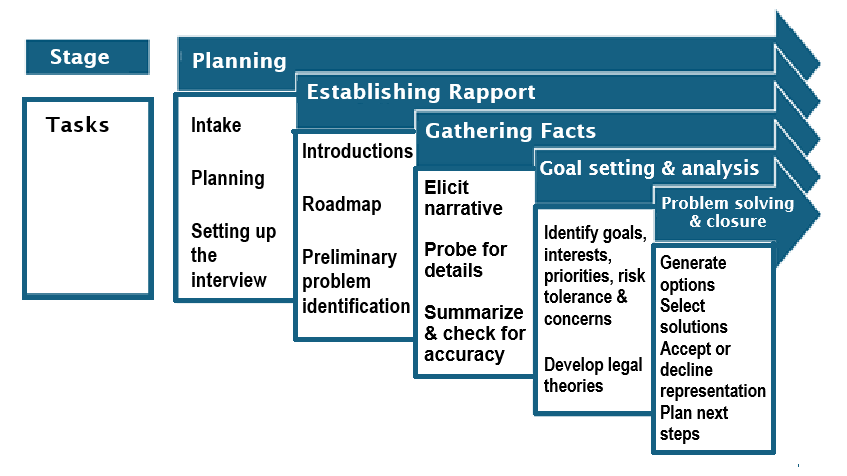
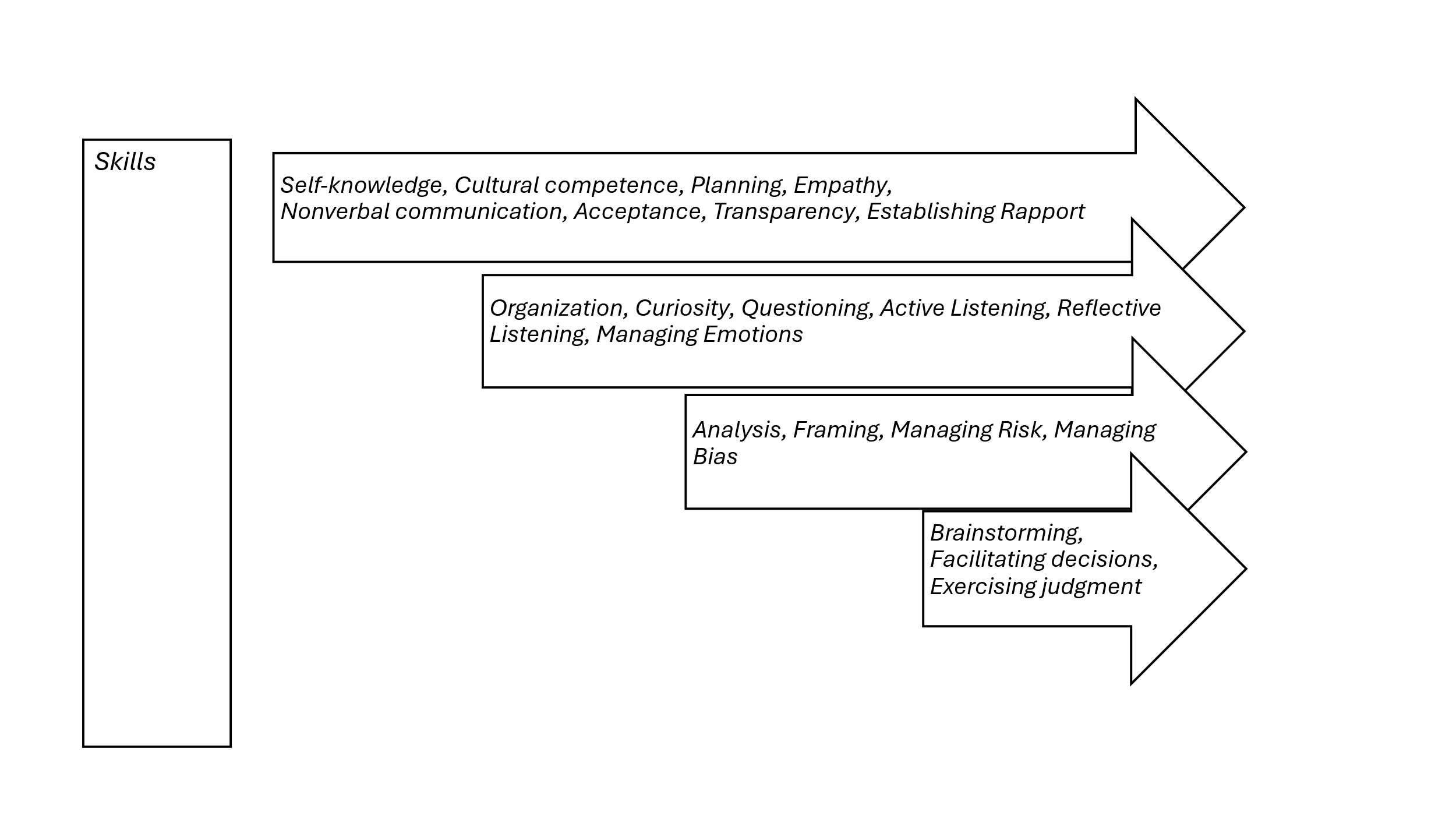
The counseling process includes several types of assistance. As we discussed in the prior chapter, the attorney first assists the client in clarifying interests and goals and places the client’s problem in a legal context. This chapter focuses on the remaining steps in the counseling process. First, the attorney must educate the client regarding the relevant law. Next, the attorney must work with the client to generate potential approaches to achieving their goals, generally with the perspective that a wide variety of potential “solutions” should be put on the table (rather than a narrow set of potential “solutions”). The attorney then assists the client in evaluating the various approaches to achieving the goals. Finally, the client chooses among these alternatives—generally choosing the solution that they perceive to be most likely to satisfy the widest range of their various interests. The skills we have been developing thus far (building trust, effective questioning, active and reflective listening) are all critical in the counseling process. However, you will need to use some additional skills in this process as well. These include framing the matter, managing risks and biases in decision-making, brainstorming solutions, facilitating a decision-making process, and exercising independent professional judgment in advising the client.
This text focuses on the initial client interview. Of course, neither you nor your client will fully understand the more nuanced nature of the client’s matter as a result of the initial interview alone. The counseling process is one that is a continual process of conversations throughout the representation. You will need to think creatively through ways in which to gather necessary additional information as economically as possible. This process of applying the law to the known facts and identifying the key unknown facts that need to be gathered is one important way that you will add value to the client’s efforts to achieve their goals.
As you gain a richer set of facts, your counseling may change over time. Your client may have neglected to share with you or may have forgotten to describe some aspect of his situation that suggests the matter is more or less complicated than it first seemed. Indeed, there may be specific information you have asked the client to bring forward—a contract, some correspondence, a written chronology of events—that reveals new information that places the client’s issues in a different light. During litigation, you may discover that the opposing party disputes the facts or has filed a counterclaim. You must then help your client both prove their claims and defend against the opponent’s claims. Your business client may be operating in a fluid environment where market or financing changes may affect the client’s options or objectives.
Thus, one key component of the facilitated problem-solving process involves ongoing investigation, analysis, and communication. Ongoing investigation can take many forms. You may recognize that the client has documents, photographs, or other potential evidence that could shed some light on the matter. You may realize that it would help if the client or you could contact the client’s friends, acquaintances, or coworkers to gather additional information. You may understand that there is legal research that needs to be done on nuances of the law as it relates to the client’s situation. This ongoing fact gathering will in turn require additional legal analysis and research.
You can see that this is a recursive process. As you gather additional information, it will impact your understanding of the nature of the client’s problems—what seemed to be the presenting problem may become less significant in light of a different problem that has arisen. This new information (or sometimes just the passage of time) also may affect the goals and interests the client hopes to achieve. This is one of many reasons why it is important to remain in frequent dialogue with the client—to make sure that you and your client continue to agree on objectives and means of achieving those objectives.
Although counseling in initial interviews is minimal and tentative, it remains essential. Both you and the client must understand the client’s goals and the scope of potential solutions before deciding whether to work together.
B. How do you best educate clients about the law?
Once you understand the nature of the client’s facts, goals, and interests, you can begin to discuss possible means to achieve the client’s goals. Often, the first step in counseling a prospective client about possible representation is to educate the client about the legal aspects of their matter. As we have seen, for a client to make an informed decision about whether to engage your services, you must translate your legal analysis into information about legal rights, obligations, and options. However, attorneys often do a poor job in providing this information. According to a 2018 CLIO legal trends report, 40% of clients report feeling frustrated during meetings with their attorneys, whereas only 8% of attorneys estimate that their clients are frustrated.[1] One significant contribution to that frustration is that attorneys do not effectively educate their clients.
It is easy to underestimate how little your client knows or understands about the law. This is one of the many reasons why one of the early questions in an interview is “Have you ever worked with an attorney before?” The client’s answer will help you assess their understanding and misconceptions about the law.
Even very sophisticated corporate clients need and want legal expertise and explanations. Often corporate law firms approach prospective clients rather than clients seeking out their services. In these communications, firms distinguish themselves not only based on their experience with similar matters, but by presenting legal information regarding possible strategies, costs, and timelines.
In the past, clients learned to select legal teams based on recommendations from colleagues and associates. Things are different now. “What is changing more rapidly is how cases are being assessed and how outside counsel are being selected,” explains Oscar Romero, general counsel at Veristor Systems. “It is no longer relationship-driven, but who can most successfully handle this matter in this courthouse in front of this judge.[2]
Tailor your explanation to your audience. Attorneys often overestimate their client’s ability to understand legal explanations. No matter who the client is, strive to use plain language to explain legal concepts. Try to remember what you didn’t know before you went to law school. It’s astonishing how quickly law students become fluent in law, but it is perhaps even more astonishing how knowing legal language displaces the everyday understanding that preceded that education. Avoid abbreviations or legal terms. Don’t assume a client understands that a “plaintiff” is “someone who sues someone” or that “the court” means “the judge.” Even less should you expect that a client will understand that negligence is “per se” or that a contract contains a “force majeure” clause.
Be especially careful to recognize that your client might not understand words that have a different meaning in law than in life. A criminal defense client may interpret advice that they shouldn’t “make a statement” to mean that they shouldn’t sign a written document. They may not understand that the advice means “don’t say anything to anyone.” The state statutes might call your client’s legal process a “dissolution of marriage” but to most people that is a “divorce.” “Motion” means “movement” to someone without the legal training to translate that word into “a request to the judge to make some kind of ruling or order in a case.” Telling your client that they don’t have good “title” to a piece of property will leave them wondering how that can be if they have a copy of a deed in their name. Remember how hard you labored in your first year to learn the legal meanings of everyday words like owner, intent, reasonable, etc.
Proceed slowly, checking often for understanding. Remind your client that law is complex and that you want them to stop you and ask for clarification if they don’t understand. Try to avoid asking closed questions to assess client understanding. If you ask a client, “Does that make sense?” or “Do you understand?” your yes/no question may result in the client telling you “Yes” even though the more accurate answer is “No.” The client may not want to be perceived as ignorant or may simply not want to slow down the proceedings, thinking that the question suggests they should understand. To avoid this type of “false positive,” in which the client tells you they understand when in fact they are still confused, you can ask the client to explain how they understand the law you have just described to them. This is a form of “reverse reflective listening” that allows you to assess whether the client actually has an accurate understanding of the law as you have described it. Follow up with “What questions do you have about this?”
Keep in mind that the client does not need to know everything that you know about the law in order to make an informed choice about hiring you. You need to provide enough information to build the client’s trust and confidence without overwhelming them. Most doctors today provide patients with “after-visit” notes and instructions. Attorneys too can use written materials during and after the meeting to help reinforce or amplify explanations. In today’s legal environment, many clients will have already consulted internet sources to read about their legal issues. They may have talked to friends or family about their matter. Part of the education function then may first consist of “unlearning” some of the misinformation or gross generalizations they bring to the counseling session.
You must not only educate the client about their rights and obligations but about the legal processes required to secure those. Explain the steps in the legal processes that might be engaged to meet the client’s goals. Use visual aids. Assess your client’s interest in details of process to guide how much explanation you provide. In every case, be sure to explain that as time passes and new information emerges, the client will be given an opportunity to revisit their assessment of the matter and that the possible solutions or approaches may change. This counseling is particularly important in managing the client’s expectations.
At this stage in the interview, you will need to revisit issues of costs, timing, and outcome. You will rarely be able to provide definitive information about any of these. However, you can help the client understand what factors will affect these aspects of the representation. You should explain that each of these variables can change if facts change.
Skills Practice
Suppose that a client has come to an attorney wanting to open a restaurant. Client asks the attorney, “Is there a way I can make sure I won’t lose my house if something goes wrong?”
Consider the attorney’s initial response:
Attorney: Protecting your house is only one of several operational, tax, and liability implications of entity selection. Your choices are basically a sole proprietorship, an LLC, an S-corp, or a C-corp. Now, mitigating personal liability, which is what I understand is your primary concern, necessitates an entity structure that creates a legal separation between your personal assets and the business. A sole proprietorship—default treatment absent formal entity formation—would provide no such insulation, rendering you personally liable for all debts and liabilities under the doctrine of unlimited personal liability. In contrast, if you opt for an LLC, governed by the Revised Uniform Limited Liability Company Act (RULLCA), or a corporation formed under the Model Business Corporation Act (MBCA), you can avail yourself of limited liability protections.
Client: …Can you say that again in English?
Try to improve on this attorney’s obtuse obfuscation by preparing a plain English version of this explanation before comparing your answer to the one on the second page of the exercise. Note: this is where generative AI can be a helpful tool in writing to clients. You could cut and paste this paragraph into an AI agent and ask it to rewrite the paragraph in plain English. You could then check the rewritten content for accuracy and completeness. However, in an in-person conversation with a client, you do not have the leisure of editing (with an AI tool or otherwise) but must have the skill of “translating” legal terms in a way that your client can understand. Explaining complex legal concepts to lay people is not easy. Try to translate the attorney’s explanation yourself and then compare to this more plain-spoken attorney’s attempt to explain the business entity choices to this client.
Helping a client understand legal categories requires more than just plain language. Even when explained clearly, some clients may be reluctant to accept the explanation given. Consider a divorce client who is told that any property he currently owns is considered “marital property” and must be listed as such in a divorce petition. The client may object, “But my name is on the title!” or “But I bought it!” or “But we already divided our property and she agreed that this was mine!” It will take patience to help the client to understand that the way the law characterizes their property may not align with their expectation about how that property should be characterized. The attorney will need to not only explain the meaning of “marital property” but the significance of that characterization for the client’s ultimate goals in the divorce.
How you frame legal issues can be critical to the client’s willingness to explore these topics. For example, business clients often view attorneys as “deal killers” because of the tendency to focus on potential problems in a transaction. As James Freund, a professor and retired partner at Skadden Arps in New York, points out, “In a transactional practice, nothing comes easy. There are invariably two opposing points of view on significant issues, and the parties will even clash… over a circumstance that may never come to pass. Every disputed issue has to be resolved in order for the deal to take place. And the business lawyers bear the primary responsibility for getting it done. Viewed in its broader context, this activity falls under the rubric of problem-solving. Unless you’re a problem solver, you’re unlikely to be an effective business lawyer. And the problems that stand in your way aren’t limited to transactional matters… they can involve dealings with regulatory agencies, tax planning, strategizing about how to protect intellectual property, and on and on.”[3] Entrepreneurs may quickly become frustrated with the attorney whose approach to explaining the law is a litany of barriers and obstacles rather than a more positive frame. Regardless of the reason for a client’s frustration, you must have patience and empathy if you are going to help them to understand their rights, obligations, and options.
The stress of meeting with an attorney can make it difficult for a client to listen and remember an attorney’s explanations. Many attorneys use written or electronic resources to help their clients understand the legal aspects of their matter. This might be in the form of a follow-up letter repeating some of the information provided. Depending on the matter and the client, you may want to provide written or electronic informational resources for the client to read more about the substantive or procedural aspects of their matter. Even for the client who does not hire you, providing these generalized resources gives the prospective client value for their investment in the initial interview and creates goodwill in your practice.
C. How do you assist a client in generating and selecting potential solutions?
1. The choice to provide counseling
Once you have provided your client with some information about the legal aspects of their matter, you can begin generating options for achieving those goals.
For most clients, the option that is most salient in the initial interview is the choice to engage your services. This important decision is one that requires a client’s informed consent. Informed consent is not a paper the client signs or a decision they make, it is a process and a conversation. The Rules of Professional Conduct define “informed consent” as “the agreement by a person to a proposed course of conduct after the lawyer has communicated adequate information and explanation about the material risks of and reasonably available alternatives to the proposed course of conduct.” In other words, for a client to make an informed choice, they must have options and enough information to weigh those options. Informed consent isn’t based on whether the client’s decision is a good one. A client has a right to be “pigheaded” and “to tilt at windmills.” McKnight v. Dean, 270 F.3d 513, 519 (7th Cir. 2001). Informed consent does, however, have everything to do with communication.
What if it seems likely that the client will not be able to afford your representation or seems reluctant to engage an attorney? Should you still engage in the process of generating options? Unless the client is someone whom you simply do not want to help (for whatever reason), there are several reasons to engage a prospective client in some initial counseling even if this will be the only meeting you will have. First, as a matter of professionalism, the prospective client has entrusted you with their matter for the purpose of exploring whether you can help them. They have invested their time and privacy (and funds if you charge for an initial consultation) in sharing their information. Basic principles of reciprocity dictate that you provide them with some value in return. Second, all clients, including those prospective clients who do not ultimately engage your services, are sources of referrals and reviews. A client who leaves your office with greater clarity on their legal and practical options will be more satisfied than a client who was given little other than a sales pitch for your services. Third, sometimes the process of this preliminary counseling uncovers ways that you could help the prospective client that they would be willing or able to engage.
Some clients have very limited options. The law may not align with their goals or provide realistic remedies. In these instances, your counseling consists largely of educating the client about their situation and assisting them in planning how they might give up or give in. Other clients may not be able to afford options that require the assistance of a private attorney. Helping these prospective clients by providing brief advice, referral to pro bono help (if it is available), and resources for self-representation can go a long way to fulfilling your responsibility “to ensure equal access to our system of justice for all those who because of economic or social barriers cannot afford or secure adequate legal counsel.”[4]
2. Generating options
For clients for whom you will be generating more complete options in order to make a choice about how to proceed and whether to engage your services, you will begin by revisiting the client’s goals and interests. The attorney should explore not only the client’s positions and interests as to outcomes but their expectations about how those outcomes might be achieved. Asking the client about potential obstacles or challenges they anticipate in pursuing their matter can help to uncover these expectations. Likewise, you can ask if the client has any specific preferences or concerns about the legal strategy or approach you might take.
Especially today, with the surfeit of information available on the internet, some individuals will come to you having thoroughly researched their issue. These prospective clients may believe that they already know the best way to address their legal issue and simply want you to carry out their plan. This may be a client who is very interested in being engaged in the decisions about their case or it may be a client who is so sure of their own “expertise” that they will not listen to your advice.
You can best respond by first acknowledging their active interest in understanding their case. Ask more about the research they have done. If they have brought materials, ask to review them. If they mention websites, get the URL. Assess their openness to your advice by explaining the complexity and uniqueness of legal matters and the fact that small differences in facts can impact legal strategies and outcomes. Ask if they would be open to different approaches. If the client is trying to decide between hiring you and representing themselves, give them independent professional judgment on the advantages and disadvantages of each of these options. With an approach that respects the client’s initiative but assesses their expectations and communicates the value of professional legal expertise, you will be able to determine whether this is an individual you wish to represent. If so, your approach will have established trust and set the foundation for a collaborative attorney-client relationship.
Preview the process of generating options for your client. It can be helpful to frame that process as a partnership. The client is an expert in their situation—the resources and people involved—while you are the expert in the legal system processes. Explain that you will first work together to brainstorm some ideas for solutions and then you will evaluate those options. Emphasize that to effectively brainstorm, you will need to separate generating ideas from evaluating ideas, so the client should feel free to offer any ideas for solutions they may have. Brainstorming requires generating a wide variety of ideas rather than searching for the single answer or assuming that solutions are fixed or zero-sum. Encourage your clients to think beyond current limitations and explore “what if” scenarios. Pose questions like, “What would you do if we had unlimited resources? What if I could snap my fingers and magically make something happen? Encourage clients to consider long-term goals by asking them to specifically envision the situation five or ten years into the future. Ask “What would you like this situation to look like at that point in time?”
To generate options, begin with the client. Ask the client for their ideas for solutions or avenues to achieve their goals. (“What have you tried? What have you thought about?”) Some prospective clients will resist offering solutions, wanting to defer to you to decide how to proceed.
Some clients’ ideas for self-help should be discouraged as they may be prohibited or dangerous. Consider for example a landlord who comes to you seeking assistance with a tenant who has damaged the property in some way. The landlord may not know that changing the locks to evict the tenant is unlawful. They may not fully recognize the safety risks involved in trying to remove the tenant without legal process. To avoid suggesting that your client consider these kinds of tactics, use the third person when discussing the reasons to avoid these options. (“Sometimes people think that a good solution might be…”)
Next turn to considering who else might be able to help the client solve the problem or achieve their goals. For some issues, enlisting the assistance of family members, business partners, friends, or members of the community might be productive. Sometimes non-profit agencies can be especially helpful to prospective clients (e.g. better business bureau, professional organizations, etc.). Governmental agencies may have resources to assist in the client’s matter (e.g., police, regulatory agencies). For some kinds of matters, local media can be a valuable ally. In our landlord example, the landlord might explore whether police intervention would address their concerns. For many disputes, the client’s insurance company is an important resource.
Rarely is a prospective client’s matter solely a legal issue. Sometimes a client simply needs a different type of professional in addition to or even instead of an attorney. The entrepreneur seeking to start a small business may need business planning assistance. The individual seeking estate planning services may need a financial advisor. The parent involved in a divorce may need mental health support. These allied professionals may be as important to achieving the client’s goals as your own services.
What about your services? Again, one of the most common problems in brainstorming solutions is to consider only a single solution. In nearly all circumstances, there are a range of options for engaging your representation. Rule 1.2(c) of the Model Rules provides that an attorney can limit the scope of representation so long as that limitation is reasonable, and the client gives their informed consent to the limitation. As previously mentioned, it may be that providing the client with information is all they need or want. For example, you might agree to provide some brief research and a second counseling meeting for the client. You might facilitate communications (act as a spokesperson, write a letter or make a phone call on behalf of the client, accompany the client in meetings, coach the client in their communications). You might go a bit further and help the client with a limited part of their matter—drafting a particular clause in a contract but not negotiating the entire contract or helping draft a complaint but not representing the client in a trial. You might agree to represent a client in one phase of their matter, leaving it up to them as to whether to employ you for additional representation. Representing an individual who wants to start a business, for example, you might draft the documents necessary to register as a state business entity but not negotiate for business licenses or other matters necessary for the business to open its doors. In a dispute, the scope of your representation might be limited to writing a demand letter or attempting to negotiate a settlement, or you might agree to represent the client through a trial but not if an appeal is necessary.
The following chart summarizes some of these options:
|
Who |
Can do what |
|
The Client |
|
|
Other private parties or organizations
|
|
|
Public entities (local, state, federal, international)
|
|
|
A private lawyer
|
|
Discuss with the client the iterative nature of the process of generating options. At any given point in the process, the “options” for solving the client’s problem(s) may be, of necessity, described in only general terms because neither of you has sufficient information to make an informed decision about which options seem preferable at that moment. In this context, the options available to the client generally involve deciding whether to try to solve the problem(s) with insufficient information (and likely a wide margin of error associated with the consequences of the decision) or to invest time and money in gathering more information to provide a better context for decision-making.
Thus, the discussion of options for solving the client’s problem(s) likely will have a range of options that will change over time. Some options are preliminary or incremental steps that advance the client’s understanding of her problem(s) or investigate the ultimate options available for meeting the client’s goals. For example, in a dispute, the attorney and client might identify some important incremental options such as research or fact investigation or informal attempts to resolve the dispute without engaging legal assistance. These incremental options will then determine whether and what more final options are best. In a dispute, these might include the attorney writing a letter to the opposing party asking for relief. This option might meet the client’s goal if it results in a change in behavior or compensation for injuries or both. If that is ineffective, the attorney might agree to pursue settlement discussions (which may result in a settlement) or mediation (which also may result in settlement). If an agreement cannot be reached, the attorney could then offer to undertake litigation (which may lead to a court decision or to settlement). Similarly, in a transactional matter, incremental options could influence final options. A business opportunity may require first some preliminary research to discover any financing options, market analysis, or legal restrictions. Final options could include forming a business entity, obtaining tax status, or complying with securities requirements for investor funding.
In this iterative process of counseling, you help clients understand their immediate options and the steps they can take to gather information for better decision-making while forecasting possible future options. What is significant about this iterative approach? It is a process in which clients can maintain significant control of their destiny. The client doesn’t have to commit to a final option from the beginning but can discuss the range of final options and choose an incremental option that moves the client toward being better positioned to make an informed choice among the final options. Thus, the client doesn’t need to decide at the outset to invest $30,000 or $50,000 or $100,000 in litigation that will take the next four years and involve a significant loss of autonomy (as the attorneys and the civil procedure and evidence rules and a judge become the controlling players in solving the dispute). Rather, the client can choose to invest $2,000 over the next two months on an incremental option—information gathering efforts that bring the client to a point in which they can better assess the final options. Then the client can choose to stop, or to invest another $2,000 or $5,000 in another incremental option that may take a few months. At the conclusion of each incremental step in the process the client has a “decision point”—a point at which you and the client can revisit the final options (in light of the new information) and a new array of incremental options.
3. Evaluating and selecting options
After identifying the immediate and future options that are available to a client, the attorney will help the client to evaluate the benefits and costs associated with each of the options. When discussing benefits and costs, use the client’s goals and interests as reference points to evaluate how well each option meets those objectives.
To be most fruitful for the client, the evaluation of options should proceed in a structured and orderly manner in which the costs and benefits of each option in relation to the client’s goals and interests are explored in comparison with other options. However, this purely analytical spreadsheet approach may not be helpful to all clients. Sometimes conveying options in the form of a story or example can help the client to better assess options. Of course, you need to take care that your stories are not drawn from particular representations of other clients, lest you violate your duty of confidentiality. However, you can help the client to get a clearer understanding of a particular option with a conversation that begins with “what might that option look like?” or “let’s assume this is how we proceed” and then draw out a concrete picture of how a particular choice might play out.
Some prospective clients may want to simply defer the decision to you. These individuals may ask you to “take care of the problem” and make all the decisions. They may indicate that they “trust your judgment” to “get the best results you can.” It is fairly common to have a prospective client ask: “What do you think I should do?” or “What would you do in my situation?” These are enticing and sometimes intoxicating questions. These are questions that place you in the problem-solving mode (where many attorneys like to be) or in the context of “expert” to whom the prospective client is looking for advice. These are questions that invite you to be authoritarian and outline what you would do.
Most commentators generally agree that the one thing you should avoid in this situation is answering the question as asked. One possible response to this type of question is the “redirection” response—something that suggests “What I would do doesn’t matter because I am not in your situation. You must make this decision because you have to live with the consequences. I don’t.” Then the conversation can return to the collaborative work of generating and evaluating options. Alternately, you might provide a reflective response in which you first describe your understanding of the prospective client’s perspective on the situation (seeking confirmation from the prospective client that you have accurately described the prospective client’s perspective) and then describe what you would do if you were the prospective client standing in the prospective client’s shoes. “Well I can’t tell you what I would do in your situation, because I am not in your situation, but if I were you in your situation, given what you have told me about your desire to avoid risk (for example) or avoid unnecessary costs (for example) or your desire to avoid taking action that would deteriorate your relationship with your neighbor/coworker/friends (for example), I think the options that merit the most exploration would be these three options.” At this point, you return to an analysis of the options, and the pros and cons, with the goal of having the prospective client talk through why each option might be more or less preferable than another option. Many commentators argue that attorneys should avoid giving direction during initial interviews because, no matter how client-focused they try to be, they risk imposing their own perspectives and values in selecting options.
In trying to decide whether and how to deal with these situations, one important consideration should be how to deal with ultimate disappointment. If the prospective client is making the decision based on their own assessment of the relative merit of various options, and things don’t work out, the prospective client is less likely to blame you. If the prospective client decides to do something because you told her that’s what you would do, and it doesn’t work out, you are far more likely to have a client who is reluctant to pay your fees, to recommend you to others, or to return to you for legal services in the future. Thus, there are both practical and philosophical reasons for being reticent about the extent to which you provide specific direction to a client who asks you to suggest a particular solution.
Sometimes you cannot make final decisions in the initial meeting because you or the client need to gather more information. New information may require reassessing the legal position and cause clients to reevaluate their goals. In follow-up meetings, revisit your understanding of the client’s problem and objectives. Start by restating the client’s previously identified concerns and goals, then ask what has changed and whether the client has additional information to share.
After evaluating each of the final and incremental options that seem most relevant to the client’s situation, it is time for the client to decide—to choose among the final options and incremental options. Keep in mind that the client can be pursuing multiple options at one time. For example, a client may be interested in pursuing an incremental option—gathering more information through witness interviews, interrogatories, or depositions—while also pursuing a final option such as settlement negotiations. Or clients may have to begin to pursue a final option, such as filing a lawsuit, so that they have access to certain incremental options, such as discovery under the rules of civil procedure, while also engaging in settlement discussions. Thus, the decision process of the client should not be narrowly confined to choosing one option. Rather, the decision process should reflect the options that may best serve the client’s goals and interests, recognizing that some options may be pursued only partially or may prove to be unsuccessful.
Again, because the client’s understanding of their goals and interests is a subjective assessment that you may try to understand, but cannot truly grasp, and because the client is the person who has to live with the consequences of her decision among options, you should be placing responsibility for choosing among options in the hands of the client. You can assess benefits and costs and identify other options that the client may not have considered, but in choosing among options, you should be sure that the decision is the client’s, not yours. As noted above, while the model of counseling we are recommending is that of facilitated problem-solving, the reality is that each person likely will do this in a different way, tailored to his or her personality and style. And regardless of each person’s style, the process likely will include components of an authoritarian model and components of a more client-centered model. For example, when talking about the law and how it applies to the facts, it is understandable that the attorney will be engaging the client in a more authoritarian manner. The law, after all, is the area of the attorney’s expertise. But in evaluating options in light of the client’s goals and interests, for example, the client is the expert, and the attorney should be more focused on a client-centered model of counseling.
Skills Practice
Maria, a mid-level marketing manager at a large corporation, has recently noticed discriminatory behavior from her direct supervisor, Mr. Thomas. Maria, who is a Latina, has overheard Mr. Thomas making dismissive comments about diversity initiatives, and she has observed that he consistently overlooks her for high-profile projects in favor of her white male colleagues. When she inquired about promotion opportunities, he suggested that she should “focus on being a team player” rather than “being too ambitious.”
Recently, Maria discovered that a less experienced white male colleague was given a promotion she had also applied for, even though she had superior qualifications and experience. Additionally, during meetings, Mr. Thomas frequently interrupts her or dismisses her suggestions, while giving full attention and consideration to similar ideas when presented by white male colleagues.
Maria is feeling increasingly marginalized and frustrated, but she is unsure about how to proceed. She is worried that filing a formal complaint could lead to retaliation, harm her career, or create a hostile work environment, yet she is concerned that, without doing something, her career will continue to suffer. Help Maria generate options to address her goals. Complete the exercise below, then compare your ideas with the ones provided.
4. Understanding biases in decision-making
Among the many shortcuts our brain uses to make decisions, several cause us to weigh certain information more heavily than other information. Understanding these biases can help you identify how to help clients improve their decision-making.
One example of a bias in our decision-making is that which causes us to prefer information that is easier to access. This availability heuristic[5] leads us to give the greatest weight to information that is most readily available in decision-making. Several types of information might be readily accessible. One type is that information we have most recently received. We hold recent information in short-term memory and can most easily access it, impacting our decision-making. A second type of information is that which we first received about a subject. The maxim that “first impressions count” captures some of our understanding of this primacy bias. Primacy operates not only to give outsized weight to the initial information we receive but to influence how we view subsequent information.
The “halo effect” describes one way in which primacy of information influences how one takes in subsequent information.[6] The impact can be positive or negative.[7] A particularly memorable application of this effect is a study in which subjects were presented with two different descriptions of a person. The first person was described as “smart, diligent, critical, impulsive, and jealous” and the second as “jealous, impulsive, critical, diligent, and smart.” Even though the two descriptions contained the same information, subjects judged the first person more favorably than the second.[8] Watch for this heuristic and provide clients options in more than one order.
The initial interview requires financial or numerical assessment of value (if for no other reason because of the assessment of attorney’s fees). In this regard, yet another impact of the primacy effect can be seen in the concept of anchoring.[9] Anchoring explains how a decision can be primed by setting a numerical benchmark. Anchoring research suggests that the first side to make an offer can frame the other side’s valuation, pushing the results closer to that initial offer.[10] Even numbers that have nothing to do with the valuation can “anchor” subsequent decisions. In one study of sentencing, judges were asked to sentence a woman convicted of shoplifting by first rolling a dice (which was rigged to either turn to a three or a nine) and then setting their sentence. Judges who rolled a nine produced a sentence of eight months compared to the five-month sentence that resulted when judges rolled a three.[11] Another example of this effect is the difference between being given a refund and a bill. If an attorney requests an advance payment of fees for a representation and then does not charge against the entirety of that advance, the last financial transaction a client will have with the attorney will be a refund. Given the higher “anchor” of the initial advance against fees, the client may go away feeling that they have gotten a great deal compared to the client who is charged the exact same amount but whose last financial transaction with the attorney is paying the fees.
These are just a few examples of how the order in which information is presented can affect decision-making. How one asks the question can affect decisions in other ways as well. Law students learn early on the importance of “framing the issue.” Behavioral psychologists explain how that framing impacts decision-making. Framing is especially important when assessing risk. Most people are loss averse, meaning we will take more risks to avoid a loss than achieve a gain.[12] Combined with loss aversion, framing can readily shape legal decisions. For example, in one study of custody decision-making, two parents were presented to decision-makers. The first had average parenting characteristics, the second a combination of positive and negative characteristics. When the question of custody was framed positively—as “who should be granted custody” —the second parent was favored as decision-makers focused on the positive characteristics that parent displayed. When the question was framed as denying custody, the decision makers focused on the second parent’s negatives and chose the first parent.[13]
Every representation involves a degree of risk. You should explain the uncertainties and risks associated with pursuing the client’s objectives and assess their client’s risk preferences. You can do so by asking the client directly about their tolerance for uncertainty, and their willingness to take on these risks. Careful listening and observation will help you to assess the client’s comfort level. Some clients may use cautious language or express concerns about potential negative consequences, indicating a lower risk tolerance, while others may be more optimistic or open to taking calculated risks. You can pose different scenarios, options, or potential outcomes and observe how the client reacts. The client’s responses and body language can provide valuable cues about their comfort level with risk.
How you frame risk can have a powerful effect on the client’s decision-making. Nearly every outcome can be framed as either loss or gain. Take a criminal defendant’s choice to accept a plea bargain. Framing that decision as a potential loss might sound like this: “Accepting the plea bargain means you will have a conviction on your record, which could impact your future employment opportunities, your reputation, and your personal life. You will also have to comply with the terms of the plea deal, which might include community service, fines, or even some jail time.” The same choice could be framed to emphasize the potential gains: “By accepting the plea bargain, you avoid the risk of a much harsher sentence that could result from a trial. You can benefit from a more predictable and typically lighter sentence, allowing you to resolve the matter quickly and start rebuilding your life without the uncertainty and stress of a prolonged legal battle.” Since we know that framing influences decision-making, how do you help clients to frame options in a way that permits them to weigh their options on equal terms?
Attorneys must take care to monitor for the impact of when and how questions are asked, or information is presented. These biases can be exceedingly difficult to counteract. As with other cognitive biases, one cannot easily eliminate these biases by simply educating clients or asking them to ignore or discount certain evidence.[14] Since cognitive biases are a result of our fast-thinking unconscious processes, the best way to counter these is to be aware of the circumstances in which they may be affecting decision-making[15] and turn to slow thinking regarding these decisions. Slow thinking might mean simply slowing down and lowering tensions. When we are “forced to make quick decisions using subjective criteria, the potential for bias is great.”[16] We can help our clients make more rational choices by looking for more objective measures[17] or deliberately searching for evidence to re-evaluate the framing or anchoring.[18]
Finally, revisit the materials on culture and communication in Chapter Three. These same differences affect decision-making. Recall that a client’s culture may differ in the emphasis it places on the individual versus the collective. Some clients may focus especially on the present while others may be more future-oriented. The client’s values will influence their evaluation of options.
These unconscious influences on decision-making can affect not only the client’s assessment of their options but your assessment as well. Your legal training in viewing situations from multiple perspectives and maintaining a critical focus on evidence and logic can help you to recognize when these biases are affecting your client or your own evaluation.
Reflective Practice
Attorneys have a dual responsibility to guide clients toward sound decisions while respecting their autonomy. Reflect on how these cognitive biases could challenge this balance. Answer the following questions.
Check your Understanding
These questions encourage you to think about how subtle differences in the order and presentation of information can impact client decisions. Consider how awareness of these biases might lead you to adjust your counseling approach—such as presenting options in varying orders or deliberately slowing down the decision process to engage more reflective (slow) thinking.
How do you address common counseling challenges?
There is no such thing as an ideal prospective client. The prospective client who comes into your office and clearly and concisely explains all of the important facts of her situation in precise chronological order with short asides in which she can communicate the practical problems associated with her situation or the emotional challenges presented by her situation doesn’t exist. The prospective client who has all of the related documents copied in a color-coded three-ring binder, again arranged in chronological order doesn’t exist. Prospective clients come to lawyers because there is something in their lives that is causing turmoil, or there are goals they want to meet but need help sorting through.
But within this vast sea of prospective clients, there are several prospective clients who present particular difficulties for many attorneys. In this chapter, we will introduce you to some of the most common ways in which prospective clients present difficulties for counseling and try to describe some ways you can work through these difficulties to help understand the prospective client’s situation and get to a point in which you and the prospective client can make an informed decision about whether to proceed with representation.
1. The prospective client with unrealistic expectations
At some point in your career, you will have a client or two who comes into one of your follow-up counseling sessions and commences the session with one of the following pronouncements: “You know, I was surfing the internet regarding my situation, and I found a bunch of articles written by other attorneys describing cases just like mine that seem to be generating verdicts worth millions of dollars. I think we have been undervaluing my case.” Or “I saw that another business like mine opened in town and was able to obtain a zoning variance to operate in the same area I am interested in.” As you try to talk through the situation, your client seems inclined to hold firm to their unrealistic expectations and “pushes back” when you try to explain why his case may not be worth as much as the cases about which they were reading. Similarly, a transactional client may have unrealistic expectations of what it will take to be successful in a transaction or venture. The mismatched assessment of the value of a case or the probable success of a venture can be a particular problem for many attorneys and clients. The challenge is complicated by the fact that generally, the discussion of valuation is one in which the attorney is the voice of experience educating the client. When the client develops a firm (if misguided opinion) about the value, the dynamic of the discussion changes significantly.
Sometimes these inflated expectations are a product of the attorney’s own communication. Attorneys who advertise their successes can create client expectations, despite the frequent professional responsibility rules that require that these statements have disclaimers accompanying them. Similarly, assuring a client at the beginning of a representation that you can help them achieve their goals, that you can work things out, or other promises of success, while often offered to reassure an anxious client or even to convince a client to engage your services, are a surefire way to end up with a disappointed client. Instead, provide realistic assessments of costs, timing, and probabilities of success. Identify ethical barriers and explain clearly limits of your representation. Explain the contingencies that can affect outcomes. Keep the client regularly informed about the progress of their case. Regular updates can help manage expectations and reduce anxiety.
Sometimes the problem is that clients are relying on information from other sources (the internet, friends, or family). To moderate these expectations, first begin with empathy. Thank them for bringing this information to you. Value their enthusiasm or optimism. Ask questions that help uncover the basis of their expectations. For instance, “What information or sources have you relied on to form your expectations about this case?” With some clients, tactful confrontational questions may be helpful to hold the client accountable to their expectations. For instance, “What evidence do you have that supports such a high expectation?” Explain why the sources they are relying on are not predictive in their situation. Share case studies and statistical outcomes that do provide realistic outcomes. Create scenarios with different outcomes to help the client visualize potential results. This can be particularly useful in showing the range of possible settlements or verdicts. Encourage the client to consider “in case you’re wrong” scenarios. For example, “What would you do if the court’s decision doesn’t go in our favor?” or “What if the settlement offer is lower than expected?”
It may take time to reset a client’s unrealistic expectations. Set realistic, incremental goals that can lead to the overall objective. This helps in managing expectations over time and keeps the client motivated. Establish clear benchmarks for success at different stages of the case or transaction. This helps in setting a realistic pathway and aligning expectations. If necessary, refer clients to counseling or support services, especially if their unrealistic expectations are rooted in emotional or psychological needs.
2. The fee-conscious prospective client
Fee-conscious prospective clients can appear in two different guises. The first is a prospective client who has a real problem that merits real attention but their concern over fees overwhelms their ability to make reasoned choices about the representation. This may appear at the very beginning of the interview, when anxiety over fees makes it difficult for the client to even begin to discuss their issue. Sometimes these clients will be uncomfortable even raising the issue of fees but their concern over costs will be in the background, interfering with their ability to fully engage in the interview. For these prospective clients, raising the issue of fees at the top of the interview is especially essential.
Clients who are especially concerned about fees may feel relieved to know that there are ways that they can reduce costs by helping in the matter. You might suggest ways that clients may be able to develop additional facts or gather documents to assist in the representation. Counsel the client about available and prohibited self-help options. A client armed with sufficient information may be willing and able to negotiate a deal or a resolution of a dispute on their own. Help the client to carefully weigh the risks of self-help approaches.
Some clients’ anxiety over fees goes beyond concerns over their anxiety over the uncertainty of costs or their ability to manage those costs. These clients may resent having to pay any money to someone to help them solve their problems. This “misguided miser” prospective client hears that the costs might be $10,000 and becomes overwhelmed by a number that is larger than anything he has ever spent in his life. For these types of prospective clients, modest efforts to help the prospective client reassess the situation along the lines of an investment decision can be fruitful. Reminding the prospective client of the “goals” the prospective client had described previously, and encouraging them to think in terms of placing values on those goals (so that there can be a comparison with the costs) may be fruitful. But sometimes nothing is fruitful, and there is not much you can do other than recognize that the prospective client may be destined to miss out on the value of legal services because of their inability to adjust their perspective on the fees and costs.
A second type of fee-conscious client is one who appears to have a good claim or transactional plan but literally can’t afford to pay for legal services to assist. For a transactional client, the inability to afford legal services to pursue their plan may be a sign of an even larger problem of business planning. Helping this client to more realistically assess the overall costs of their plan, including legal fees, can be some of the most useful counsel you can provide. For a litigation client, if the claim has sufficient value, a contingent fee arrangement or the applicability of fee-shifting to a claim may provide a solution. Nonetheless, there remain many very deserving prospective clients for whom a just result requires some type of legal assistance, but who simply cannot afford that assistance.
Attorneys have an obligation to make legal services available. For these prospective clients who cannot afford legal assistance, at a minimum, you might fulfill your obligation by providing referrals to nonprofit legal services organizations or to other resources. You might choose to provide some limited-scope assistance to make self-representation possible. You might choose to represent the client pro bono. Your duty of diligence requires that you manage your caseload. Making decisions in these situations can be very challenging, as the prospective client clearly needs help and you may want to respond to that need. For some attorneys, the inability to say no to a deserving but limited-income prospective client threatens their ability to sustain their practice. Before committing to assist in representing a prospective client pro bono, you need to have a really good sense of how your client load is distributed between paying clients and non-paying clients so that your portfolio of clients doesn’t get too out of balance.
3. The prospective client and their third-party decision-makers
When you are dealing with a young adult client (who still may be subject to significant parental influence) or someone in a dependency relationship, a problem can sometimes arise in which your client appears to lack independent decision-making ability or appears to be significantly influenced by someone else.
For example, suppose that after talking with a client about her case during the initial interview, you sense that she seems less than thrilled to be talking with you and has reservations about bringing suit. She relayed her story in a coherent manner and appeared to answer your questions sincerely and honestly but always seemed reserved. While she indicated that she wanted you to represent her in this matter, there was some hesitancy in her responses. When you inquired further, however, she insisted that she wanted to go forward with you as her attorney. At your follow-up meeting, her hesitancy about going forward resurfaces. You gently confront her, and she confides in you that her husband is “pushing her into this” because he sees the case as a “sure winner” and is looking to make a lot of money. Your client says her husband always needs money, but they never seem to have any. She doesn’t know what he does with it.
The “hidden” influence problem is very challenging because it creates two different levels of problem-solving activity in which the attorney needs to be engaging the client. One level concerns the matter that brought the client to you. The other level concerns the client’s relationship with her husband.
Some attorneys might be inclined to ignore the issue of the husband’s influence, considering this to be tangential to the representation. However, this route poses threats to the attorney’s ethical responsibilities to the client. The attorney’s duty of loyalty is to the client, not to her husband. The attorney must ensure that the client’s decision to bring suit is genuinely her own, not the product of coercion or undue influence. If the client feels pressured, her consent to litigation may not be fully voluntary, which could undermine the attorney-client relationship and the integrity of the case. Rules of professional conduct dictate that the lawyer must abide by the client’s decisions regarding the objectives of the representation.[19] If the decision is effectively being made by her husband, the attorney cannot be confident they are following the client’s wishes. Practically, a client ambivalent about pursuing litigation is less likely to remain committed through discovery, settlement negotiations, trial, or appeals. If the case is largely the husband’s project, it risks collapse later, possibly harming the client financially or emotionally.
At a minimum, then, you will want to ensure that the decisions about the representation are truly the client’s. Meet with the client without the husband present and ask open-ended questions about what she wants to achieve, why she’s hesitant, and whether she feels free to decide. Help the client understand the costs, risks, and emotional burdens of litigation. This may help her make a decision that’s truly her own, not one based on her husband’s optimism about a “sure winner.” How might this discussion proceed? Consider this approach:
I want to make sure we’re moving forward based on what you want, not what anyone else wants, because you’re my client and the decisions about your case are yours alone. You mentioned your husband is encouraging this lawsuit, and I understand he sees it as a good opportunity. But I need to ask—how do you feel about pursuing this case? Is this something you want to do for yourself?
If you’re feeling pressure, or if you have doubts about going forward, we can talk about your options, including ways to pause or explore alternatives like settlement, mediation, or even not filing suit. My role is to help you make an informed decision and support whatever you choose, even if others might not agree.
This keeps the focus on your client’s autonomy, avoids judging the husband, and opens the door for her to express hesitations freely.
If there is any concern that the husband is exploiting the client financially (or worse), the client may be facing threats to her safety that are far more serious than the matter that has brought the client to the office. Effective representation means identifying issues that are not strictly within the scope of the representation but that pose significant collateral consequences for the client. For this reason, attorneys should routinely screen for the presence of domestic violence when third parties appear to be influencing a representation. Securing a favorable damages judgment for a client but ignoring the enormous collateral consequences of physical and psychological safety for that client is neither competent nor ethical.
Simple question like “Do you feel safe?” or “Are you afraid?” can uncover deeper concerns of abuse. If the client does indicate that her husband’s behavior is controlling or abusive, you might provide information about counseling, domestic abuse hotlines, or financial and legal advice resources. Of course, not all clients will feel comfortable sharing this information:
While it is an attorney’s duty to screen for domestic violence, the attorney also must respect the client’s decision to not disclose information about the abuse. The client may determine that sharing the information with her or his attorney poses a safety risk. Or, the trauma may be too difficult for the client to discuss, despite the benefit to her or his legal case. Attorneys and advocates need to respect that choice. Attorneys should ask direct questions about domestic violence; however, if the client does not want to discuss the issue, the attorney should clearly communicate that the door is always open for further discussion and assistance, on that or any other topic.[20]
Whether a third party is a threat or merely an influence, your duty of loyalty to your client requires that you ensure that your client is directing your representation freely and making fully informed decisions.
4. The prospective client acting on a matter of principle or honor
In many circumstances, your client will be driven by a matter of principle or a matter of honor in her understanding of a problem and in her approach to thinking about solving a problem.
For example, your client was the Postmaster in a small town for many years. He was fired from his job for sexual contact with an intellectually disabled employee. He tells you he didn’t do it and wants to fight his discharge, and you have agreed to represent him. Subsequently, you have a chance to review the postal investigator’s records. Based on your review of the records, it looks like the evidence will support the discharge. When you meet with your client to talk about how the case looks following your review of the records, he breaks down crying and says, “I need you to defend me to protect my honor with my wife. If I let this go and don’t fight she will see it as my admitting I did it and probably divorce me. I gotta defend myself.”
This, in some respects, presents a variation on the “third-party decision-maker” problem, except that in this circumstance, the “third-party” has an implicit involvement rather than an explicit involvement. In the “third-party decision-maker” example discussed above, the premise is that the third-party is explicitly directing the client to proceed with litigation the client may not have an interest in pursuing if she were an independent decision-maker. In this situation, however, the third-party is not explicitly directing the client; rather, the client is independently guiding his actions because he is concerned about what those actions will communicate to a third-party and how that third-party will respond to those actions. The third party might be his wife (as in the example), or it might be other members of an association or community of which he is a part whose opinions of him matter greatly.
When a client is motivated primarily by honor or principle—especially when their decision-making is tied to how they believe a third party (like a spouse or community) will judge them—the attorney’s role is to help the client examine the problem from a broader perspective. The goal is not to disregard their concerns about reputation or dignity but to reframe those concerns as one factor among many so the client can make a balanced, informed decision.
How might one ask questions that would help the client look at the problem in a circumspect manner, so that all options can be considered, rather than focusing on only one option that seems driven by the matter of “honor/principle”? First, you must acknowledge the client’s values and concerns. Ignoring or minimizing the client’s stated motivation will likely make them defensive. You can use open-ended, neutral questions to broaden the client’s frame of reference. Ask about other outcomes that are important alongside the concern about the wife’s reaction. Help the client to evaluate their fear. You might ask, for example, “How do you think your wife would respond if we pursued the case and lost, versus if we explored other ways to clear your name or present your side?” Elicit or offer alternative strategies that could address the client’s immediate concern regarding the wife’s reaction but also address the other concerns the client has identified. Once the client starts to recognize multiple interests, you can present options such as negotiating a resignation in lieu of discharge with language that does not admit wrongdoing; seeking a confidential settlement to avoid public escalation; or crafting a carefully worded statement the client can share with his wife or community to explain his decision without conceding guilt (“I am stepping away because of the toll this case would take on us, not because I did anything wrong”). Ultimately, you will need to center the decision on the client, emphasizing their agency and the importance of weighing all factors. If the client insists on their initial path forward as the only way to preserve their honor, you will need to decide whether you are willing to represent the client to aim toward this goal.
5. The prospective client with a bad idea
You will recall from our discussion of the models of the attorney-client relationship that attorneys differ on whether they believe themselves to be morally responsible for the choices their clients make. Attorneys also vary in the degree to which they are comfortable engaging their clients in an assessment of the wisdom (as opposed to the legality) of their objectives.
Certainly, when it comes to advising a client about the law, attorneys have a duty to question their client’s objectives and the means to achieve these. The attorney’s duty of “independent professional judgment” requires “candid advice.”[21] Sometimes, however, an attorney’s hesitancy in counseling a client is not grounded in the law but in a larger analysis of the practical, moral, relational, or other aspects of the client’s objectives. In most states, rules of professional conduct make it clear that an attorney has the right to refuse to lend services to a client who “insists upon taking action that the lawyer considers repugnant or with which the lawyer has a fundamental disagreement.”[22]
What do you do with a prospective client who has a bad idea, that is, an idea you disagree with as a moral or practical matter? Do you have a duty to say or do something? If the bad idea is part of the matter on which you are representing them, you likely should engage them in a discussion of their plan, even if the plan is legal and simply impractical or imprudent. In general, your discussion should involve three steps.
First, inquire—ask more about the client’s proposal. Often this process of inquiry will itself be sufficient for the client to recognize the flaws in their plan. Ask for details of the client’s plan. Once the client has clarified their plan, you can ask questions to help the client evaluate the plan. “What do you think might happen if you do that?” “Do you see any risks or downsides to this plan?” These questions avoid making judgments and so are less likely to make the client defensive and are more willing to generate a dialogue. A second line of inquiry is to explore the interest that is motivating the bad idea. Questions grounded in the “why” of the client’s plan will permit you to suggest alternative options that would be more effective, ethical, or prudent.
Second, advise—you can simply tell them why you think their idea is not a good one and why.
Third, avoid—if you don’t think they understand and agree, don’t represent them or withdraw/seek to withdraw.
What about the worst ideas—if your client says they are going to violate the law? Your options may differ depending on your state’s rules of professional conduct. In all states, you CANNOT advise or help the prospective client to violate the law, but you can explain the legal consequences of their choices. In all states, you MAY withdraw if the client insists on pursuing illegal conduct. States vary in the circumstances under which the rules say that you MUST withdraw from the representation. Likewise, states vary on the circumstances under which you may or must reveal confidential information to prevent or rectify the client’s illegal conduct. You must always carefully research and analyze your state’s rules of conduct to determine your options when faced with these clients.
Skills Practice
Suppose you are representing a client in a wrongful discharge lawsuit against his former employer. Consider this exchange in which the client discusses a strategy for proving the employer’s wrongdoing: https://umkc.box.com/s/qu8wwmm24vvv0lc1ewtwrrtawom69lv0. Complete the exercise below.
E. How do you deliver bad news to a client?
Sometimes, your analysis will lead you to conclude that the law cannot assist the client in achieving their objectives. Sometimes clients want that which the legal system cannot or will not provide (e.g., forgiveness, revenge, respect, or compensation for wrongs the system does not recognize). Sometimes the client wants a remedy from someone the legal system cannot or will not hold responsible (businesses that have dissolved or people who have died; individuals who lack capacity; individuals or entities with immunity). Sometimes the client cannot afford the outcome they desire (financially, psychologically, socially, relationally).
Delivering bad news to clients requires clear and compassionate communication. At a minimum, the prospective client should clearly understand the reason that you are unable to assist them. If you are confident that the client is expecting assistance in something that is illegal, explain that clearly, including the consequences of the client going forward. If you simply suspect this, you need not investigate further to confirm your suspicions so long as you are planning on simply declining the representation. If you are considering moving forward, however, the rules of professional conduct in your state may require that you “inquire into and assess the facts and circumstances of each representation to determine whether the lawyer may accept or continue the representation.” [23] In either case, document the meeting carefully.
If you are quite confident that the law simply does not provide a right or a remedy, explain that. If you believe that the matter is simply not one that is worth your time or effort, decline on that basis (or simply decline without an explanation). “You have no case” or “The law doesn’t permit that course of action” are quite different messages from “We aren’t able to help you at this time.” Be sure you know which of these messages you want to send. The former is a legal evaluation of the client’s matter. The second is simply a denial of representation.
Beyond these conversations, the best you can do is provide a sympathetic ear to help the client process the hard reality check. Sometimes you may be able to help the client reframe the problem or find ways to help the client respond to the bad news you are delivering. For some kinds of problems, you might consider referring the client to other professionals (counselors, financial advisors, business coaches, etc.) to help them consider how they might change their own behavior or perspective to come closer to some of their goals.
Remember the limited nature of the information you have in an initial interview; it is a good idea to temper “bad news” with the message that it is possible that other attorneys may see the matter differently. If the client wants to get a second opinion, encourage them to seek out that option quickly as time limitations may apply.
Skills Practice
Consider an interview with a client who wishes to purchase property for a business. The property is currently zoned for residential uses only; however, the municipal zoning ordinance has a process by which one can request variances. Review this interview transcript of the initial information gathering, then answer the questions that follow.
Attorney: Good afternoon! I understand you’re looking to purchase a property for your business and have a question about zoning. Can you tell me more about your business and your goals for this property?
Client: Sure, I run a small bakery, mostly pastries and cakes. I’d like to relocate to this property because it’s centrally located, offers enough space for my kitchen and retail area, and has better foot traffic. Right now, I’m renting a space, but I want something more permanent.
Attorney: Great. First, let’s talk about your specific business operations. Could you describe exactly what activities your business involves? For instance, hours of operation, noise level, traffic volume, parking needs, and any special equipment you plan to use.
Client: We usually open around 7:00 a.m. and close around 4:00 p.m. Traffic would mostly be walk-in customers, but some might park briefly to pick up orders. Noise would be minimal, maybe some kitchen equipment noise, but nothing excessive. Equipment would include ovens, refrigerators, mixers, and baking stations—standard bakery items.
Attorney: Good, that’s helpful. Now, let’s discuss the property itself. You’ve shared the address of the property, so I’ve been able to see that you are looking at a charming older house on a moderately sized lot. Are you planning any physical alterations?
Client: Yes, I’d probably need to remodel part of the interior and perhaps add parking spaces in the back yard.
Attorney: I see that the house is surrounded by other residential homes. Have you spoken with the neighborhood association about your plans?
Client: No, but the house is very close to a busy commercial area, which makes it ideal. I suppose talking with the HOA would be a good idea.
Attorney: Probably. Homeowners associations are often influential when it comes to zoning requests. Next, let’s talk about your timeline and budget. What is your timeframe for opening the business in this location, and have you budgeted for the remodeling, the zoning variance process, and other costs?
Client: Ideally, I’d like to open within about six months. I’ve budgeted for remodeling and renovations, but I hadn’t considered costs associated with zoning variance requests or delays.
Attorney: That brings me to the zoning issues you’ve asked about. The property is currently zoned residential, but there are options to have a bakery be allowed in that location. You could request a rezoning or there is a process for requesting a variance. The variance would likely be the route you would want to pursue. Usually, to qualify, you’ll have to demonstrate special circumstances. One way to do that is to show that the surrounding area is already shifting from residential to commercial uses. Do you know of other businesses in the immediate area?
Client: Yes! It’s not obvious when you drive through the neighborhood, but Google Maps shows three different residences that operate businesses: a dog day care, a hair salon, and a music teacher.
Attorney: Ok, great. Would you operate like these businesses—that is, without a “storefront” presence?
Client: No. Ideally I want to have a small café. Even as a bakery though I want people to be able to come pick up items—I’m not interested in working wholesale. Plus, I think a storefront, especially with a little coffee shop, would really benefit the neighborhood. You know, when my mom was little she said that there was always a little store or coffee shop every few blocks. I think it would be a great community gathering place.
Attorney: Have you looked at other alternative locations that don’t have zoning restrictions?
Client: Yes, other available commercial properties nearby are either too expensive, not the right size, or less accessible to customers. This property’s unique location really fits my budget, provides customer access, and offers potential growth.
Skills Practice
In this problem, the attorney represents Nick in his divorce from Christine. You will watch and listen to a series of segments from the attorney’s interview with Nick. Watch and listen to each segment and then respond to the question before watching the next segment.
We begin the interview at the point in which the attorney is turning the discussion to Nick’s relationship with his stepdaughter Holly. Nick and Christine have been married a little less than five years. Christine has sole legal and physical custody of her 13-year-old daughter Holly from a previous marriage. Nick has not adopted or otherwise made any parental claims regarding Holly. Holly’s father pays child support but has little interaction with her otherwise. Holly has lived with Nick and Christine since they married.
Reflective Practice
In the Child Custody problem above, the attorney had to give the client some very bad news—that he had no legal rights as a stepfather. Reflect on the attorney’s approach. Think about times in which you had to deliver bad news. Answer the following question.
F. Why is self care an important part of client counseling?
The process of interviewing and counseling requires a tremendous investment of self—establishing trusting relationships, conveying empathy, understanding perspectives, exercising creativity, and balancing roles. All these investments in your client can take a toll on your own emotional and mental health if you do not pay close attention to professional boundary-setting. Especially in a practice that involves a great deal of trauma, but even in transactional practices, it is far too easy to make the client’s issue your own.
The duty to maintain your own emotional health is an implicit part of the basic notion of fitness to practice law. Indeed, most state’s rules of professional conduct provide that if a lawyer’s “physical or mental condition materially impairs the lawyer’s ability to represent the client” the attorney must withdraw from representation.[24]
Burnout and compassion fatigue are very real risks for attorneys in practice areas that expose them to client trauma. What can you do to protect yourself in these areas of practice? A critical protection for attorneys is setting appropriate boundaries; that is, maintaining appropriate professional relationships and keeping one’s own personal interest separate from the client’s interest. Ethical guidance on this point is sparse. Conflicts of interest rules refer generally to situations in which an attorney’s own personal interests may materially limit his or her ability to competently and diligently represent the client[25] and insist that an attorney maintain independent professional judgment.[26]
There are few explicit rules of professional conduct that address boundary failures. Extremes addressed by rules such as prohibitions on initiating a sexual relationship with a client[27] or lending money to a litigation client[28] address clear examples of becoming too personally involved in a client’s life. But since the rules of professional conduct are for the purposes of regulating only that ethical misbehavior that threatens clients, the courts, or the public, there is little consideration given to crafting guidelines for attorneys to help protect their own psychological and emotional health.
While every attorney must establish clear boundaries with their clients, where the lines are may differ from attorney to attorney. These include structural boundaries of space and time (for example, not giving out home phone numbers or limiting locations where one will meet clients). Some of these boundary rules can be established in the initial meeting with the client. As a long-term family law attorney tells her clients in her initial consultations, “This is a strange relationship. I will learn the most intimate details about you and your family, and you will learn nothing about mine.”[29]
Even more important and more difficult to establish are the permeable boundaries of the balance of emotional distance and connection. Even the clearest emotional boundaries may not protect you from emotional overload. The best practice to protect yourself emotionally is knowing yourself and having opportunities to reflect on how your practice is affecting you.
Finally, attorneys must learn to take care of themselves. Certainly, this is much easier said than done, and in the end is a very individualized process. Nonetheless, general parameters of self-care include finding a balance between work and life, finding creative outlets or spiritual practices that replenish the helping professional, and systematically monitoring one’s own emotional and mental health. Attorneys have an increasing number of resources available to help address self-care issues. State lawyers’ assistance programs, once accessed primarily by attorneys with alcohol and other substance use issues, are increasingly being asked to present programs and provide resources for all attorneys to maintain their fitness to practice. Within law schools, courses and programs to teach students how to maintain balance in the practice are gaining momentum. Clearly, the profession generally is recognizing that self-care is an important component of competent lawyering.
Chapter Eight Endnotes
- CLIO, 2018 Legal Trends Report. https://www.clio.com/resources/legal-trends/2018-report/ ↵
- Nicole A. Clark, How Attorneys Are Shoring Up Client Research for the Perfect Pitch, L. TECH. TODAY, July 18, 2024. https://www.americanbar.org/groups/law_practice/resources/law-technology-today/2024/how-attorneys-are-shoring-up-client-research-for-the-perfect-pitch ↵
- Scott Edward Walker, Top 10 Reasons Why Entrepreneurs Hate Lawyers, VENTURE HACKS, Jan. 14, 2010. https://venturehacks.com/hate-lawyers. ↵
- Model Rules of Pro. Conduct Preamble ¶ 8 (Am. Bar Ass’n 2023). ↵
- Availability Heuristic, APA DICTIONARY OF PSYCH., Nov 15, 2023 https://dictionary.apa.org/availability-heuristic. ↵
- DANIEL KAHNEMAN, THINKING, FAST AND SLOW 82-84, 121-127 (2011). ↵
- Theodore Eisenberg & Valerie P. Hans, Taking a Stand on Taking the Stand: The Effect of a Prior Criminal Record on the Decision to Testify and on Trial Outcomes, 94 CORNELL L. REV. 1353, 1379-87 (2009)(revealing defendant’s past criminal record creates negative halo effect). ↵
- Id. at 82. ↵
- KAHNEMAN, supra n. 1 at 119. ↵
- Ralph A. Weber, Understanding Anchoring, 95 WIS. LAW. 16, 18 (May 2022). ↵
- KAHNEMAN, supra n. 1 as 125-126. ↵
- Id. at 368-69. ↵
- Roller, How Anchoring, Ordering, Framing, and Loss Aversion Affect Decision Making, UX Matters (March 7, 2011) http://www.uxmatters.com/mt/archives/2011/03/how-anchoring-ordering-framing-and-loss-aversion-affect-decision-making.php. ↵
- See, e.g., Barrett J. Anderson, Note, Recognizing Character: A New Perspective on Character Evidence, 121 Yale L.J. 1912, 1935 (2012) (“[S]tudies have demonstrated that jury instructions do not provide a satisfactory remedy when improper character evidence is presented to the jury. That fact strongly suggests that the halo effect cannot be cured by informing people that they are likely to use character proof wrongly.”) ↵
- Tigran W. Eldred, Insights from Psychology: Teaching Behavioral Legal Ethics as a Core Element of Professional Responsibility, 2016 MICH. ST. L. REV. 757, 799 (2016). ↵
- JENNIFER EBERHARDT, BIASED: UNCOVERING THE HIDDEN PREJUDICE THAT SHAPES WHAT WE SEE, THINK, AND DO 285 (2019). ↵
- WILLIAM URY, GETTING PAST NO: NEGOTIATING YOUR WAY FROM CONFRONTATION TO COOPERATION 183 (1993)(suggesting that negotiators “go to the balcony”- that is, take the stance of a neutral observer to the conflict). ↵
- KAHNEMAN, supra n. 1, at 126. ↵
- Model Rules of Pro. Conduct r. 1.2(a) (Am. Bar Ass’n 2023). ↵
- Erika Sussman & Carolyn Carter, Domestic Violence Screening Tool for Consumer Lawyers, Apr. 2012. https://crdvsi.wordpress.com/wp-content/uploads/2012/04/crdvsi-screening-tool.pdf. ↵
- Model Rules of Pro. Conduct r. 2.1 (Am. Bar Ass’n 2023). ↵
- Id. r. 1.16(b)(4). ↵
- Id. r. 1.16(a). ↵
- Id. r. 1.16(a)(3). ↵
- Id. r. 1.7. ↵
- Id. r. 2.1. ↵
- Id. r. 1.8(j). ↵
- Id. r. 1.8(e). ↵
- I do not recall which long-term family law attorney who told me this was a common explanation of the explanation she gave in prospective client relationships. ↵