
Chapter One – An Overview of the Prospective Client Interview
Learning Objectives
After working through these lessons and practicing the skills presented, you will be able to:
- Explain why the initial meeting with a prospective client is critical to ethical and effective practice.
- Identify the five components of an initial client interview.
- Identify models of the attorney-client relationship and how these models will be reflected in the interview.
- Perceive the value of reflection in professional practice and begin to acquire skills in reflective writing.
A. How does the prospective client meeting require choices that are critical to an attorney’s ethical and effective practice?
An initial client meeting presents the most recurrent and important ethical choice for most attorneys: the decision whether and how to represent a particular prospective client. Knowing which clients to turn down is just as important as knowing which ones to accept. That decision, typically made during the initial client meeting, will impact every aspect of an attorney’s practice. Agreeing to represent a particular client not only determines your responsibilities to that client but also determines your ability to represent other clients. Your choice of clients influences your professional development, reputation, financial stability, and overall well-being. Likewise, for your client, the decision to employ an attorney is a decision to trust another to represent their interests in some of the most important aspects of their lives. Ordinarily, both you and your prospective clients will be making this decision after a relatively brief initial meeting. You can see, then, how vital it is that you develop the necessary knowledge and skills to be able to manage this interaction well.
The initial consultation is ordinarily when both the client and the attorney decide whether to enter into an attorney-client relationship. During this first meeting, your job is to help clients decide whether hiring an attorney is a wise choice, and if so, whether you are the right attorney for them. Just as important is your own decision about whether you are able and willing to take this person as a client.
There are some cases or clients you must decline. For example, if you lack the skills, knowledge, time, and resources to provide competent representation, you must decline a prospective client’s case unless you can become competent through study or association with another attorney.[1] Likewise, you must decline a potential client’s matter if it presents a conflict of interest: that is, a matter in which the interest of any other person (a current client, former client, third person, or even your own interests) would materially limit your ability to represent this client competently, diligently, and with confidentiality.[2] Obviously, you will want to avoid any client who is seeking assistance to commit a crime or engage in fraud or other wrongdoing.[3]
Additionally, you may choose to decline some clients even if the rules of professional conduct permit you to represent them. All attorneys have clients, cases, or transactions that they wish they had not accepted. These representations can present significant risks of malpractice and discipline simply because they are so unpleasant that attorneys are tempted to neglect them. When this means ignoring calls, emails, or avoiding contact with difficult clients, the attorney risks violating professional duties of diligence and communication.
Trust is critical in the attorney-client relationship and that includes your ability to trust the client.[4] Accordingly, as you consider whether to offer your representation to a prospective client, you must assess your compatibility. Is this person one whose communication style, responsiveness, resources, expectations, experience, and personality will make possible a relationship of respect and trust? At the same time, the client will be assessing you for similar compatibility.
For those clients you want to represent and who want to have you represent them, the communication in the initial meeting is critical to setting the tone for the rest of the representation. The ethical duty to communicate with a client is a core duty, expressed in the Model Rules of Professional Conduct as the duty to ”keep a client reasonably informed about the status of a matter” and ”explain a matter to the extent reasonably necessary to permit the client to make informed decisions regarding the representation.”[5] Yet one of the most common disciplinary complaints against attorneys is the failure to communicate. The seeds of that failure often are planted in the initial meeting between attorney and client, when attorneys fail to attend to how their conversation may inadvertently shape (or misshape) client expectations about time, costs, communication, objectives, or approach. Clear communication in the initial meeting can prevent later misunderstandings and ensure that clients feel informed and involved in their legal matters.
We can learn from studies of doctor-patient communication about how important this communication can be to satisfy clients and to lower risks of malpractice actions or disciplinary complaints.
Lawsuits against primary care physicians were more likely when the physicians were less skilled in educating patients, when they did not encourage or facilitate patients’ expressions of concerns or opinions, and when humor or laughter was minimal in physician-patient interactions. Visit length was 20 percent longer in the no-claims group. Nonverbal expressions of affect held the strongest predictive value of any variable…[6]
Clients are similar in this respect to patients. Both want professionals who are competent and can provide straightforward and accurate information about their circumstances and options. They also want professionals who are caring people, worthy of their trust.[7] They want a professional who will listen and accept their concerns without judgment, but who will also help them to move toward solutions. They want professionals who are calm, empathetic, and patient.[8] The initial interview is the first and perhaps most important place at which you can demonstrate to a prospective client that you are competent, caring, and worthy of trust.
Setting the tone for the relationship includes managing the client’s expectations about the type and scope of services you will provide, the manner in which you will deliver those services, the cost and timing of the services, and the results they can expect. In order to manage these expectations, you must first discover the client’s assumptions and goals. When there is a mismatch between your approach to providing services and the client’s expectations, you will need to decide whether to adjust your practice to meet the client’s expectations, help the client adjust their expectations, or encourage the client to seek other counsel.
As you can see, there are many complex and critical goals you are working toward in the initial interview:
- Setting the tone for building a relationship of trust,
- Informing the client of the purposes and constraints of an initial interview,
- Providing information and managing a client’s expectations about the costs, timing, scope, and utility of the legal services you can offer,
- Gathering information about the client’s matter sufficient to inform the representation decision,
- Assisting the client in clarifying interests and objectives sufficient to inform the representation decision,
- Deciding whether to represent the client,
- Assisting the client in deciding whether to engage your services,
- Making clear the nature of your relationship after the initial interview (non-engagement or engagement),
- Providing value to the client as appropriate to the decision whether to represent,
- If representation is agreed upon, informing the client of possible solutions and setting a preliminary plan for representation,
- If you are going to represent the client, agreeing on the scope and terms of that relationship, and planning next steps.
B. What is the overall structure of a prospective client interview?
The structure of most initial client interviews reflects the multiple purposes outlined above. As you are first learning the skills of interviewing and counseling, you may think of the interview as proceeding in “stages” to accomplish each of these purposes in something of a linear order. However, in practice, the purposes overlap and you frequently will find yourself emphasizing different purposes throughout the course of the interview.
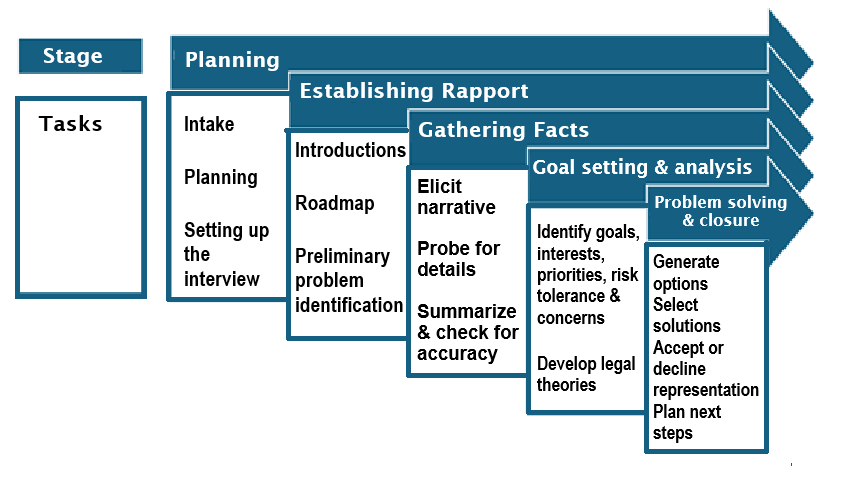
Before the initial interview begins, your planning should be designed to frame the relationship. You do this through the intake process and through setting up the initial meeting. The “stages” of the interview itself then begin with introductions, when you and the prospective client get to know one another and begin to lay the groundwork for trust. You explain the nature and goals of the interview process and invite the prospective client briefly to describe the nature of the matter that has brought them to you. The interview will quickly turn to a more detailed fact gathering process. Before, during, or after this process (and often at all three times), you will also engage the client in a process of identifying and clarifying their goals and priorities. This requires identifying not only what the client wants (their objectives) but why (the underlying interests, concerns, and values driving those objectives).
As the prospective client’s matter and goals become clearer, you often will move toward preliminary counseling or problem-solving. At this point, you likely will focus on preliminary legal theories you have been formulating throughout the interview and educate the client regarding rights and duties. This process may require that you return to additional fact gathering and goal clarification. You will work with the client to generate ideas about legal and practical options for pursuing their goals. As the interview closes, you will decide whether to represent the prospective client and they will decide whether to engage you to represent them. Sometimes, that decision will occur during the meeting; in other circumstances, the attorney or the client may need more time for the decision. In any case, as the interview concludes, the attorney should summarize the interview and communicate clearly with the client about the existence (or non-existence) of an attorney-client engagement.
For all stages of the interview, a number of skills are required. You must be able to: listen actively, use of prompts and questions, to identify and reflect both content and emotion, to communicate information clearly, and to describe legal theories and possible solutions.
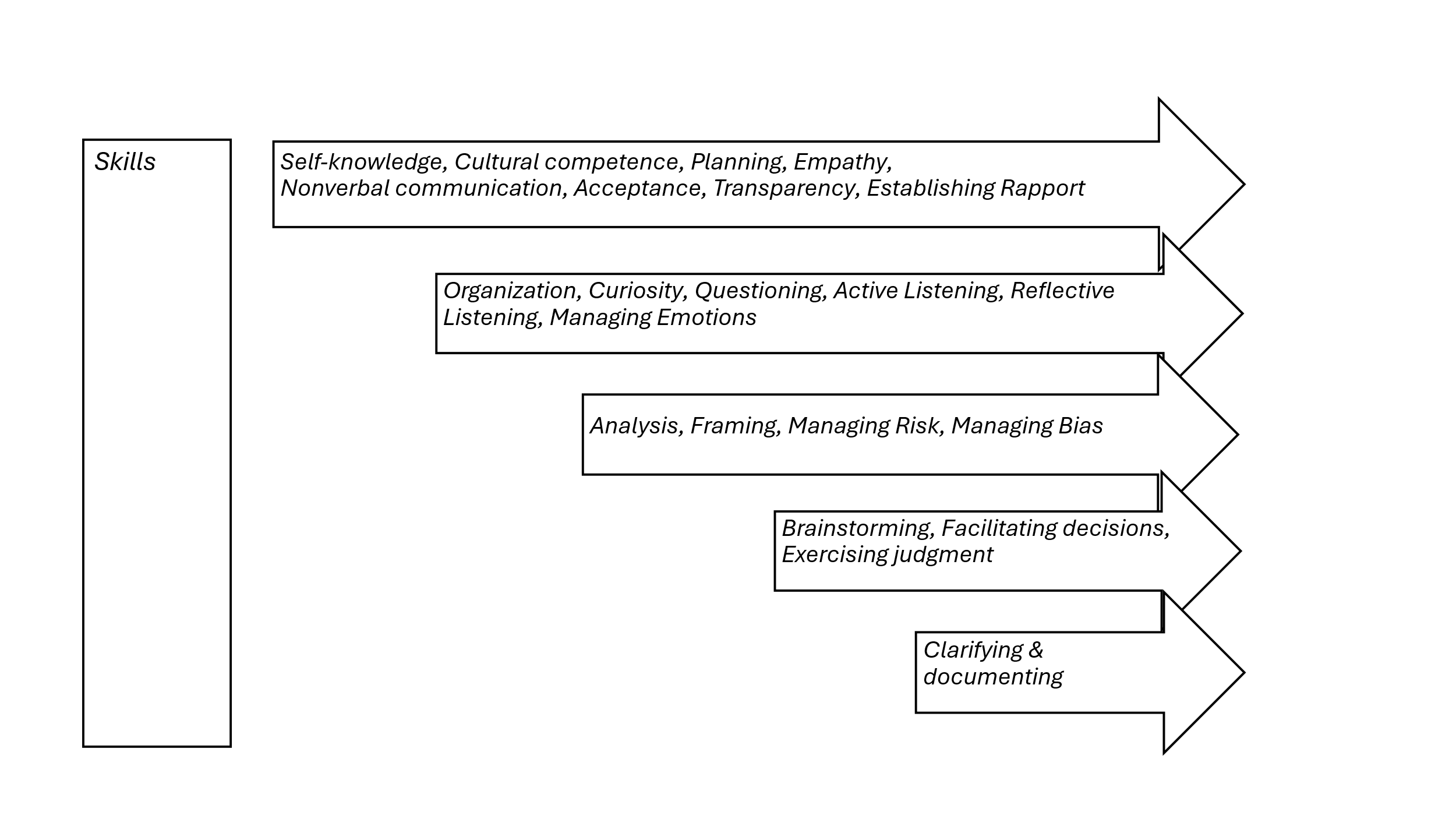 This text proceeds through these parts of the interview, providing instruction and opportunities for practice of these key skills along the way.
C. What is the nature of the attorney-client relationship?
An attorney-client relationship is a special type of agency relationship. The client is the principal, responsible for deciding the objectives of the engagement, and the attorney is the agent, responsible for the means of achieving those objectives. However, unlike many traditional principal-agent or employer-employee relationships, the attorney-client relationship is also a fiduciary relationship. Because clients lack the specialized knowledge and training to supervise a lawyer’s work, they must trust that their lawyers are carrying out professional responsibilities properly. Chief Judge Benjamin Cardozo noted that these fiduciary relationships require a greater responsibility than other agency relationships: “The trustee is held to something stricter than the morals of the marketplace. Not honesty alone, but the punctilio of an honor the most sensitive, is then the standard of behavior… the level of conduct for fiduciaries [has] been kept at a level higher than that trodden by the crowd.”[9]
The fiduciary responsibilities of attorneys are embodied in state rules of professional conduct.[10] Those core fiduciary duties include competence,[11] diligence,[12] communication,[13] confidentiality,[14] and loyalty.[15] Those duties attach as soon as the attorney-client relationship is formed. However, the rules of professional conduct also treat a prospective client as a type of limited client.[16] Accordingly, an attorney owes each of these duties to some extent even in the initial interview, even before an attorney and client have agreed to a representation.
While you can decline to represent a prospective client for any reason, or for no reason at all, once you have committed to representing a client, your ability to withdraw from that relationship is limited. In general, you cannot withdraw from a representation if it will materially harm your client. The rules of conduct provide limited exceptions to this rule. If you are unable to fulfill your duties to the client or the law, you may be required to withdraw from a representation.[17] Likewise, the rules permit you to withdraw from a representation in a very limited range of circumstances, primarily those in which withdrawal is necessary to disassociate yourself from client misconduct.[18]
The rules of professional responsibility also speak to the dynamic that should exist with respect to communication and decision-making responsibilities within the attorney-client relationship. There are some decisions that always require a client’s consent such as waivers of conflicts of interest or settlement decisions. In criminal matters, defense clients always have the final say on pleas, plea agreements, jury trial waiver, and whether the client testifies.[19] Conversely, there are some client directions that you simply may not follow, such as the client’s direction to ignore the law or a court order, to file a frivolous pleading or motion, or to engage in other illegal or unethical conduct. Optimally you will screen out clients who expect this kind of assistance before agreeing to represent them.
In the middle ground are those decisions for which the allocation of authority between attorney and client is less clear. Generally, you have the discretion to determine the means by which the representation is to be carried out, while the client determines the objectives.[20] Clients may believe that you should take every step possible to advance their interests, regardless of whether that step is effective, efficient, or professional. The law addressing the attorney’s duty in this regard leaves much more discretion to the attorney than a client may realize:
A lawyer has authority to take any lawful measure within the scope of representation … that is reasonably calculated to advance a client’s objectives as defined by the client…, unless there is a contrary agreement or instruction and unless a decision is reserved to the client…. A lawyer, for example, may decide whether to move to dismiss a complaint and what discovery to pursue or resist. Absent a contrary agreement, instruction, or legal obligation…, a lawyer thus remains free to exercise restraint, to accommodate reasonable requests of opposing counsel, and generally to conduct the representation in the same manner that the lawyer would recommend to other professional colleagues.[21]
This distinction between means and ends is far from a clear line. Even as to objectives, you must “reasonably consult with the client about the means by which the client’s objectives are to be accomplished” and “keep the client reasonably informed about the status of the matter.”[22] If a client objects to your decision about the means for pursuing their objectives or if you object to the client’s objectives, you are left to negotiate the matter with your client. If the disagreement cannot be resolved, you must withdraw from the representation.[23]
Because there is so much discretion when it comes to putting these rules into practice, you should make these lines clear from the start of the representation. Always clearly establish your boundaries, not only as to the scope of your representation but as to the means by which you will pursue the client’s goals.
Attorneys have varying approaches to this allocation of decision-making. Most attorneys have a default position regarding their authority in the relationship. Commentators have noted that these positions fall within one of three models—an authoritarian approach, a client-centered approach, and a collaborative approach.[24]
Traditionally, attorneys have been understood to take an authoritarian approach to the attorney-client relationship. The authoritarian approach is best described as a “highly directive” approach. Attorneys who take this approach might talk about the importance of “controlling” their clients. One of the most extreme examples of this is reflected in a conversation one of the authors had with an acquaintance asking for suggestions of attorneys she could contact about her desire to obtain a divorce. In discussing her situation, she noted that she had an attorney who had represented her a year previously as she became legally separated from her husband. She further indicated, however, that she did not want to continue with that attorney because she was uncomfortable dealing with him. When she had contacted him about her situation, the way he talked with her suggested that she should stay out of the way: “You have asked for my help. I am the attorney. I know what to do.” This is about as “directive” as one can be.
The extremes of the authoritarian approach can run contrary to the rules of professional conduct. Notably, if an attorney does not engage the client in the decision-making process, the attorney is unlikely to be meeting the demands of Rule 1.4 regarding communication with clients.[25] If the attorney does not elicit or honor the client’s decision about the objectives of the representation or does not consult with the clients about the means by which those objectives are to be achieved, the attorney is acting inconsistent with rule 1.2(a) regarding the allocation of decision-making authority.[26]
Partly in reaction to the overreaching by attorneys reflected in the authoritarian approach, many commentators have suggested that attorneys should take a client-centered approach to the relationship.[27] The client-centered approach is best understood as a “highly deferential” approach. The advocates of the client-centered approach argue that this approach can be especially important when representing clients who are socially or economically disadvantaged. A client-centered approach for these clients seeks to empower these clients to exercise decision-making authority in their lives. However, client-centered practice need not mean that you cannot express opinions about the wisdom or practicality of a proposed course of action, merely that you do so only to aid the client in their own decision-making.
Taken to an extreme, the client-centered approach (especially when used in representing sophisticated and powerful clients) can move toward the image of a lawyer as a “hired gun”—someone who will advocate for whatever position a client wants. This extreme approach is also contrary to ethical rules. Rule 2.1 provides that “a lawyer shall exercise independent professional judgment and render candid advice” to clients.[28] The comment to that rule emphasizes that sometimes attorneys must question a client’s decisions.
A client is entitled to straightforward advice expressing the lawyer’s honest assessment. Legal advice often involves unpleasant facts and alternatives that a client may be disinclined to confront. In presenting advice, a lawyer endeavors to sustain the client’s morale and may put advice in as acceptable a form as honesty permits. However, a lawyer should not be deterred from giving candid advice by the prospect that the advice will be unpalatable to the client. [29]
Other commentators have suggested that both of these approaches are problematic because they are prone to “imbalance”—with decision-making authority either unduly allocated to the attorney or unduly allocated to the client. These commentators believe that the attorney-client relationship should be more balanced. Accordingly, they suggest that attorneys should pursue a collaborative approach to the attorney-client relationship.[30] Even this approach can raise ethical concerns, however. An attorney has an obligation to charge reasonable fees for their services[31] and to work to make legal services available.[32] Taking a collaborative approach can increase the costs of legal representation compared to delegating some decision-making to either the attorney or client.
For an attorney to rely on any one of these models requires a client who is able and willing to work within the model’s framework. Consider, for example, the client who has a limited capacity for decision-making. The rules of professional conduct suggest that “When a client’s capacity to make adequately considered decisions in connection with a representation is diminished, whether because of minority, mental impairment or for some other reason, the lawyer shall, as far as reasonably possible, maintain a normal client-lawyer relationship with the client.”[33] The attorney may find that the collaborative or client-centered models may not fit as well with these clients, who may require more direction than others.[34]
Of course, in actual practice, these different models for communication and decision-making are rarely exclusive. The role of the attorney in the attorney-client relationship is not easily confined to any one of these three categories or approaches. To be in a “collaborative” attorney-client relationship does not mean that the relationship won’t have aspects in which the attorney is directive or authoritarian or in which the attorney is deferential or client-centered. Indeed, it is not hard to imagine a conversation between an attorney and a client in which the relationship spans all three approaches within a fifteen- or twenty-minute period. While there are appropriate reasons to be concerned about abuses resulting from imbalances inherent in the authoritarian and client-centered approach, and corresponding reasons to gravitate toward the collaborative model, the collaborative model in reality will encompass situations in which the attorney appropriately will need to direct the client or defer to the client.
Check your Understanding
Suppose a client had been in an auto accident and was consulting with an attorney regarding possible claims. The conversation might encompass the following exchanges:
We think it is important for students to think broadly about how they conceive of their role in the attorney-client relationship. We are attorneys and people. Who we are as attorneys should not be divorced from who we are as people. The values and perspectives that shape our lives as individual members of a community also must inform our understanding of who we are as lawyers within society.
D. Why is reflective practice a habit of effective professionals?
Reflective practice is a habit of expert learners and practitioners. You have likely heard the expression “practice makes perfect.” It’s not true. It is only practice plus reflection and correction that leads to improvement. That process of reflection requires observing and critiquing your own performances regularly and evaluating how your daily actions are shaped by your values, preferences, and perspectives. Attorneys who neglect this reflection will never be aware of their own strengths (so as to capitalize on these), weaknesses (so as to improve), or passions (so as to sustain themselves). Reflection gives meaning to experience and turns experience into practice. Reflective practice can also be used to learn from observation of others.
Often the most useful way to incorporate regular reflection into your professional development is through reflective writing. Writing engages your thoughts in a different (and sometimes deeper) manner than just thinking about a topic. Accordingly, a journal or log can be an important tool for improving your professionalism. Because reflection is so critical to skills development, this text includes regular reflective writing exercises.
How do you structure a written reflection?
First, describe in concrete terms the activity upon which you are reflecting (whether a reading, question, observation, or your own actions). The very act of summarizing the observation/activity can lead to additional observations and evaluations. This can be especially so when you describe something in present rather than past tense. You can even experiment with reflections from a second- or third-person point of view. Authors know all about the value of varying points of view in describing and understanding a situation. Trying out different points of view in your reflections can not only support rich reflection but can also help you to develop the skill of viewing a situation through multiple perspectives.
Describing what you are reflecting upon is also important if you want to share the reflection with others or you want to review the reflection at a later time. Without a description to preface the actual reflection, you (or your reader) will not have critical context to understand your evaluation. In practice, you may be asked to share with other attorneys your reflections (evaluations) on a witness, negotiation, or other interaction. Even if your readers or listeners also were present for the event, what they saw and heard is unlikely to be precisely the same as what you saw and heard. Beginning with rich descriptions, then, sets the stage for rich reflection.
Second, engage in a critical evaluation (questioning, examining more closely) the situation. In his book, “The Reflective Practitioner,” MIT Professor Donald Schon[35] suggests that professional behavior is guided by theory. Schon describes two types of theories: “theories-of-action” which are the values, strategies, and underlying assumptions that affect behavior, and “theories-in-use” which are the theories implicit in one’s habitual actions. In other words, professionals don’t always behave in ways that are consistent with how they talk about their professional values and beliefs. Through reflection, professionals can examine their own theories (both explicit and implicit) and align their behavior and theory. Carefully examine the ideas or actions upon which you are reflecting to identify your own explicit and implicit beliefs and theories. What surprised you? Challenged you? Confused you? How are your personal assumptions, habits, or values connected to the opinions or behaviors upon which you are reflecting?
Third, use the reflection for further learning. What additional action or reflection will you use to develop your skills, improve your understanding, or refine your beliefs? The more concrete your plans for building upon your reflection, the more you will learn.
Here is an example of reflective practice from one of the author’s experiences working on a clemency project.[36] The author began with a description of the event. The clemency petitions workgroup had met to review the cases of women who had been incarcerated for the murder of their batterers at a time before evidence of battered spouse syndrome was admissible. One of the key elements in consideration was creating a powerful package of petitions that would persuade the governor to grant clemency. Who should be included in this package was the topic of discussion.
Notice how detailing exactly what was said and the emotions and thoughts that were involved helped the author gain insights and lessons that would be applied to future representations:
Assisting in our deliberations was a secretary who had been incarcerated and released. “Kay” quietly listened and took notes during much of our discussion, speaking only to answer questions about prison procedures or personnel.
The discussion turned to the consideration of individual petitions. Some petitions were stronger than others, but some presented more sympathetic petitioners than others. Where should we draw the line? I suggested that we include only those petitions that presented a strong possibility of success. I thought it would simply be one more cruel blow to put forward the names of women with less than optimal petitions and have them denied any relief once again. It seemed to me that this would simply replay the entire trauma of their original conviction. I thought I was exercising empathy and compassion to inform my independent professional judgment. I summarized all these thoughts by interjecting: “But we don’t want to give these women any false hopes.”
At my comment, Kay fled the room in tears. I went after her, hoping to offer an apology or comfort, as the situation demanded. When I walked up to her in the hallway, she blurted out through her tears, “You just don’t understand. Hope is all they have. You live every day holding onto hope. If one hope is dashed, you find another. That’s how you survive. If you don’t have hope, you don’t survive.”
Going into that meeting… I was fully aware that I had no idea what prison life was like…. I knew full well that I really couldn’t fully appreciate the circumstances these women had lived through. I knew what I didn’t know. But that didn’t stop me from assuming. Kay’s admonition—”You just don’t understand”—rings in my ears to this day, reminding me that my first job as a counselor and advocate is to listen to the client: the true experts in everything except the law.
Reflective Practice
Think about a personal circumstance in which someone has come to you with a problem or concern, and answer the following questions.
Check your Understanding
Chapter One Endnotes
- Model Rules of Pro. Conduct r. 1.1 (Am. Bar Ass’n 2023). ↵
- Id. r. 1.7. ↵
- Id. r. 1.2(d)” A lawyer shall not counsel a client to engage, or assist a client, in conduct that the lawyer knows is criminal or fraudulent, but a lawyer may discuss the legal consequences of any proposed course of conduct with a client and may counsel or assist a client to make a good faith effort to determine the validity, scope, meaning or application of the law.” See also, r. 1.4(a)(5) directing that an attorney shall “consult with the client about any relevant limitation on the lawyer's conduct when the lawyer knows that the client expects assistance not permitted by the Rules of Professional Conduct or other law.” ↵
- We will learn more about trust in Chapter Three. ↵
- Id. r. 1.4 (2009). ↵
- Kathleen A Zoppi & Ronald M. Epstein, Interviewing in Medical Settings, in HANDBOOK OF INTERVIEW RESEARCH: CONTEXT AND METHOD 355, 372 (Jaber F. Gubrium & James A Holstein, eds., 2001). ↵
- Clark D. Cunningham, What Do Clients Want from Their Lawyers, 2013 J. DISPUTE RESOL. 143, 146-151. ↵
- Marsha Kline Pruett, Tamara D. Jackson, Legal Ethics: Some Current Issues in the Practice of Family Law, The Lawyer's Role During the Divorce Process: Perceptions of Parents, Their Young Children, & Their Attorneys, 33 FAM. LAW Q. 283, 294-95 (1999). ↵
- Meinhard v. Salmon, 164 N.E. 545 (N.Y. 1928). While Justice Cardozo was speaking in this case of the fiduciary duty business partners owe to one another, the principles apply even moreso to the attorney client relationship, where there is an ever-greater imbalance of power and reliance by the client-principal. ↵
- All states draw from the American Bar Association’s Model Rules of Professional Conduct as a model for their state disciplinary standards. ↵
- Model Rules of Pro. Conduct r. 1.1 (Am. Bar Ass’n 2023). ↵
- Id. r. 1.3. ↵
- Id. r. 1.4. ↵
- Id. r. 1.6. ↵
- Id. r. 1.7-1.11. ↵
- Id. r. 1.18 (for example, an attorney owes the same duty of confidentiality to a prospective client as to a former client and information received from a prospective client can create a conflict of interest disqualifying the attorney from other representations). ↵
- Id. r. 1.16(a). ↵
- Id. r. 1.16(b). ↵
- Id. r. 1.2(a). Some courts have read this rule to extend beyond the enumerated decisions to a range of ultimate decisions and other states expressly add additional matters to this list of decisions reserved to clients. "Rule 4-1.2(a) requires a client to be in control of the decisions that have the capacity to affect the client profoundly, specifically referencing the decision whether to accept a settlement of the case. . . ." In re Coleman, 295 S.W.3d 857, 864 (Mo. 2009). ↵
- Id. r. 1.2(a). ↵
- Restatement (Third) of the Law Governing Lawyers §21, comment 3 (2000). ↵
- Id. r. 1.4(a)(2)-(3). ↵
- Id. r. 1.2, comment 2. ↵
- See, e.g., THOMAS L. SHAFFER AND ROBERT F. COCHRAN, JR., LAWYERS, CLIENTS, AND MORAL RESPONSIBILITY (2d. ed. West 2009)(Ch. 1, 2, and 4). ↵
- Id. r. 4. ↵
- Id. r. 1.2(b). ↵
- See DAVID BINDER ET AL., LAWYERS AS COUNSELORS: A CLIENT-CENTERED APPROACH (2d. ed. 2004); ROBERT M. BASTRESS AND JOSEPH D. HARBAUGH, INTERVIEWING, COUNSELING, AND NEGOTIATION SKILLS FOR EFFECTIVE REPRESENTATION (1990). ↵
- Id. r. 2.1. ↵
- Id. r. 2.1, cmt. 1. ↵
- See Shaffer and Cochran, supra n. 24, at Chapter 4. ↵
- Id. r. 1.5(a). ↵
- Id. r. 6.1 and Preamble ¶1. ↵
- Id. r. 1.14. ↵
- Rodney J. Uphoff, The Role of the Criminal Defense Lawyer in Representing the Mentally Impaired Defendant: Zealous Advocate or Officer of the Court?, 1988 WIS. L. REV. 65 (1988); Stanley S. Herr, Representation of Clients with Disabilities: Issues of Ethics and Control, 17 N.Y.U. REV. L. & SOC. CHANGE 609 (1989-90). ↵
- DONALD A. SCHON, THE REFLECTIVE PRACTITIONER: HOW PROFESSIONALS THINK IN ACTION (1984). ↵
- The author incorporated this reflection from her journal into an essay on the topic. Barbara Glesner Fines, Clients as Teachers, 91 A.B.A.J. 54 (2005). Available at: https://irlaw.umkc.edu/faculty_works/78. ↵