
Conclusion
This text provides a good deal of knowledge about client interviewing and counseling; however, being able to conduct an interview and counsel a client requires more than knowledge. It requires the adoption of a set of values and the development of a set of skills.
To be effective at interviewing and counseling clients you must make a commitment to core values of the legal profession: service, autonomy, and responsibility. You must have a deep appreciation of the various roles you play in representing a client.[1] Initial interviews engage an attorney in their role as counselor, which involves not only informing clients of their rights and obligations but helping clients to clarify their goals and craft solutions—both legal and practical—to achieve those goals. Acting as a counselor is a distinct role from acting as advocate: a counselor owes a client independent professional judgment,[2] including identifying weaknesses in a client’s position or foolishness in their goals. It is in the initial interview that you will demonstrate respect for your client’s autonomy while also fulfilling your responsibility to the rule of law and system of justice.[3]
You must also make a commitment to the value of continual improvement.[4] You may be familiar with Carol Dweck’s book “Mindset”[5] in which she distinguishes between a fixed mindset and a growth mindset. Individuals with a growth mindset believe that intelligence and ability are changeable and can be developed over time through effort and persistence. As a result, they are constantly looking for new challenges, which they perceive as opportunities to grow and improve. By contrast, people who have a fixed mindset believe individuals are born with certain amounts of intelligence and ability, which are stable and unchangeable over time. As a result, they try to avoid looking dumb at all costs because they believe this would reveal an inherent deficiency in their intelligence. When it comes to bias, a fixed mindset can cripple our ability to recognize and change negative stereotypes and harmful behaviors. This may cause us to isolate ourselves in a narrow world of sameness lest we make a mistake in interacting with others who are different than ourselves or exposing ourselves to experiences that challenge our skills. A growth mindset, on the other hand, encourages us to seek out knowledge and experience, knowing that we have much to learn and that mistakes are often the most powerful teachers.[6]
How practically can you improve your skills in interviewing and counseling? As a general matter, improving any skill requires a recursive practice in which you plan, practice, reflect, and correct.
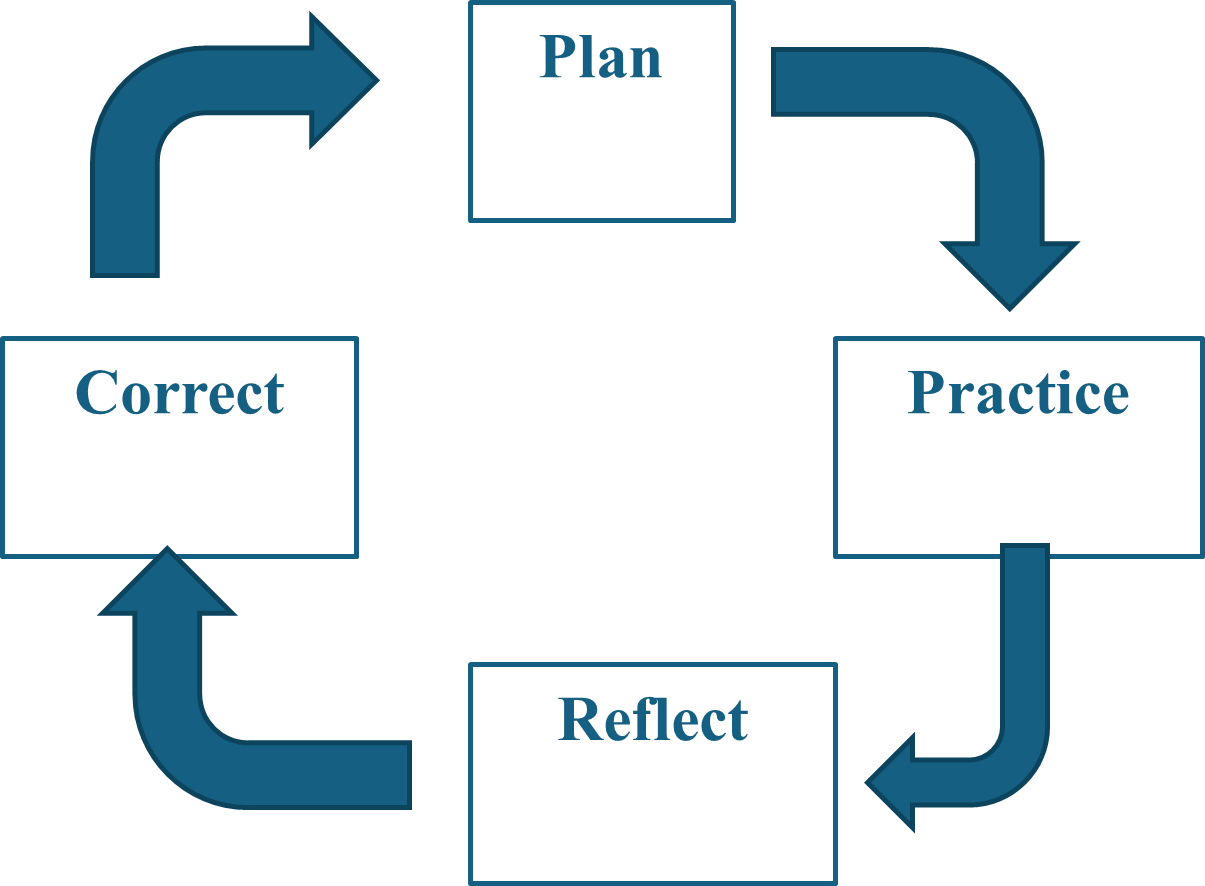
Planning improvement begins with goal setting. Identify a specific skill that you want to improve in the context of interviewing and counseling. In this text, we have explored a number of specific skills:
- Understanding your own preferences, philosophies, biases, strengths, and weaknesses
- Developing your cultural competencies
- Planning for interviews
- Improving empathy
- Managing nonverbal communication
- Conveying nonjudgmental acceptance
- Communicating with transparency
- Establishing rapport
- Organizing an interview
- Exercising curiosity and avoiding premature judgments
- Questioning effectively
- Actively listening
- Paraphrasing and summarizing
- Identifying and reflecting
- Helping clients to clarify goals, interests, disputes, and risk preferences
- Analyzing facts
- Framing situations
- Managing biases
- Brainstorming solutions
- Facilitating decisions
- Exercising judgment
- Clarifying relationships
- Documenting
Identify a particular skill you would like to improve and state your goal in concrete, measurable terms.
Practice the skill you have identified. Entire institutes are devoted to improving skills of trial practice, but there are few formal opportunities to practice interviewing and counseling in formal programs. Accordingly, you must develop your own plan and resources for practicing skills. Many of the practice exercises in this text are ones you can continue to use throughout your career. Obviously, you will have opportunities to practice your skills in general as you meet with clients, but you can practice many skills outside this specific context. For example, you can develop relationship skills in any setting in which you are interacting with others and you can develop empathy by reading literature.
Reflect. Throughout the text you have been asked to develop the skill of reflection—describing what you have done or observed, questioning why and how, identifying ways to improve or extend your learning, and then planning opportunities for future improvement. Reflection need not be in writing, though there are particular benefits to written reflection. Many attorneys engage in reflection through dialogue with others. With some skills, recording yourself in audio or video and observing and critiquing your performance can be very effective, though as we have discussed, you would not generally want to record interactions with actual clients. Finally, seeking feedback on your skills, particularly from those who have keen observation skills and a willingness to provide candid evaluation, is a powerful source for improvement.
Correct. Practice and reflection are of little value if you do not take advantage of the insights provided from this process to repeat the cycle of planning, practicing, and reflecting to continually improve.
Through this iterative process of continual improvement, anyone can become highly effective in carrying out one of the most common and important roles of an attorney: acting as the agent of our system of justice by building a relationship with a client and helping them to protect their legal rights and fulfill their legal responsibilities.
Conclusion Endnotes
- Model Rules of Pro. Conduct Preamble ¶ 2 (Am. Bar Ass’n 2023). ↵
- Id. r. 2.1. ↵
- Id. Preamble ¶¶ 5-6. ↵
- Id. r. 1.1, comment 8 (“To maintain the requisite knowledge and skill, a lawyer should keep abreast of changes in the law and its practice, including the benefits and risks associated with relevant technology, engage in continuing study and education and comply with all continuing legal education requirements to which the lawyer is subject.”). ↵
- CAROL DWECK, MINDSET: THE NEW PSYCHOLOGY OF SUCCESS (2006). ↵
- https://hbr.org/2019/11/how-the-best-bosses-interrupt-bias-on-their-teams. ↵