
Chapter Seven – Goal Setting and Legal Analysis
Learning Objectives
After working through these lessons and practicing the skills presented, you will be able to:
- Close the information gathering portion of the interview and transition effectively to the counseling portion of the interview.
- Clarify the client’s objectives, interests, concerns, and expectations.
- Translate the client’s facts into legal categories.
- Identify some categories of value orientations and be able to speak about an issue from the perspective of these different orientations.
In this chapter, we examine the end of the fact gathering phase of the interview and the transition to counseling. This phase involves analyzing the facts gathered and setting goals for addressing the issues identified.
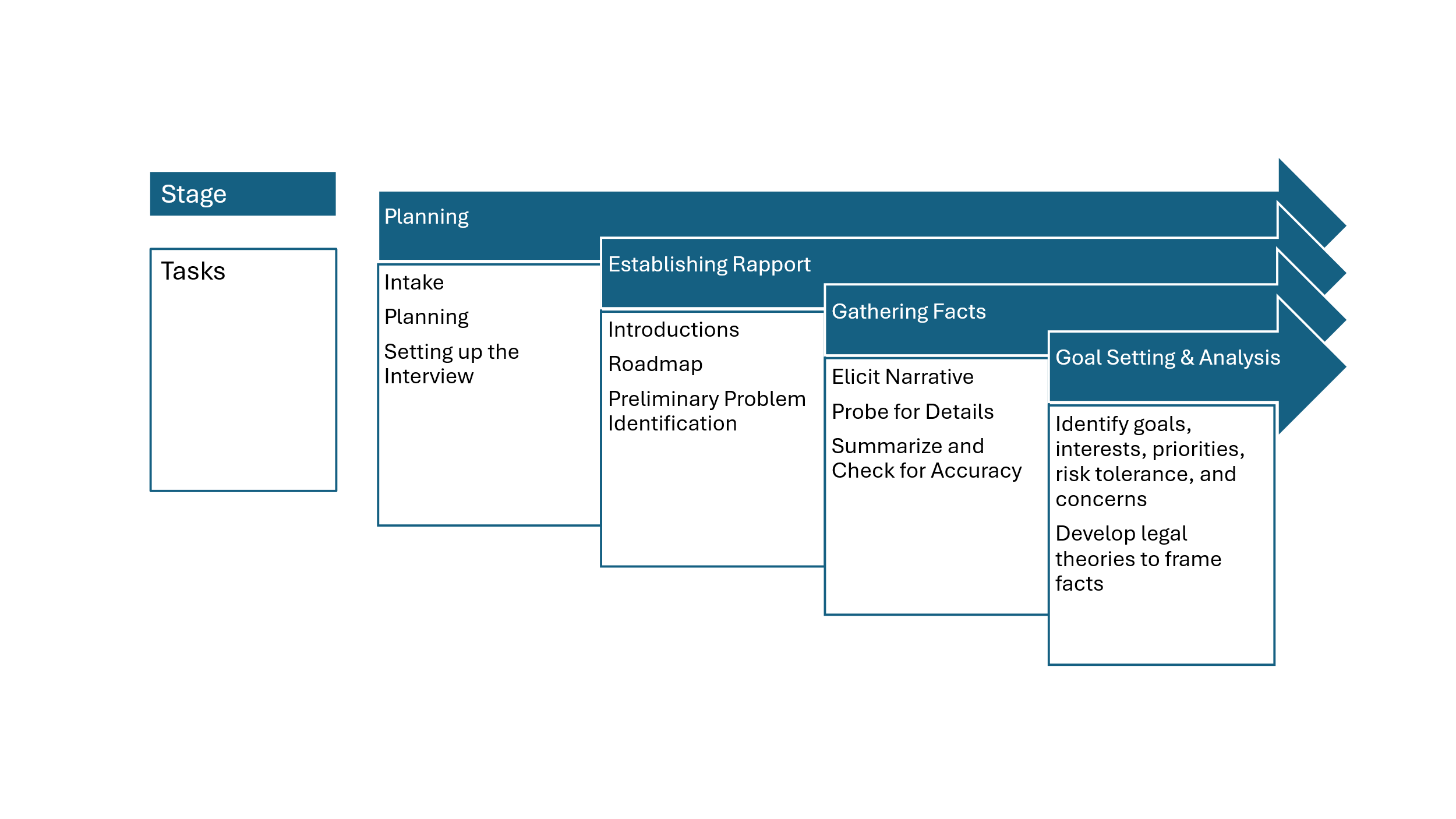 Some of the skills needed at this stage are familiar for law students—identifying legal theories and matching those theories to facts to spot issues. This stage also requires a second set of relational skills—helping the client to identify and clarify their goals. Just as fact gathering requires first a preliminary identification of the problem or transaction followed by probing for more details, the process of identifying and clarifying goals also involves multiple layers: not only what the client wants but why, not only what the client hopes but fears, and the priorities and risk tolerances for each of the multiple goals a client may have. These skills build on the skills we have already been exploring in the previous stages of the interview.
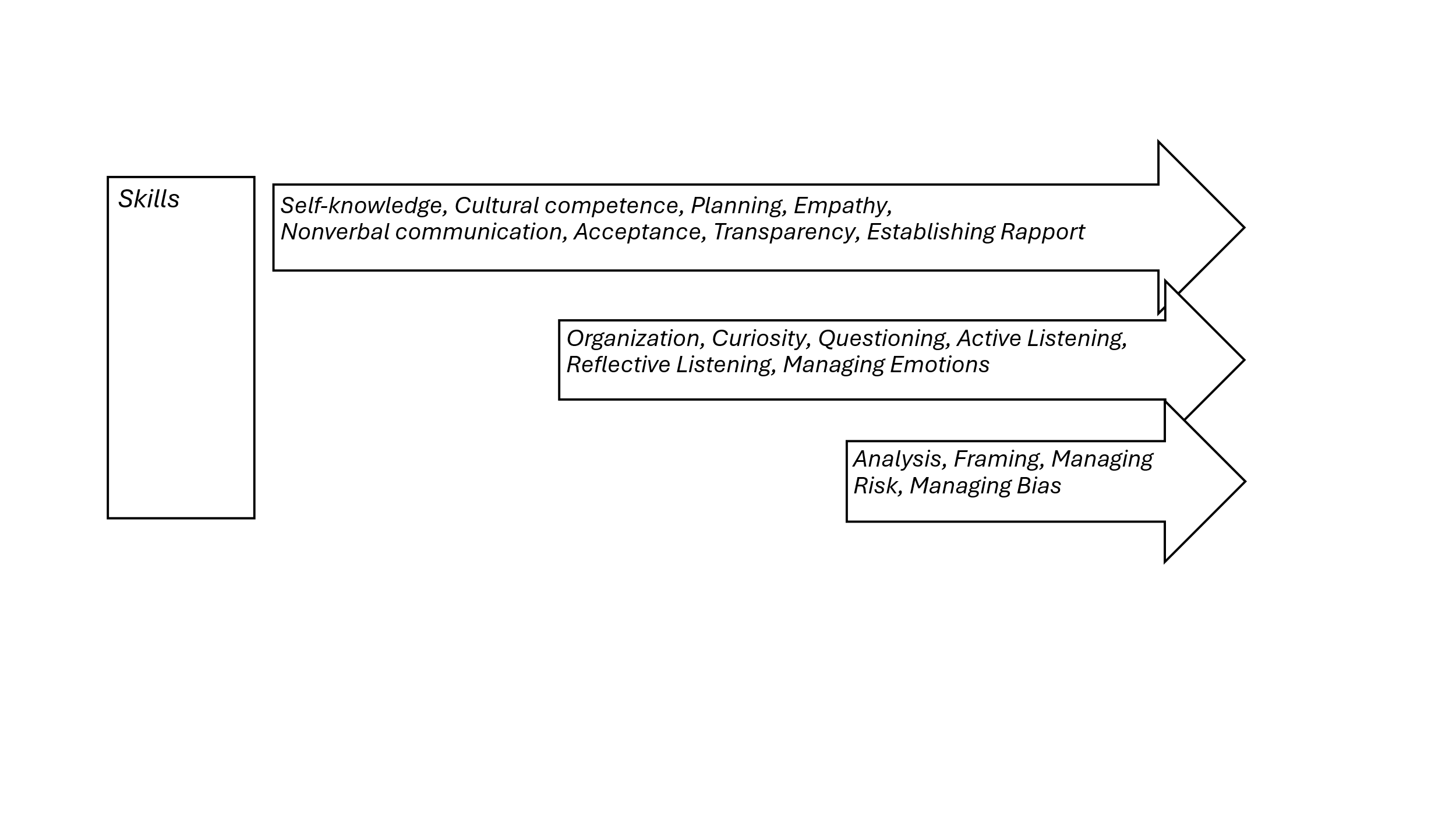
A. How do you know when to transition from fact gathering to deciding whether to move forward with representation?
How do you know when you have gathered sufficient facts to be able to begin making decisions about the representation? You will generally know to close out fact gathering in the initial interview when additional questions fail to uncover additional information. The best way to know that you have reached that point is to return to open-ended “wrap up” questions that allow the client to address any remaining topics they wish to discuss. These questions should make it evident that the client has fully expressed their concerns and has nothing further to add. It may be that the first time, or the first couple of times, that you try to wrap things up with an “anything else?” type of question, the client may indeed have additional topics or information to add. You can continue to probe for these additional details as time permits. Sometimes the client will return to topics already discussed, signaling the importance of this aspect of their matter. Use reflective listening to acknowledge that you have heard and understand the importance of these matters. Of course, sometimes as a practical matter, fact gathering ends when there is no more time available.
When you have exhausted topics or time, you will move to the counseling portion of the interview. An effective way to make that transition is to provide an overall summary of the situation, emphasizing the key facts and perspectives in the matter. You might signal to the client that this is what you are doing and invite their attention and correction: “Okay, let me make sure I understand this situation” or “Correct me if I’m wrong but here’s what I see.” When you finish your summary, invite the client’s response by asking “Do I have that right?” “Did I miss anything important?” or simply, again, “Is there anything else?” After this summary, provide a roadmap for the remainder of the interview.
B. How do you assist a client in clarifying goals and objectives?
Analyzing the client’s matter requires understanding the client’s objectives and how to achieve them. Helping the client clarify their goals and select potential solutions is the heart of the counseling function. This requires exploring the client’s underlying interests and motives beyond their stated positions and using values to clarify goals.
1. Understanding positions and interests
One set of critical questions needs to be addressed as you transition to counseling: the client’s goals and expectations. In much of the middle part of the interview, you will be focusing on the “what happened” part of the client’s matter, including the emotions involved in that matter. As you conclude this portion of the interview, you will turn to the “why” of the client’s story. There rarely is a simple answer to this question.
How do you determine the client’s objectives and interests? Like any other part of the interview, you can simply begin with open-ended questions to identify the client’s objectives. Ask directly: “What outcome are you hoping to achieve?” Unpack the client’s conclusory descriptions of their goals by asking for specifics. For example, you might ask “What does ‘justice’ look like to you?” or “What would you consider a ‘successful negotiation’ to be?” As with fact gathering, use reflective statements to check your understanding.
Frequently, clients will focus on short-term goals. Part of the value you can provide to a client in goal setting is to help them consider longer-term goals as well. Attorneys can help clients broaden their perspective beyond immediate concerns to consider long-term implications through several strategic approaches. One method is simply to ask future-oriented questions. For example, a client in a custody dispute may be focusing on the needs of their children at present. Asking how those needs might change when the children are older can help to inform the client’s immediate goals. Likewise, focusing on securing a business advantage or closing a transaction may blind a client to considering their longer-term goals for that business or relationship. Here is where gathering more context for the client’s goals can help to broaden the scope of goal setting. Exploring a client’s overall goals for their career, family, finances, or business may provide an important lens for examining short-term goals. The goals a client selects in an initial interview need not be set in stone. Assuming you enter into an attorney-client relationship, you should invite the client to revisit their goals after they’ve had some time to consider the broader implications or have more information on which to assess their situation.
Whether focused in the present or future, you need to go beyond asking for desired outcomes. Questions about goals uncover only the client’s position (what they want). To engage effective problem-solving you must understand the interests driving those objectives (why they want something). Positions are the specific demands or proposals your client expresses, while interests are the underlying needs, desires, concerns, and motivations behind those positions. Accordingly, you must listen for both the explicit positions and the implicit interests driving those positions.
Don’t expect simple answers to your questions about goals. Clients bring complex motivations to a legal matter. Personal, emotional, relational, and business considerations often drive client decisions alongside strictly legal concerns. Many clients approach attorneys without clearly defined goals. As Professor Rubinson notes, “client perspectives—like the perspectives of everyone else—are rife with competing concerns, ambiguities, and ambivalences, and thus are not unitary. These dissonances and instabilities are not merely risks of interviewing and counseling but in many ways define these very processes.”[1] Some clients simply feel overwhelmed and want the attorney to suggest a path forward. They may have conflicting goals, like wanting a peaceful divorce while also desiring significant custody rights that might provoke conflict. Clients may be reluctant to fully disclose certain motivations due to embarrassment, fear of judgment, or uncertainty about relevance.
Consider, for example, a criminal defense client who expresses a desire to accept a plea deal. The attorney may consider the legal or strategic reasons that might drive this decision. A plea agreement might avoid exposure to more serious charges that prosecutors might pursue at trial, prevent evidence of other misconduct from becoming public, or secure specific outcomes like particular facility placement or program participation. However, for the client, a much wider range of implicit goals or motivations may be driving this objective. For example, the client may be motivated by assumptions about how a plea deal will affect their own well-being and safety. The uncertainty and anxiety about an unpredictable trial outcome may outweigh the impact of a sentence. They may be focused on the immediate threats of escaping pretrial detention conditions that may be harsh or dangerous. They may be weighing the impact of an immediate resolution on their broader life circumstances. Perhaps they believe that resolving the case quickly will permit them to retain a job or house that might be lost during a lengthy trial process. If they are not a citizen, their primary consideration may be preserving their immigration status if certain convictions would have deportation consequences. Accessing treatment programs that might be available through certain plea arrangements may be a priority consideration. Finally, the client may be motivated by social or identity factors, such as maintaining privacy about personal matters or preserving their dignity through avoiding public exposure of embarrassing facts. They may view a plea agreement as the best way to accept responsibility for their actions in a way that aligns with their personal values or religious beliefs.
Additionally, the client may be focusing on the impact of their case on others rather than themselves. Their underlying goal may be to protect co-defendants or loved ones who might be implicated during a trial. They may believe that a plea deal will protect their family from trial publicity or from having to testify; reduce the financial burden on family members who may be supporting them; or allow them to return more quickly to caregiving responsibilities for children or dependent family members.
Beware of the tendency to assume that instrumental outcomes are the client’s most important goals. A client’s objectives may have less to do with instrumental outcomes such as money damages or court orders, and more to do with procedural values or psychological needs for validation of self-worth, competence, and identity. Many clients have a primary goal of simply “wanting their day in court.” The procedural value of having a formal authority to hear their story may be at the center of their decision-making. For some clients, vindication of their experience may outweigh the risk of even harsh outcomes. Sometimes the attorney’s nonjudgmental acceptance of the client’s perspective is all that is necessary to address this need for validation and process, but if it is not addressed in some way, it will distort all other decisions.
Check your Understanding
In each of the following examples, consider the possible implicit goals that might underly the client’s stated goal. Click each one to compare your answer.
By identifying both explicit and implicit goals, attorneys can develop legal strategies that address the client’s full range of needs and priorities, leading to more satisfying outcomes and stronger attorney-client relationships.
Uncovering interests and motivations
How do you help a client discover and clarify their underlying interests and motivations? In the book “Difficult Conversations,” authors Douglas Stone, Bruce Patton, and Sheila Heen from the Harvard Negotiation Project offer valuable insights into identifying underlying interests and motivations in the context of negotiations. They use a “three conversations” framework, that describes three simultaneous conversations happening beneath the surface of a difficult conversation. This framework can be helpful in exploring a client’s positions and interests.
The first conversation (“What Happened?”) focuses on truth, intentions, and blame. In the context of client goals, this is often the surface level conversation about what the client wants and is often where the conversation about goals begins. Just as we have emphasized in gathering facts, the authors emphasize the importance of approaching client goals with genuine curiosity rather than assumptions and employing active and reflective listening to detect unstated concerns.
The authors describe two other conversations that can help uncover the interests driving a client’s goals. The second conversation (“Feelings”) addresses emotions triggered by the situation. As we have explored previously, exploring the client’s emotions can uncover drivers of the client’s goals and decisions. Careful listening and observation are key to understanding this interplay between emotions and goals. Notice your client’s emotional reactions, body language, or tone shifts when discussing certain topics. Ask about how the client would feel about a particular outcome. Creating space for emotions to be articulated safely and acknowledging these emotions without judgment can help a client to explore how their emotions are affecting their decision-making.
The third conversation (“Identity”) concerns how the situation affects and is affected by self-image. Understanding how legal issues touch on the client’s sense of self-worth, values, or reputation can provide important insights into the client’s priorities and risks tolerances. To listen for these identity interests, pay attention to repeated themes or concerns. Particularly when clients take seemingly irrational positions, consider how the situation may present a threat to the client’s self-image. Here again, maintaining a nonjudgmental stance is critical. Be sure you have gained information about the broader context of the client’s matter (relationships and finances for example). All these will give clues to how the client views themselves in relationship to the matter that has them seeking your assistance.
All of these techniques might seem inefficient and indirect. One might assume that the most efficient and effective way to discover motivations or interests is to ask the client why they want a particular outcome. Indeed, in some instances prompting the client to tell you more about why a particular outcome is important to them can be an effective method to elicit more detailed explanations of the interests underlying a goal. However, in many cases using “What” and “How” questions can be even more effective. Asking a client why they want a particular outcome (or especially why they don’t want a different outcome) can feel accusatory or judgmental. The attorney who asks a victim of domestic violence, “Why don’t you just leave?” will have diminished the significant barriers and risks the client faces in their relationship and seemingly blamed the victim for the violence they are enduring. Even if a “Why” question does not make a client defensive, these questions often invite rationalizations rather than exploration. “Why do you want to pursue this claim?” might make clients feel they need to construct a logical justification for their goals. These post-hoc explanations may not reflect their actual motivations and the answers are often too abstract to be helpful.
In comparison, “What” and “How” questions often feel more neutral and non-judgmental. Asking, “What aspects of this situation concern you most?” invites information without implying criticism. This creates psychological safety for a client’s honest disclosure and more often will elicit concrete details. “How would an ideal resolution look to you?” generates specific, actionable information and helps the attorney understand practical priorities. Moreover, both questions look toward future solutions rather than past motivations.
Compare the effect of these “Why” questions versus “What” or “How” questions:
|
“Why do you want to sue your employer?” |
“What outcome are you hoping to achieve through litigation?” |
|
“Why is having sole custody important to you?” |
“How would shared custody impact your relationship with your children?” |
|
“Why didn’t you disclose this information earlier?” |
“What considerations influenced your timing in sharing this information?” |
|
“Why do you think we should reject this settlement offer?” |
“What aspects of the settlement offer don’t meet your needs?” |
These alternative question formats help clients articulate their true interests without feeling defensive, ultimately leading to more productive attorney-client communication and more effective representation.
Evaluating an Interview
Recall your prospective client from Chapter Three, in which Karen Davis, a financial advisor, has developed software for client profiling that she has questions about. The attorney has learned more about Karen’s product, which essentially creates comprehensive client profiles based on publicly available data. Consider this portion of the interview in which the attorney transitions to goal setting. Answer the questions that follow.
TRANSCRIPT OF INTERVIEW – KAREN DAVIS

Attorney: I can see that you are very excited about this program Karen. Let me make sure I understand how it works. You use online web search tools to gather information on prospective clients from any information that’s publicly accessible on the web: social media profiles, property records, court filings, business registrations, news mentions. This isn’t your web search tool. You use the commercial search service called FastFinder.
Karen: Right. I pay $200 a year.
Attorney: But the tool you have developed takes all that information, compiles it into a profile, and uses an algorithm that you have developed to assess the prospect’s risk tolerance and to suggest investment vehicles. You mentioned that it can even predict major life events that might affect financial planning. You’ve been testing the program with potential clients for about three months now, and it has cut your client onboarding time in half.
Karen: Yes, it saves me hours of client interviews and questionnaires, giving me a competitive advantage.
Attorney: Have I missed anything?
Karen: No, that’s it. But you can see why it’s important I protect the work I’ve put into this product.
Attorney: Let’s talk more about that. When you say you want to protect your work, what does that look like?
Karen: I’m not sure. I really don’t know what my options are.
Attorney: That depends on what you want to do with the program. Are you primarily looking to use it exclusively in your practice, or are you considering commercializing it more broadly?
Karen: Right now, it’s giving me a major edge over other advisors. Ideally, I’d like to keep exclusive use for a while, but I can see how other financial advisors would pay good money for it. If I could license it while maintaining some control, that could be a nice additional revenue stream.
Attorney: That’s helpful to understand. If you were to license it, would you want to remain involved in its further development, or would you be comfortable having others take that on?
Karen: Oh no! I’d definitely want some say in how it develops. This is my brainchild, and I understand the financial advising business in a way that tech people might not. I wouldn’t want it turning into something that doesn’t serve advisors or their clients well. I’m concerned it could be misused.
Attorney: Tell me more about those concerns. What specific types of misuse are you worried about?
Karen: Well, imagine someone using all this personal data to specifically target people going through divorces or who’ve recently inherited money, and then pushing high-commission products that aren’t in their best interest. Or worse, using the psychological profile elements to exploit emotional vulnerabilities to sell unsuitable investments.
Attorney: Those are substantial concerns. How does that factor into your thinking about licensing versus keeping exclusive use?
Karen: It makes me hesitant about widespread licensing. If I do license it, I’d want strict controls in place—maybe even ongoing monitoring of how it’s being used. I’d want the ability to revoke access if I discovered someone was using it unethically. I realize that might limit the commercial potential, but I didn’t create this to help predatory advisors take advantage of people.
Attorney: So maintaining ethical use of the technology is actually a significant goal for you, potentially even more important than maximizing revenue from licensing?
Karen: Absolutely. My reputation in this industry is everything. I wouldn’t want my name associated with something that became known for enabling unethical practices. I want this to elevate the profession, not give tools to the wrong people. That’s partly why I came to you—to figure out if and how I can maintain that kind of control.
Attorney: What’s your timeline for pursuing protection and potentially commercializing this? Is there any urgency driving your decisions?
Karen: I’d like to move fairly quickly. Word travels in our industry, and once people hear what I’m doing, someone with more technical resources might try to create something similar. I’ve invested about eight months developing this already.
Attorney: Those are important considerations. What would success look like for you in a year or two with this software?
Karen: In an ideal world, I’d have it protected legally, be using it to grow my client base significantly, and maybe starting to license it to select colleagues for additional income.
Attorney: One more question about your goals—how important is confidentiality regarding this software? Are you concerned about keeping the methodology proprietary versus having to disclose details through the patent process?
Karen: I hadn’t thought about that. What do you mean exactly?
Attorney: When you file for a patent, you disclose how your invention works, and that information becomes public. The trade-off is that you get exclusive rights for a limited time period. An alternative is keeping it as a trade secret, which means protecting it through confidentiality but not having the legal monopoly a patent provides.
Karen: I see. The algorithms are really what make it special. I wouldn’t want competitors to see exactly how I’m analyzing the data, even if they can’t legally use the same method.
Attorney: Thank you for that clarification. Let me summarize what I’m hearing about your goals to ensure I understand correctly. You want to protect your software from competitors in the financial advising industry. This is giving you a competitive edge right now and that business advantage is important so you would like to move relatively quickly to secure protection. You have some concerns about disclosing the system, primarily because you are concerned about the potential for exploitation. So while you are interested in potentially licensing the software to others as a significant source of income, you would want to do so in a way that would allow you to have some kind of mechanisms that might allow monitoring and enforcement of proper use. Is that an accurate representation of your priorities?
Karen: Yes you’ve got it exactly right.
Attorney: Thanks. I want to raise one other aspect that we haven’t discussed. You mentioned that you have been using the software for several months now and that you haven’t explicitly told your clients about this tool and how you use it. I know that you said that you had discussed the program with my partner Jeri when you were first developing the program about how your use is affected by privacy laws and financial regulations. Is that a continuing concern we need to address as well?
Karen: No I’m pretty confident about that. Jeri and I went over that pretty thoroughly and I got the green light before I started using the software. In fact it was that discussion that really got me thinking about how others might misuse the software. Jeri recommended me to you, since she said she’s not an expert on protecting property rights in software programs.
Attorney: Excellent. Based on what you’ve shared, I think we need to explore several avenues. let’s discuss the different intellectual property protection strategies and their trade-offs….
3. Using values to clarify goals
Understanding the values that underly a client’s objectives can be as important as understanding the objectives themselves. Our moral frameworks shape our own and our client’s choices. Modern moral psychology provides insights into the cognitive, emotional, and motivational factors that shape our moral frameworks. Drawing insights from various disciplines, including neuroscience, evolutionary psychology, and cultural psychology, Dr. Jonathan Haidt and his colleagues have developed important theories based on their research on how individuals arrive at moral judgments.
Moral Foundations Theory[2] proposes that morality is based on a set of innate psychological foundations that shape moral intuitions and judgments across cultures. Their research, which continues to evolve, currently identifies a set of basic values that all humans have as templates from birth. Our experience, education, and upbringing then shape those templates, giving greater or lesser emphasis to one or more of these values. Each of these values can be identified by the language used to describe a situation as well as by the emotions a client might exhibit in reaction to a situation in which the value is honored or disrespected.
The following chart summarizes these values, along with the emotions associated with situations in which one perceives the value being upheld and being violated.
|
Value/Violation |
Emotions when expressing the value |
Emotions when experiencing violation |
|
Care/Harm Concerned with caring for others (especially vulnerable individuals) and protecting them from harm |
Empathy and compassion |
Concern or distress |
|
Fairness/Cheating Concerned with fairness, justice, and reciprocity. |
Gratitude or satisfaction |
Anger or indignation |
|
Loyalty/Betrayal Concerned with loyalty to one’s group, family, or community |
Pride, patriotism, belongingness |
Anger, betrayal, moral disgust |
|
Authority/Subversion Concerned with respect for authority, traditions, and hierarchies |
Respect, obedience, awe, security |
Resentment, defiance, contempt |
|
Purity/Degradation |
Sanctity or elevation |
Disgust or revulsion |
Other values have been suggested as part of the innate frameworks. These include Liberty or Autonomy, with the violation of this value being expressed as oppression. Emotional reactions may include feelings of indignation or outrage when freedom is restricted, and feelings of liberation or empowerment when freedom is protected or achieved. Two other frequently suggested values closely related to equality are proportionality and equity.[3]
Of course, the relationship among these values is not so neatly categorized in individuals. Moral judgments and behaviors often involve a complex interplay of multiple moral values and emotional reactions. Moreover, researchers debate the validity of these categories or their ability to predict behavior or decisions.[4] However, we need not resolve these debates to find the framework useful as a tool for understanding and communicating with others. It can be helpful in interviewing a client to take some time to explore how a client might be engaging one or more of these values—consciously or subconsciously—in making judgments and choices.
A single problem can be framed through many different value lenses. Understanding your client’s moral framework can aid communication and can be important in identifying the client’s interests. Understanding your own moral frameworks is equally important, especially when your moral framework differs from that of your client. Moral psychology researchers have developed tools to help you to better discern your value orientations.[5] Whether through these tools or simply through self-reflection and dialogue, understanding value orientations can help you to better understand and frame a client’s concerns or goals and can be a valuable tool for generating and communicating options for solutions.
Check your Understanding
Your client has a dispute with a contractor over the installation of an air conditioning system in the client’s home. While the attorney may view this as a breach of warranty or negligence, the client might express their concern in value-laden terms. See if you can identify the value the client likely feels has been violated.
As you listen to a client’s description of their situation, be aware of your own value lens so that you can avoid making assumptions about shared values that will interfere with your complete understanding of the client’s goals.
C. How do you translate the client’s facts into a legal framework?
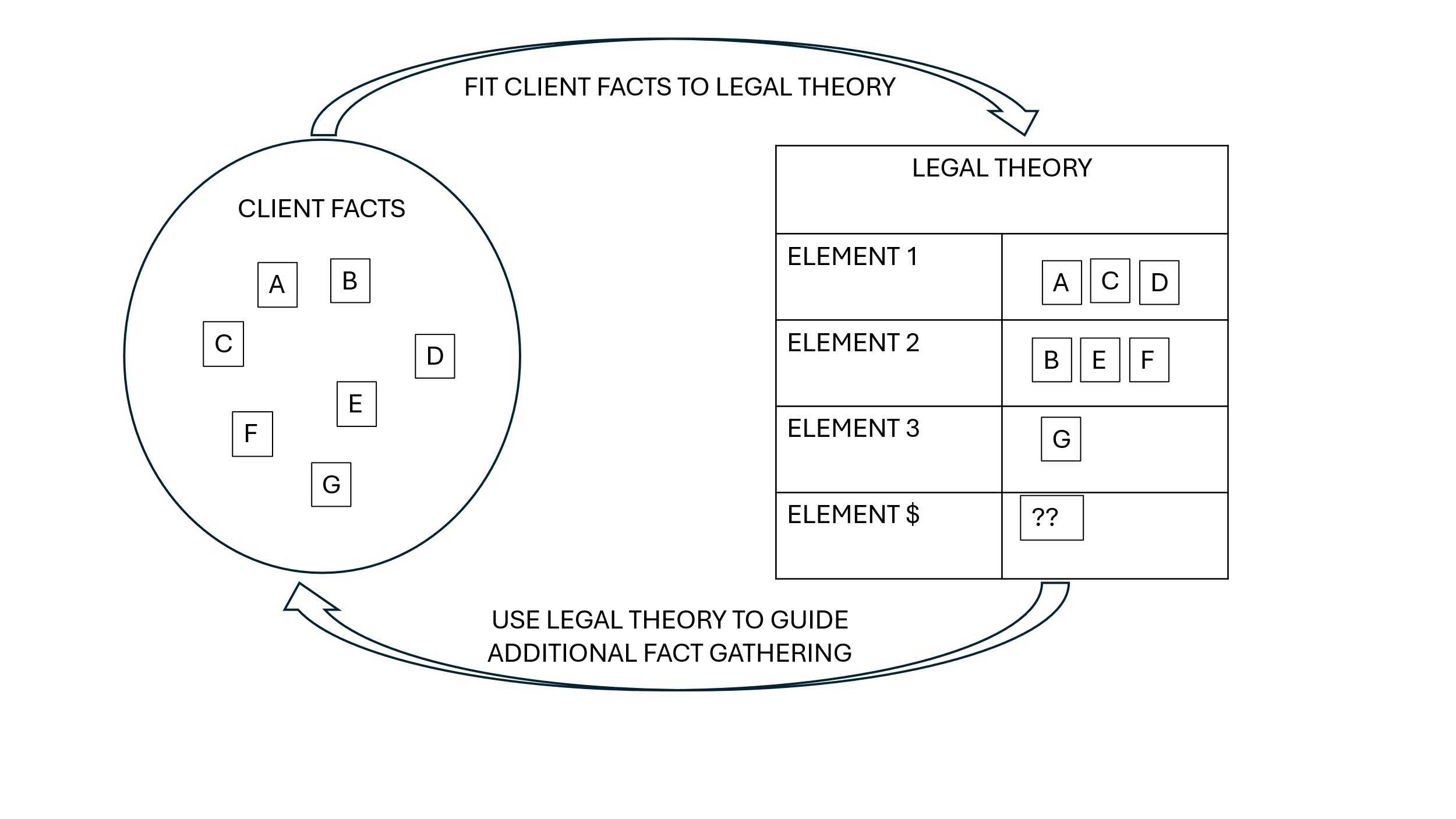
At the same time that you are gathering a basic set of facts regarding the prospective client’s situation, you will have begun to build a preliminary legal theory regarding those facts. The relationship between information gathering and legal analysis is not linear but cyclical. The questions you ask will be guided in part by your preliminary ideas about the possible legal issues; the possible legal issues you identify will then lead you to ask additional questions. This iterative process will continue throughout the representation as you translate facts into legal categories and that translation then leads you to search for new facts, which in turn may cause you to revisit your initial legal theory.
1. Issue spotting in the initial interview
In some ways, the initial client interview is like a traditional final exam. In both settings “issue spotting” is a core function of the attorney. Unlike law school exams, in an initial client interview you will not necessarily know in advance the area of law that the client matter will require, nor will you be given all legally significant facts in a neat package. Two of the most important transition-to-practice skills you must develop are the ability to identify relevant issues through the lens of many different areas of law and the ability to apply those legal principles to uncertain and undeveloped facts. Indeed, the NextGen bar exam emphasizes this skill by introducing “integrated question sets” that ask you to apply different areas of law and skills to a single problem and includes questions about fact investigation and research necessary to address that problem.
As you specialize your practice, most of your clients will bring you familiar legal problems. A domestic relations attorney will likely be focusing on the application of divorce or custody statutes. An estate planning attorney will give particular attention to the law of trusts and estates. A state public defender will be focusing on criminal law. However, even in specialized areas of practice, attorneys cannot assume that they know a prospective client’s legal issues before having thoroughly gathered the facts. The domestic relations client who seeks a divorce may also have tax, immigration, debtor-creditor, criminal law, or tort issues. The concerns of the owner or director of a company regarding their entity may include personal concerns for themselves as an owner. You must be able to spot the issues that are within the scope of your representation but also be able to identify those legal issues that may be present but that you will not address. The United States Supreme Court in Padilla v. Kentucky, 559 U.S. 356 (2010) held that that a criminal defense attorney has violated that client’s Sixth Amendment guarantee of effective counsel if the attorney does not advise their noncitizen clients that there may be potential immigration consequences of accepting a guilty plea. This is but one example of the many times that you must know enough about the law in general to recognize potential additional legal issues that may be outside the scope of your representation.
To translate your client’s facts into a legal framework in litigation, you will need to determine whether and how those facts can serve as evidence to prove each required element in a legal proceeding. Similarly, in a transactional matter you will need to consider how these facts can be incorporated into agreements and policies to achieve a specific transactional goal. Preliminary legal analysis is a necessary step not only for gathering relevant information, but for determining whether you can help your clients achieve their goals in a manner and at a cost acceptable to them. In litigation, you must help the client determine whether there is a substantive claim or defense. In a transactional matter, you must determine what agreements or structures can best meet your client’s objectives.
In conducting this legal analysis, you should ask three basic questions:
What laws apply? In the first year of law school, we learn that the law is divided largely into civil (torts, contract, property) and criminal law and we learn to read cases to identify the legal principles in these areas of law. However, much of the law that attorneys apply in their day-to-day practice is far more often statutory or administrative. Procedural law issues, such as filing or registration procedures, or statutory deadlines or limitations, can be the most critical aspects of a matter. You may not be able to gather all the necessary facts in the initial client interview to be able to complete your legal analysis; yet you will need to decide whether to represent a client in the face of this uncertainty. For this reason, you must be sure that you understand the client’s core problem, interests, and goals. You must be able to develop a sense for whether you are likely to be able to help the client, even though you will be uncertain about how the case or transaction will develop.
What jurisdiction? International, federal, state, and local laws can all apply to a client’s matter. Overlooking the jurisdictional aspects of a client’s matter is an easy step on the road to malpractice.
What solutions? Most clients do not usually care about the finer details of the doctrines that apply to their matter. They do care deeply about the outcome, however. Some outcomes the legal system can provide more readily than others. Accordingly, you need to understand well the opportunities and limitations of the law in solving problems and be able to help your prospective clients to understand these as well.
If a client is involved in litigation, the available remedies will as often as not determine whether to pursue a lawsuit or a settlement. Legal remedies, whether in civil suits or criminal cases, amount to two types of solutions. One solution is to require a wrongdoer to pay money, whether damages judgments in civil cases or fines in criminal cases. Money is nearly always merely a substitute for the actual harm an individual or society has felt. (The exception is when the harm is a loss of money—such as a theft—and the remedy is a return of that money.) Money cannot reverse the harm itself.
The other solution a legal system can provide is compulsion. In civil suits, courts can order parties to do or refrain from doing something through equitable remedies such as injunctions. In criminal matters, a court can order that an individual be paroled (perhaps with service or treatment obligations), incarcerated, or executed. These are powerful remedies, but they are not easily obtained. On the civil side, courts will not grant equitable remedies unless an order is necessary to remedy an irreparable harm that a damages judgment simply cannot begin to repair. Securing criminal penalties of incarceration or death requires overcoming substantial constitutionally guaranteed protections.
The bottom line is that the law is a blunt instrument to solve the myriad matters clients bring to their attorney’s offices. A wider variety of solutions may be crafted through negotiation or other alternative dispute resolution processes. Some clients can use self-help to address disputes; others should never turn to do-it-yourself solutions. Sometimes the greatest assistance you can provide a client is to give them hard truths about their options.
On the transactional side of practice, business clients want to accomplish their goals and are less concerned about the details of how the law will get them there. Transactions offer complex relationship questions. The law provides default rules for many of these questions and attorneys in these areas need to help their clients make the decisions about how much certainty they desire, how much customization they need, and how many transaction costs they can afford to get to that certainty and customization. Likewise, attorneys assisting clients with compliance issues face similar questions of scope and cost in selecting services.
Much of the legal analysis you will conduct during a client interview and counseling session is not something that you will share with the client explicitly. However, this ongoing legal analysis is essential to complete fact gathering and effective counseling.
2. Naming, blaming, and claiming
An attorney thinking about how the client’s facts translate into specific legal rights and obligations will necessarily also be thinking about the scope of their possible representation regarding those rights and obligations. This is especially so when a client brings a dispute to the attorney’s office. The attorney can play a powerful role in shaping the nature of the legal matter that the client is facing. Over forty years ago, Professors Bill Felstiner, Rick Abel, and Austin Sarat published a highly influential framework for understanding how disputes emerge and transform.[6] They described this process as a process of “Naming, Blaming, and Claiming.” Naming occurs when someone realizes that they have been hurt. They then may turn to Blaming another party or cause for that injury. Finally, Claiming occurs when the person asks that third party for remedy. If the remedy is refused, a dispute emerges. The framework views each stage as subjective, unstable, and incomplete. When a client comes to an attorney with a dispute, the attorney must revisit this process with the client through the lens of the law.
First the attorney must assist the client in naming the problem or grievance. The client must name the loss they fear or the gain they hope to achieve through the representation. The attorney then reframes the client’s concerns in legal terms or as a potential legal issue. The attorney may broaden or narrow how the client names their injuries. The attorney will assign legal categories to the client’s problem or injury. This process may broaden or narrow the client’s matter. If the law provides multiple ways of characterizing a right or wrong, the attorney and client must determine which of these theories best meets the client’s goals.
The law also may lead the client to reframe the nature and extent of their injury or consider the extent to which others share the same injury. For example, a client may be focused solely on their immediate injury and not recognize longer-term losses. A client may be focused on solely emotional harms without considering financial implications or vice versa. What losses has the client incurred or allegedly caused? What wrongful gains might have resulted from the wrong? Who else might have been injured who might support or compete with the client’s claim?
For example, suppose your client is a farmer who believes that their neighbor has intentionally discharged environmental waste onto the client’s land. The law may classify the chemical that was dumped as toxic waste or perhaps the injury would be better characterized as simply a nuisance or trespass. The legal characterization will require framing the client’s losses. The farmer may be focused on the costs of his own single crop failure. However, the attorney may ask the client about the costs and risks of an on-going threat of environmental damage, the psychological and aesthetic losses of damaged land, or the profits the tortfeasor made by not having to dispose of their chemicals properly. The attorney might consider whether the client’s injury is part of a collective injury to all the farmers downstream from the spill. The client’s injury alone may not be financially significant enough to justify legal action. That calculus may change if the client’s losses are aggregated with others who have suffered the same or similar injuries. As you can see, then, by naming who has been injured and how they have been injured, the attorney can substantially narrow or broaden a client’s matter.
Second, through the blaming process, the attorney and client will consider who or what is responsible for the client’s current or future injuries. From a legal perspective, this means considering the possible targets for claims for remedies. Here, too, the attorney may cause clients to revisit their initial targets for responsibility for injuries. Sometimes the client may not know whom to blame. Sometimes the client has a target, but that target isn’t necessarily the only or best target for getting a remedy. In this process of assigning blame, the attorney may lead the client to narrow, broaden, or change the target to be blamed.
For example, a litigation client may want to bring an action against someone who is unlikely to be able to satisfy a judgment, not recognizing that others may bear equal or greater responsibility for the injury and also may be in a better position to provide a feasible remedy. Reframing the dispute to target individuals or entities with significant wealth or insurance coverage can be a legitimate counseling strategy, assuming, of course, there is a reasonable basis to believe that the targeted party bears some legal responsibility for the harm. If a party is included in a lawsuit solely because of their financial resources, without a legitimate legal claim, this can lead to sanctions or penalties against the attorney and the attorney’s client. In our environmental tort example, the farmer might blame the company that dumped the chemical. Yet it may be that the chemical producer is a better target in terms of financial recovery, or the EPA is a better target in terms of getting some clean-up assistance.
Just as an attorney may broaden the range of individuals in this blaming process, so too, an attorney may narrow the client’s targets. It is not uncommon for clients to have blamed individuals or entities for which there is no legal recourse available. Attorneys in these circumstances must dampen their clients’ unrealistic hopes.
Third, the attorney and client will together consider how they might make a claim against those blamed for the injuries named. Even if there are feasible legal claims against multiple targets for a range of different injuries, an attorney may focus their client’s attention on the most critical issues or strongest claims, thereby narrowing the dispute. Attorneys might encourage clients to settle disputes out of court or use ADR methods like mediation or arbitration, which can limit the scope and intensity of the conflict.
While the Naming, Blaming, and Claiming model focuses on disputes that could result in litigation, the same framing of goals, parties, and strategies can apply to transactional matters. When assisting a client with future planning or negotiations the client must still name their outcome or goal that they hope to achieve. This might be a financial target or a relational or reputational gain or repair, or even simply a clarity of position. In counseling the transactional or compliance client, this process of “naming” focuses more on potential future gains and losses rather than the past. The tax clients may want to know how to structure their business or personal finances to avoid or minimize future tax liability. The estate planning client may have similar tax interests but may have even greater interests in avoiding probate, ensuring that their final wishes will be respected, or reducing conflict after their death. The business client may be seeking ways to secure gains and stability as they structure their business, protect their trade secrets, manage their employees, and more. The attorney will need to clearly identify the client’s goals to know whether the attorney can realistically assist the client.
Likewise, in a transaction, the client may have a preliminary idea of where, how, or who should be involved in their plan, but may have overlooked other individuals or avenues to achieve their goals. Counseling the client means helping the client to recognize and think through this planning process. The process of translating the client’s facts into legal frames can broaden or narrow the planning process, just as it can broaden or narrow a dispute. Especially in transactional matters, narrowing a client’s matter generally simplifies and speeds up the transaction, focusing on specific goals, whereas broadening can protect clients’ broader interests and provide more comprehensive strategic benefits. Attorneys must carefully balance simplicity and expediency against thoroughness and risk management based on each client’s unique circumstances.
The power of an attorney to influence how a client frames their legal matters is one that is rife with the opportunity for self-dealing. Unethical attorneys can aggravate rather than resolve disputes in the interests of generating fees. Likewise, attorneys might unduly narrow a matter in order to make their representation possible rather than needing to refer the client elsewhere or bring in co-counsel. These personal influences may not even be conscious choices but simply the blinders of self-interest that we all carry with us if we do not stop to consider an outside perspective. Accordingly, in translating a client’s matter through a legal lens, you must always thoughtfully consider how your own interests intersect with the client’s interests and ensure that you are maintaining the proper balance of authority and decision-making.
When reframing a client’s matter, attorneys must thoughtfully choose whether narrowing or broadening better aligns with the client’s emotional, financial, and practical short-term and long-term goals. Narrowing a dispute may expedite resolution and minimize client stress, while broadening could maximize compensation, accountability, or broader systemic change. Similarly, narrowing a transaction may permit a client to capitalize on near-term opportunities and efficiencies while broadening the transaction may minimize long-term risks and avoid opportunity costs.
Consider a client who characterizes their matter as “My husband died in a car accident when a drunk driver crossed the median and crashed into him.” How might an attorney narrow the injury (naming), the parties (blaming), and the method of relief (claiming)? Consider these examples:
- Narrowing the injury:
“We might narrow the claim to focus specifically on the wrongful death claim, clearly defining damages directly linked to your husband’s death, such as funeral expenses, loss of income, and emotional distress directly resulting from the loss.” - Broadening the injury:
“In addition to the wrongful death claim, we might include a claim for punitive damages due to the driver’s reckless conduct, potentially increasing the compensation you might receive.” - Narrowing the parties:
“We could focus solely on suing the drunk driver who directly caused the accident, particularly if the driver’s fault is clear and liability insurance coverage is adequate.” - Broadening the parties:
“We could examine whether other parties contributed to the accident—for instance, the bar or restaurant that served the driver alcohol (dram shop liability), the city or state if road safety measures were inadequate, or the vehicle manufacturer if vehicle safety features failed.” - Narrowing the method of relief:
“We might seek relief strictly through settlement negotiations or mediation to achieve a faster resolution and minimize emotional distress for your family.” - Broadening the method of relief:
“We might pursue both civil litigation and advocacy through public forums or legislative channels to push for tougher DUI laws or improved roadway safety to prevent similar tragedies.”
Skills Practice
Complete this same exercise for the following clients:
Self Evaluation
Review this chart on the components of effective interviewing behaviors. Download a PDF of the chart. Rate yourself on a scale of 1-3 for each:
|
|
Effective |
Rating |
|
NON-VERBAL BEHAVIOR |
|
|
|
Listener looks bored, uninterested, or judgmental; avoids eye contact; displays distracting mannerisms (doodles, etc.). |
Listener maintains positive posture; avoids distracting mannerisms; keeps attention focused on speaker; maintains eye contact; nods and smiles appropriately. |
|
|
FOCUS OF ATTENTION |
|
|
|
Listener shifts focus of attention to self: “When something like that happened to me, I….” (Attention focused internally, thinking how you would feel, respond, etc.) |
Listener keeps focus on speaker: “When that happened, what did you do?” |
|
|
ACCEPTANCE |
|
|
|
Listener fails to accept speaker’s ideas and feelings: “I think it would have been better to…” |
Listener accepts ideas and feelings: “That’s an interesting idea, can you say more about it?” |
|
|
EMPATHY |
|
|
|
Listener fails to empathize: Ignores emotions or concerns; assumes rather than exploring; expresses judgment (“I don’t see why you felt that…”) |
Listener empathizes: “So when that happened, you felt angry.” |
|
|
QUESTIONING TECHNIQUE |
|
|
|
Attorney interrogates clients or uses question forms in haphazard fashion. Attorney closes information gathering prematurely and uses primarily closed-ended and leading questions. |
Attorney uses questions most appropriate for purpose and client, asking about one topic at a time. Attorney prefers open-ended questions to gather information and direct or closed questions to facilitate disclosures, explore gaps or inconsistencies, or check understanding. |
|
|
PROBING |
|
|
|
Listener fails to look for gaps or inconsistencies, fills in with assumptions, or fails to follow up and probe for details. |
Listener probes in a helpful way (without cross examining client): “Could you tell me more about that? Why did you feel that way?” “A few minutes ago you said…”
|
|
|
PARAPHRASING |
|
|
|
Listener fails to check the accuracy of communication by restating in his own words important statements.
|
Listener paraphrases at the appropriate time. |
|
|
SUMMARIZING |
|
|
|
Listener fails to summarize.
|
Listener summarizes the progress of the conversation at key transitions and asks for confirmation.
|
|
|
STRUCTURE AND SIGNPOSTING |
|
|
|
Attorney fails to structure questions in a logical fashion or communicate that structure to the client. |
Attorney organizes fact gathering in a way that effectively gathers critical details and communicates to the client when moving from one topic to another. |
|
Rate yourself on each of the components. Ask your classmates to observe an interview and provide a rating. Develop a plan for improvement.
Chapter Seven Endnotes
- Robert Rubinson, Constructions of Client Competence and Theories of Practice, 31 ARIZ ST. L.J. 121, 153 (1999). ↵
- JOHNATHAN HAIDT, THE RIGHTEOUS MIND: WHY GOOD PEOPLE ARE DIVIDED BY POLITICS AND RELIGION (2012). ↵
- Chris Skurka, et. al, All Things Being Equal: Distinguishing Proportionality and Equity in Moral Reasoning, 11:3 SOC. PSYCH. & PERSONALITY SCI. 374 (2020). https://doi.org/10.1177/1948550619862261 ↵
- For example, the category of “purity” in particular has been criticized as a specific moral domain because it is too loosely defined and separate from other values in that it does not include interpersonal harm. Kurt Gray, et. al, The Problem of Purity in Moral Psychology. 27:3 PERS SOC PSYCHOL REV. 272 (Aug. 2023) doi: 10.1177/10888683221124741. These same authors have argued that the relationships between values and emotions are better characterized as overlapping circles rather than directly linked associations. Kury Gray, Chelsea Schein, & C Daryll Cameron, How to think about emotion and morality: circles, not arrows, 17 CURR OPIN PSYCHOL. 41 (Oct. 2017) doi: 10.1016/j.copsyc.2017.06.011. ↵
- https://yourmorals.org. ↵
- W.L.F. Felstiner, et. al., The Emergence and Transformation of Disputes: Naming, Blaming, Claiming...” (1980-81) 15 L. & SOC’Y REV. 631. ↵