
Chapter Five – Preliminary Fact Gathering
Learning Objectives
After working through these lessons and practicing the skills presented, you will be able to:
- Use open-ended questions and minimal prompts to elicit client narrative.
- Take notes in a way that accurately captures information without interfering with communication.
- Recognize different ways to frame questions and be aware of the advantages and disadvantages of each.
- Use active- and reflective-listening techniques, including paraphrasing and reflection to encourage disclosure, communicate nonjudgmental acceptance, and check accuracy.
- Recognize, name, and manage the emotional aspects of the problems presented and the force of those emotions on decision-making.
In this chapter, we will focus on the skills needed during the middle part of the interview in which the attorney will be gathering details from the propsective client.
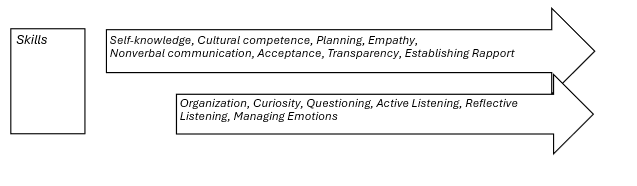
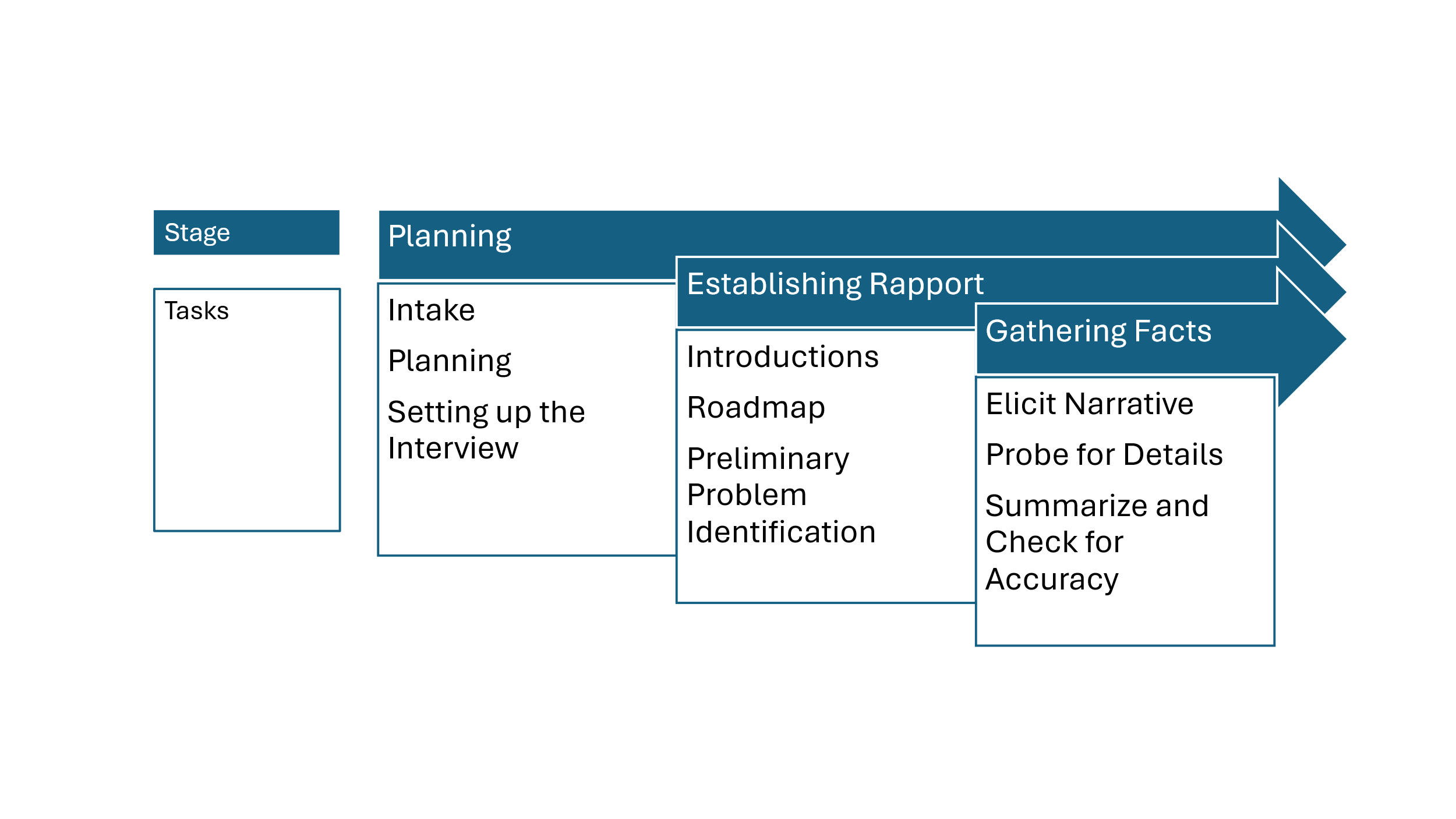 In terms of the skills that are especially important in this part of the interview, we will focus in particular on taking notes, asking questions, and listening and reflecting back both content and emotion.
A. What are the components of the information gathering part of an initial interview?
Once you have set the stage for the interview proper, you can move toward getting the critical information for the client’s matter. Remember that your goal in gathering information is to form a picture of the client and their matter that is sufficiently complete to allow you to determine whether this is a representation that will be mutually beneficial and what types of solutions you might be able to offer.
For an efficient interview, you will want to work from general to specific. Start with identifying the primary topic or concern that has brought the client in to see you. Then, using open-ended questions and prompts, you will gather the general information about that matter. Finally, you will go back over the information the client has provided and ask questions about specific details.
If you have information about the client’s matter from your intake process, you can begin by simply repeating that information. “I see that you are here today because you would like to make a will.” Or “I understand that you are concerned about a competing company stealing trade secrets.” Alternately, you can ask the client to identify the topic(s) for the meeting by asking an open-ended question such as, “What brings you in today?” or “How can I help you?” This approach invites the client to select the details about their situation that are most important to them.
Once you have the major topics or concerns identified, you can then request a more complete description of the client’s matter. Give your client some guidance on how you want them to provide you with this more detailed information. Be explicit about your need for detailed information without the client editing themselves. “The more details you can give me about your situation/plans/problem, the better I can help you. So don’t worry about whether information is relevant or helpful, just tell me as much as you can.” At the same time, you should explicitly warn the client not to fabricate information or guess at answers if they simply don’t know. You might say, for example, “If you don’t know or don’t remember, that’s okay. Just say so.”
For a matter that involves a past event—primarily in disputes—a chronological summary of the dispute can be helpful. “Start at the beginning.” “Walk me through what happened…” At the same time, if you are working with the client to recall past events, you can enhance both their recall and their disclosure by reminding them that you want them to describe their situation in any order that comes to mind.[1] In criminal defense practice, a neutral but open-ended question to begin fact gathering would be to ask what the police are saying happened. The client will tell you what they want you to hear about their involvement in the charged crime. This approach avoids your suggestion that the client was indeed involved in the criminal activity.
For transactions or advising on future actions, you are more likely to start with their objective or goal and then ask for a more detailed description of their planned transaction or relationship. While focused on future planning, you will want to gather detailed information about any steps the client has already taken toward their goal, whether that is research, conversations, investments, or other action.
Some clients may provide a fairly complete narrative of their situation in response to an initial question.[2] However, be aware that not all clients will be comfortable providing a narrative response and you will need to use narrower questions and more explicit prompts. “In cultures which discourage self-disclosure, such as some Asian or Latino cultures, an interviewer expecting the client to provide a narrative tale may be disappointed. Once again, there is the accompanying risk that the lawyer will perceive a client who does not participate in the narrative, revealing process as difficult, dishonest, or uncooperative.”[3] Remain flexible and vary your questions according to the client and the context.
Keep in mind that this initial narrative is more important for identifying the overall issues and topics you want to explore in more detail than it is for getting the whole story. You will necessarily need to go back over the narrative to confirm facts, fill in gaps, and gather details.
Do not interrupt the client as they begin their narrative. Attorneys are far too quick to assume they know where the client’s story is headed and to cut off the client. Interrupting and narrowing inquiry leads to premature closure of the information-gathering stage. In contrast, in most instances, permitting the client to provide an uninterrupted narrative provides more complete and accurate information in the most efficient way possible. Of course, there may be times when you may need to cut short a client’s narrative. As a general rule, however, you should encourage a client’s open narrative response. This is not only important for making sure you understand the client’s entire situation; it also is important for reinforcing a rapport and building a relationship of trust. Creating a questioning dynamic in which the client feels like they are being cross-examined is not likely to build a relationship of trust.
As we mentioned previously, it will be important to be attentive to providing nonverbal encouragement to your clients (head nods, facial expressions showing attention/engagement, etc.) so that they feel heard.
Pay particular attention to the first statements the client makes and any statements or characterizations that are repeated. You will likely have many questions about the details of what the client is saying, but, unless clarification is absolutely necessary to understand the client’s narrative, save your curiosity until the client has come to a stopping point.
Early on in problem identification, you will also want information about the client’s expectations. Thus, a critical question in any initial interview is simply: “What do you want?” (Or variations on that theme such as “What do you expect to get from this action?” or “What do you hope I can do for you?”) As you move into the counseling phase of the relationship, you will revisit this question, but asking this question early in the interview can identify clients with unrealistic expectations—who want something the law cannot provide or who expect results to be obtained in an unrealistic manner, timeframe, or cost. Exploring objectives can also reveal client motivations that you would prefer to avoid (such as the client whose primary goal is angry revenge). Finally, this question can identify those “expert” clients who not only know exactly what they want but believe they know exactly how you should be accomplishing those objectives.
To some extent, starting the initial interview with an open question should not be that difficult. Indeed, many attorneys may develop a set of stock open questions that they use at the beginning of most interviews. Continuing to use open questions as this initial information gathering part of the interview unfolds can be more challenging. You are likely to want to clarify ambiguity, flesh out a situation, fill in gaps, or otherwise gather certain information that you know is likely to relate to the legal issues implicated in a given situation. This may lead you to begin asking direct or closed questions targeting this specific information.
While this can be okay and indeed may be appropriate when a client has left out relevant information or has described something in an ambiguous way, this shift to closed-ended questions has the potential to be a slippery slope that results in falling into a pattern closer to interrogation than conversation. Thus, until you are confident the client has had a chance to tell their whole story, focus on continuing to prefer open questions unless there is a good reason to do otherwise. When you have interjected a direct or closed question to clarify a specific ambiguity or fill a critical gap, return to open questions.
For example, if the client is telling a roughly chronological story about what happened between leaving a bar and getting into an auto accident and fails to describe who was driving the car as she and her friend left the bar, it might be entirely appropriate to interject a direct question: “Who was driving the car when you left the bar?” But then to make sure that you return to the roughly chronological story, it probably makes sense to follow up the response by using an open question: “What happened then?” or “What happened next?” This will likely generate more useful information than a series of closed questions in which you ultimately end up guessing at other information that you hope is relevant and helpful. You will have an opportunity to revisit the details of each part of the client’s matter in the middle phase of the interview. Your ability to gather relevant details efficiently and effectively depends on gaining a clear overview of the problem through this initial information gathering.
B. Why and how should you take notes during an interview?
There are two primary reasons to take notes during an interview. One is to accurately capture information from the interview. Few people are able to accurately recall the details from an interview without some form of notetaking. Taking notes reduces memory decay and helps you to recall other content from the interview. The second purpose of notetaking is to help to organize your interview. Many times, while a client is speaking, you may have a question or topic for follow-up. Rather than interrupting or side-tracking the narrative, you can simply note these questions and topics for later follow-up. Notes help you to reflect the speaker’s content and identify gaps and inconsistencies that need to be addressed. Some attorneys actually use two different notepads or windows to separate information from questions or reflections.
Before you jump into taking notes, however, think about the impact of notetaking on your client. You may be motivated to start taking notes as soon as the client begins speaking, but it is far better to simply sit and actively listen to the client, undistracted by writing or typing and focusing on establishing rapport and encouraging recollection and disclosure. Once you have an overview from the client, you can turn to recording information. For most clients you should ask for permission to take notes (e.g., “would it be okay now if I took some notes?” or “I’m just going to jot down a few points as we talk if that’s alright.”) Some clients may be worried about what might happen with notes, so you can assure them that your notes are kept strictly confidential. As you take notes, avoid becoming a stenographer and trying to write down everything that is said. Notetaking can interfere with listening, drawing your attention away from your client to your notes and your own thought processes. Moreover, the physical process of taking notes can distract both speaker and listener alike. Excessive attention to notes implies that your notes are more important than your client.
The stronger your listening skills, the less need for extensive notetaking. Why? Because if you truly understand a message, you will need only a few key words to trigger that understanding. Some details are more important to write down than others. If there are names, make sure you have the full name and have spelled it correctly. Write down the exact words of key conversations and put in quotations. Two details that can determine outcomes are locations (jurisdiction) and time (statutes of limitations). Make sure you ask about these details early on and ascertain how certain the client is that they are correct about these. If a detail is especially important and the client is speaking too fast, don’t be afraid to say, “Please give me a second; I want to write that down.”
For the majority of the interview, however, you should listen first—summarizing the message in brief notes—and then review and expand on the notes when the speaker has finished speaking. How to achieve the balance between the need to record information and the need to actively listen to the speaker is one of the great balancing skills in active listening for the professional. Never let notetaking interfere with communication. Better to take a few minutes after the interview ends to go back over the notes to fill in details while your memory is fresh than try to create extensive notes while you are trying to listen to the client.
What about recording a conversation? Wouldn’t this be the best method to preserve all the information in your interview? It might, but it is certainly not efficient, because it simply delays the process of extracting relevant information from the interview. A voice recorder does not provide the other benefits of notetaking as a tool for analysis and structure. Attorneys who are recording an interview may be less present and attentive to client cues, relying on the availability of the recording to fill in gaps in attention. Finally, voice recordings are subject to legal regulation and ethical constraints. Even without these, surreptitious recording is not a good first step for building a trusting relationship. Accordingly, you need to ask a client’s permission to record your conversation. For many people, knowing that every word is recorded inhibits the free flow of their narrative and raises concerns of security of information. It would be the rare circumstance in which a recording would be a good idea.
Should you take notes on a computer or by hand? For most attorneys, handwritten notes have many advantages. A computer screen can set up a physical barrier between you and your client. The sound of keys tapping can distract. If you are a very fast typist, your ability to “transcribe” the conversation can lead you to take more notes than are necessary and think about what the client is saying less. Flipping back and forth between pages is more time-consuming and difficult on a computer than with paper. If you are a highly visual learner, computers do not easily provide the platform for mind-mapping, drawing charts, or other tools that you might choose to use. Finally, some clients may be concerned about the security of your notes when you are taking them on a computer. It is difficult for someone to “hack” your paper note pad, or for you to inadvertently send your paper notes to someone else. You certainly will want to have a system to either transcribe your notes to electronic form at a later date or otherwise preserve them securely. Overall, for most attorneys, taking notes by hand is the best way to interact with a client. Technology increasingly provides ways to address some of these issues. For example, journalists sometimes use recording pens, which not only provide a voice recording but also transfer the written notes as page scans to a computer. Most AI tools can now convert a scan of handwritten notes into editable text.
As with any new tool you consider, however, you should always weigh the benefits in terms of your goals and the effect that tool might have on the process of interviewing. Many attorneys use checklists to help manage their notetaking, particularly in initial client interviews. The advantages are obvious—a checklist will ensure that you do not overlook key information and provide an organized method for proceeding through the interview and for recording information. There is a significant danger with checklists, however. A checklist assumes that you have correctly identified the client’s issue. Moving too quickly to use the checklist can result in missing the bigger picture. In some instances, the legal context of a client’s matter is fairly clear from the beginning —a client wants to form a business, get a divorce, plan an estate, or resolve a dispute. A checklist can be very helpful in gathering the required information in these cases.
The biggest danger of relying on checklists, however, is that filling in the checklist can soon become the entire focus of the interview—rather than understanding the client, building rapport, and getting the entire story. Writing down an “answer” to an item on the checklist has a sense of finality (“check, done, next question…”) that can interfere with your curiosity or your incentive to follow up on responses, seeking clarification or amplification. Remember that the purpose of the initial interview is to gather enough facts about the client and the matter to determine whether representation is a good idea. You need not gather every detail in the initial client interview in order to make that determination, but you do have to have a clear picture of the client’s issues, expectations, and goals.
The best time to use a checklist is before the interview—to review the kinds of questions and information you want to cover and perhaps even to give to the client to complete before the interview begins—and at the end of the interview. Rather than consulting the checklist during the interview, concentrate on the conversation and the relationship. Then at the end, you can consult the checklist to see if there is anything else you have overlooked and even to use as a tool to reflect back to the client the content of the interview.
Whether you use separate pages, capital letters, visual boxes, numbers, or some other method, organize your notes as you take them. As a client’s narrative unfolds, certain categories of information will emerge: relationships, incidents, actions, or motivations for example. For each of these, you will want to probe for more details about that topic. If your notes provide room to expand on topics and clearly label the topics you are working with, you can more easily structure the interview and avoid missing key aspects of the situation. Use flags such as underlining, circling, question marks or stars, to help you to remember topics you want to ask more about or that are especially important to explore.
Sometimes the most useful notes are visual rather than verbal. To understand timing and sequence of events, a timeline of some sort can be especially helpful to clarify when events took place and for identifying gaps in a story. You can even ask a client to draw a timeline during the interview if the sequence of events is especially complex or difficult to understand. To understand relationships among people, organizational or family relationship charts can be used to not only identify all parties and their relationship but to discuss them with the client. Psychologists often use a “genogram” which is a graphic representation of family relationships that can be used to visualize hereditary or behavioral patterns and emotional relationships. Charts, diagrams, and mind-maps are all different ways of taking notes that reflect visually the relationship among ideas. If you are especially visual, you will likely develop your own methods that help you to structure an interview and record information. The key is to develop a method that works well for you—there is no single “best” way to take notes during an interview.
Once an interview has ended, take a few moments to review and complete your notes. Professor Gretchen Viney suggests the following criteria for making sure that your notes are complete and useful. Good notes:
- Are legible and can be easily reviewed,
- Are dated,
- Fill any gaps between the prior client meeting and this client meeting,
- Contain the lawyer’s impressions of the current situation, keeping in mind that the client, or subsequent counsel, may read those impressions, and
- Contain a notation about tasks arising from the meeting and deadlines for those tasks.[4]
Generative AI tools can be used as part of a post-interview process of organizing and analyzing your notes and other products of investigation. These tools can categorize client statements into relevant legal categories, identify patterns or gaps, and flag potential legal issues raised during the conversation that might require follow-up questions. The tool might generate timelines or relationship maps to better understand complex factual scenarios.
Despite all of these potential benefits, using generative AI tools for organizing and analyzing interview notes raises additional concerns. Most generative AI tools will require transmitting this data to external servers. This poses questions regarding confidentiality and even the potential loss of attorney-client privilege. Client information could potentially be incorporated into the AI’s future training data unless explicit safeguards exist. Unless you are sure that your client’s information is protected when using AI, you should inform the clients of the tool, its uses, and its risks, and obtain the client’s consent.
Perhaps an even greater threat from using generative AI to organize and analyze interview notes is the threat to the attorney’s judgment. AI might misinterpret nuanced legal issues or client statements, but attorneys might defer to the AI analysis rather than exercising independent judgment. The ethical challenge is finding balance—leveraging AI’s efficiency benefits while preserving the uniquely human aspects of legal judgment. You must always remain the true analytical engine, using AI as a tool subject to professional scrutiny, rather than becoming an uncritical executor of machine-generated guidance.
C. How do you use different types of questions to owHowHow do you effectively gather information?
As you move from the general problem identification to more detailed investigation, you must be able to use questions that will facilitate gathering details. For most circumstances, keeping questions open-ended will be the best approach to gathering the most information. However, as you move toward filling gaps, resolving inconsistencies, or clarifying ambiguities, direct or closed-ended questions may be more effective. Leading questions and compound questions are rarely effective in gaining accurate and complete information.
1. Using open-ended questions
What is an open-ended question? How is it different from a direct or closed question? An open-ended question is a question which does not invite a yes or no response or a specific response of any sort. An open-ended question invites a narrative response. “What happened?” “Why?” “Can you describe…” Often prompts function as well as open-ended questions. “Tell me about that…” “Help me understand…”
Open-ended questions can ask about facts, but also about assumptions (“Why do you suppose…”), feelings (“How did that make you feel?”), or attitudes (“What would you like to see happen?”). Open-ended questions and prompts can facilitate establishing rapport, gathering information, and generating thoughts, while also helping you to refrain from “filling in” gaps with assumptions.
Consider the following questions:
- “Was the light green as you approached the intersection?”
- “What color was the light when you approached the intersection?”
- “Tell me what happened and what you saw as you approached the intersection?”
The first question is an example of a closed question because it defines the range of responses—yes (the light was green) or no (the light was not green). Notably, the question may or may not elicit any additional information. (The client might answer by saying: “No. The light was yellow.” But there is some risk that the client will simply answer: “No.” To learn more you likely will have to ask more questions.)
The second question is an example of a direct question. It calls for a specific answer—green, red or yellow—but does not artificially confine the answer to a set of possible responses contained explicitly within the question. While it advances knowledge modestly more than the first question (because you should definitely find out whether the light was red or yellow if it was not green), it nonetheless limits the options the client has in answering the question (the client is only directed to describe the color of the light) and tells you nothing else about the intersection and what else was happening as the client approached the intersection.
By contrast, the third question is an example of an open question. It does not elicit a yes or no response at all and does not greatly constrain the scope of the client’s potential answer. Rather, it invites the client to describe in narrative fashion what the client recalls about what happened and what the client saw as the client approached the intersection. It is likely to elicit much more information than either of the first two questions.
Skills Practice
Suppose you are meeting the owner of a business who has an employee who has been in conflict with fellow employees. Practice turning the following direct and closed questions into open-ended questions.
Why is it generally important to prefer open questions at the beginning of the fact-gathering stage of the interview, rather than a direct or closed question? There are several reasons for beginning with an open question.
First, the open question gives the client control of the floor or control of the dialogue. This should be somewhat comforting to the client who might be anxious about meeting with an attorney and therefore may help establish a favorable rapport with the client. In addition, the use of open questions implicitly communicates to the client that the client’s assessment of the situation is important. The use of open questions, therefore, helps to reinforce the point that the client is a coequal participant in the relationship with you.
Second, the open question gives the client the opportunity to focus on those points that are most important to the client (which should give you a better sense of both the type of dispute or transaction and the emotional or non-legal concerns of the client). Even though the intake form provides some context, the nature of the questions on the form may unduly narrow the client’s concerns. By starting with an open question (or a series of open questions), you can be more confident that you understand your client’s matter in several respects—the legal problem or proposal, emotional concerns, and practical concerns. In response to a series of open questions at the commencement of the interview, a client likely will talk about those things that have caused the client the most concern—that have weighed on the client over the last several days or weeks. You can then be more confident that you understand both the nature of the legal matter about which the client is concerned and the nature of the client’s emotional and/or practical concerns.
Third, the use of open questions may elicit information that is of significance to the client’s situation but may not have been a focus of your questioning (if you had engaged in a series of direct or open questions), particularly if you had narrowed your questions based on the description of the matter set forth in the intake form. Open questions, therefore, help minimize the likelihood that you will prematurely constrain the focus of the interview.
Fourth, because open questions invite a narrative response, their use provides you an opportunity to assess how articulate the client is and what the client’s understanding of the legal situation happens to be. This can be important information in assessing the way in which a client might be perceived in litigation or negotiations. This also permits you to determine the sophistication with which you can discuss the legal aspects of the client’s situation.
In contrast, consider the likely consequences of starting an interview with a series of direct or closed questions. These questions likely will create a dynamic in which the client believes his appropriate role is to be responsive rather than assertive. Again, this is an example of ways in which we communicate implicitly to clients. By asking direct or closed questions, the message we communicate to the client is that we know what is important and will ask them questions about what is important. Their role is simply to respond to the questions they are asked. This may lead them to believe that information they were inclined to share, but about which they were not asked, must not be important. As a result, we may fail to obtain important information because our narrow questions do not elicit the information and because the client is discouraged from sharing information that is not specifically requested. This may be true with respect to both factual information relating to the legal claim as well as practical and emotional concerns that may impact the client’s assessment of the situation. The failure to gather this information can significantly impair the ability to fully understand and correctly analyze a client’s situation.
A series of direct or closed questions also may interfere with the effort to establish a favorable rapport. Using these closed questions at the start of an interview can make clients feel defensive, like they are being cross-examined. To some extent this is related to the first point. The attorney-client relationship is one in which it is easy to fall into a power imbalance in which the attorney is the authority figure and the client is subservient. While an authoritarian approach may sometimes be appropriate, you should recognize how readily some clients surrender control to lawyers, especially if you rely too heavily on direct or closed questions in the early portion of the initial interview. For those attorneys who want a collaborative rather than authoritarian relationship, open questions are better when beginning the interview.
This is not to suggest that direct or closed questions have no place in an initial interview. For example, suppose that Attorney Lee is interviewing a prospective client, Mr. Jones, about a potential breach of contract. In response to the attorney’s open-ended prompt to describe the situation that has brought Jones in, Mr. Jones has provided the attorney with an overall timeline of the dispute. Mr. Jones described the agreement that he had with a company regarding a supply contract. He explains how the contract was negotiated and some of the key terms of the contract, and then he describes that the services were not delivered as expected.
During this narrative, the attorney may notice gaps or ambiguity in information that makes it difficult to understand the situation being described. For example, when describing the “final agreement,” Jones hasn’t explicitly stated how this agreement was finalized (e.g., a signed document, email confirmation). Since a writing would be critical to determining whether the agreement is enforceable, the attorney might choose to interrupt in order to fill this gap before continuing:
Attorney: Mr. Jones, you mentioned a final agreement. Was this agreement in writing?
Jones: Yes, we exchanged emails, and they sent over a PDF document which I reviewed.
Attorney: Okay. What happened then?
Notice that the attorney used a closed-ended question to clarify a critical ambiguity and “fill in the gap” but then, to ensure she returns to the chronological flow of the story and continues to gather more details, the attorney returns to an open-ended question.
Suppose Mr. Jones then continues his narrative, explaining when the services were supposed to start and what went wrong. Later in his explanation, he mentions a conversation he had with a specific person at the company. However, he doesn’t clearly state the person’s role. Again, the attorney might find it especially helpful to identify to whom Jones was speaking, as that could affect the legal significance of the conversation or simply make it easier to follow the narrative. Notice how the attorney moves from a closed question back to an open-ended question to continue the narrative:
Attorney: Mr. Jones, you said you spoke with someone at the company. Do you recall that person’s name or their position within the company?
Jones: Gerald White, he’s the regional sales manager.
Attorney: Tell me more about that conversation with Mr. White. What did you discuss?
This is an example of cycling between open-ended questions and prompts and more direct questions in obtaining the client’s narrative. You might ask, “how often should I interrupt with specific questions?” The answer, of course, is “It depends.” How critical is the detail you are asking about to understanding the client’s narrative or assessing the significance of the facts? Is the client likely to be deterred from continuing their narrative if you interrupt? How easily will you move back to listening mode if you interrupt with a specific question? Remember that you can always go back and ask about details. Some attorneys star or circle topics in their notes that they want to go back to, rather than interrupt the client. You need to assess whether the cost of interrupting the client’s narrative is worth the details or clarity you gain.
The point is that at the beginning of the interview, you generally don’t need specific information. Rather you need to have a general understanding of the nature of the matter that prompted the client to contact you. Once you better understand the client’s situation and needs, to “fill in gaps” or “clarify ambiguities,” direct or closed questions become much more appropriate tools for gathering information.
2. Using direct or closed-ended questions
Direct or closed-ended questions are more like true-false, or multiple-choice questions. They can be answered briefly or by single word answers. “Was the window open or closed?” “Would you like this item delivered next week or the week after?” Closed-ended questions are efficient methods to confirm or clarify information or elicit more detail. For a client who is reluctant to talk, closed-ended questions can sometimes help to overcome resistance to communication. For example, a very nervous client might appreciate simply being asked to verify information from the intake sheet at the beginning of an interview. Closed-ended questions can also be used to stimulate memory as you ask a client to focus on particular details.
Attorneys will generally start exploring a topic with open-ended questions and then, as they begin to probe for details, may use more closed-ended questions. A common mistake by novice interviewers is to ask an open-ended question and then, without waiting for a response, narrow the possible response with a closed-ended question. “What was the weather like that day … Was it raining or dry?” You can think of open-ended questions like essay questions on an exam and closed-ended questions like multiple choice or true/false questions. Try to avoid turning a perfectly good essay question into a multiple-choice exam!
As you are asking about details, be sure to think about whether there are documents that would be helpful in the representation and let the prospective client know that you will need to see those documents to get a complete picture. For some representations, without being able to review a key document, you will be unlikely to make an informed decision about the representation. For example, if a client is concerned about a landlord’s threat to evict the tenant, a copy of the lease is critical. In criminal defense practice, a copy of the police report or charging document is often the place to begin the fact gathering.
3. Problematic question forms: leading and compound questions
Some question forms can lead to a variety of problems in an interview. The two most common forms to be avoided are leading questions and compound questions.
Leading questions are those questions that suggest a response. There are several ways in which a question might suggest an answer. Even an open-ended question might be leading. “What losses resulted from their late delivery?” Notice that this question suggests two facts—that a delivery was late and that losses resulted. If asked before either of these facts has been established, this is a leading question. Closed-ended questions or prompts are far more likely to suggest a response and thus be leading. A statement with a request for confirmation is very leading. “Of course, settling this dispute will be the best option, don’t you think?” Asking a question with limited options is often leading. Parents know the power of this technique to limit a child’s choice: “Do you want carrots or broccoli?” (when what the child really wants is ice cream). Beware in particular of using yes or no questions. A natural human tendency is to want to please, so asking a series of “is this true” questions may cause a client to answer yes to something that, if asked in a less leading manner, would not give the same response.
Leading questions are used most commonly in cross-examination, when an attorney is trying to put words into a witness’s mouth. To put words into the witness’s mouth, the leading question generally is structured as a yes/no question. For example: “So it would be fair to say that you were exceeding the speed limit.” In response, the witness either has to say “yes” or “no.” In the adverse possession context, an example might be: “You did not intend to claim some property that you did not have a deed for, but were just going to build a fence, is that right?” “Yes, I guess that would be right.”
Brief reflection on the purpose and context of the leading question should highlight why leading questions should be avoided in the initial client interview. When you ask a client a leading question—and puts words in the client’s mouth—you don’t actually find out what the client knows about the situation. Leading questions foster ambiguity rather than clarity and understanding. They may mask the real facts and create a situation in which you are assessing the value of a claim or the strategy for the representation on a flawed premise. In addition, leading questions “muddy” the truth because the client may begin to remember the facts as you have described them in the leading question even though your description may have be inaccurate. Finally, they create anxiety or tension in the client who feels like she is being cross-examined.
Leading questions can sometimes be used to overcome a client’s reluctance or to convey acceptance or normalcy of a situation. For example, rather than asking your client, “Have you ever used drugs?” if you already know that drug use has occurred, you can ask the more leading question, “When did you first use drugs?” Generally, however, leading questions should be avoided and only used carefully and intentionally.
Compound questions present a separate but similar problem. A compound question consists of two questions folded into one. The problem with combining questions is that it breeds uncertainty, confusion, and ambiguity. The client doesn’t necessarily know which question to answer, may answer in a way that isn’t accurate with respect to either question individually, or may simply fail to answer one of the questions. Moreover, the confusion created by the use of compound questions may erode the rapport. Ask one question at a time and let the client answer the question before you ask another question.
The lessons here are simple—avoid leading questions unless you have a very good reason to use them; avoid compound questions in all instances.
Check your Understanding
1. Can you recognize the difference between different forms of questions? Which type of question is each of the following?
2. Consider the following interview involving a client who is worried about liability for trademark infringement. Evaluate each attorney’s question and answer the questions that follow. What type of question form is used? Was this an effective technique? How might you improve the question? Flip each card to compare your analysis.
D. How and why should you develop the skills of active and reflective listening?
When you picture a lawyer communicating, what do you see? For most people, the picture tends to be of a speaker—the incisive questions in cross examination, the compelling speech in closing argument, the careful statement of position in a negotiation, or the sage advice to a client. This picture is perhaps understandable, given the orientation toward speaking in our society. Even the ethics rules on communication tend to focus on the importance of providing the client information needed for decision-making. Yet an even more critical and underdeveloped skill is that of listening. Before you can know what question to ask, what argument to advance, or what advice to give, you must have information about the person to whom you are speaking. You must listen.
All listening requires a set of discrete skills: whether you are listening to clients, colleagues, adversaries, or decision-makers. Like any skill, however, you will learn only through sincere practice. Luckily, the legal community gives you plenty of opportunities to practice—there’s always someone talking! Listening goes far beyond mere hearing (even though we say “I hear you” when what we mean is “I am listening to you.”). Hearing is a physical process but listening is a process of communication.
In this section, we will address the necessary conditions for listening. We will then discuss two components of effective listening: active listening and reflective listening. You may sometimes see these terms used as synonyms in other client interviewing materials. Here, we are using these two phrases to describe two different but important aspects of communicating with a client. Active listening refers to the way in which we receive information the client is sharing with us. Reflective listening describes the process by which we attempt to confirm with the client what it is that we have heard from the client. We will explore each of these in turn.
1. Necessary conditions for listening
Effective listening requires a combination of physical circumstances (the ability to hear and understand the message, a clear source of communication, and silence) and listening attitudes (empathy, motivation to receive the message, respect, genuineness, and trust).
Be sure your physical environment is conducive to communication. No matter how much you want to listen, that desire can be sapped by poor sound quality, lack of non-verbal content, and myriad distractions. (How often do you play computer games while you are on the phone?) Sit in such a way that both you and your client can see and hear each other. Be aware of barriers such as desks, laptop screens, light, noise, etc. Silence phones. Limit interruptions. Create a zone of privacy.
To truly listen you must focus on the speaker. However, attention wanders, and impatience is all too common when listening. When does that happen? Sometimes focus is challenged by a lack of interest. If you find the subject to be complex, foreign, boring, or irrelevant, you are unlikely to desire full understanding. That’s why learning how to motivate your curiosity is so important to learning—without motivation to learn, you will neither read nor listen actively. Without active reading and listening, you will not learn deeply.
For an experienced attorney, one of the most significant barriers to effective listening is stereotyping of clients. It does not take long when practicing in a highly specialized field for your clients to all begin to sound the same. It’s far too easy to assume that you know a client’s story when you have heard a similar story dozens or even hundreds of times. However, these assumptions about your clients close off questions and inhibit effective listening.
There are a number of circumstances in which the speaker’s frame of mind can interfere with your ability to listen. Strong emotions can make listening difficult. If your client is angry, especially if they are directing that anger toward you, the natural defensiveness of most people makes listening in these circumstances very, very difficult. Whether the speaker is a nervous lecturer or a person in a position of authority providing critique, one must push past the barriers of distraction and defensiveness to reach for the underlying message.
Sometimes distraction is a function of multi-tasking. Obviously, it is impossible to listen if others are interrupting or the phone is ringing. But you can distract yourself without any help from others at all! Perhaps the greatest threat to keeping your attention on the speaker is the distraction of your own thoughts. It’s easy to let your attention wander from the speaker to yourself: thinking about what you want to say, or what you need to say; or translating the speaker’s message into what you want to hear, need to hear, expect to hear, have heard in the past, or have spoken. It is natural for your mind to drift or start formulating responses while the client is still speaking, but effective interviewing demands sustained, focused attention.
You can improve your ability to maintain this focus and minimize distracting thoughts through practice. Mindfulness exercises can be especially helpful to train your mind to minimize or ignore distracting thoughts and maintain focus on the speaker. Practice focusing on something or someone. A common mindfulness exercise is to focus on one’s own breathing. A key aspect of these mindfulness exercises is developing awareness so that you can notice when your mind wanders. Instead of resisting or feeling guilty about distraction, gently acknowledge it and consciously redirect your attention back to the subject of your focus.
Physical grounding can also enhance mental focus. The nonverbal communication we use to communicate that we are listening also helps us to maintain our focus. Maintaining comfortable eye contact, periodically nodding, or leaning slightly forward—all of these actions signal your brain to remain engaged. Likewise, notetaking can help anchor your attention to the client’s words, but only if it does not become a substitute for listening. Consider a fairly common listening stance for a student while in class. The listener has a laptop open and is busily typing every word the speaker says. However, often the listener is not truly listening. Like a stenographer, the student is simply transcribing what they hear.
Having a structured listening routine can also help you maintain focus and curiosity. Before the interview, remind yourself of your primary goal: to understand your client’s experience fully. Setting a clear intention provides mental discipline to guide your focus. As you proceed through the interview, structure your interview to alternate between listening, clarifying, summarizing, and questioning. This structured flow helps maintain your concentration. Most importantly, as we will repeatedly emphasize, withholding judgment while you gather information is critical for many reasons. One of these is that judgment interferes with listening. Delay evaluating the client’s statements until you have fully heard and understood their concerns. Premature evaluation triggers distracting internal debates or responses.
Keeping your attention from your own thoughts is a skill that you can develop with practice, but it does require practice. The hundreds of hours you spend in classrooms and conversations in law school can provide ample opportunities for improving your attention. By practicing the habits of focused attention and nonjudgmental listening, you will significantly reduce internal distractions, allowing you to offer your clients genuine, attentive, and empathetic counsel.
2. Staying silent
Here’s a riddle for you. What word can you make out of the letters of “LISTEN” that is an essential skill for effective communication? It should probably go without saying, but to listen one must be SILENT. Don’t interrupt. Pause for a few seconds before you speak. Learn to relax and be comfortable with silence in another person’s company. Don’t talk endlessly when you do speak; leave some air space for the other.
The ability to remain silent and simply listen is a key difference between effective and ineffective interviewers.[5] Remaining silent means that you should not interrupt the client’s narrative. It also means that you should not jump right in with a question or response whenever a client takes a breath.
Silence can be a powerful motivator for clients to provide additional information. Many people are uncomfortable with silence and will tend to say something to fill the “empty air.” When we are talking with a client during the initial portion of a client interview, it is generally more important for us to hear from the client than for the client to hear from us. Therefore, we should consider using silence as a tool to facilitate greater disclosure by the client. Silence encourages others to continue to talk. The client may need a moment simply to remember or to think about how to communicate certain information. If you do not provide the silent space for the client to gather their thoughts, you will break the client’s concentration and thereby interfere with their memory retrieval or willingness or ability to communicate.[6] If the pace of your questions is rushed, the client may presume that they too should be rushed in providing their answers.[7] Silence within a conversation is uncomfortable for many people, but for others it is a natural, and sometimes very necessary, part of the rhythm of conversation.
Why don’t attorneys do a better job of staying silent?
Recall our discussion of assumptions of sameness. If you are the type of person who likes to think out loud, you may presume that others do as well. You may not recognize that other people may prefer to think before they speak. For these people, silence may be necessary to allow them the freedom to gather their thoughts. If you project your own preferences onto others, you may be led to an erroneous conclusion (that silence means the client is done talking) and cut off the introverted client who was simply taking some time before sharing their thoughts. This is problematic on two levels. First, you may not get information you need (because you didn’t give the client a chance to share it). Second, you probably have made the client uncomfortable, if not downright frustrated, since you are not giving them a chance to share their thoughts and reflections.
Another reason is simply the press of time. If you have not set aside enough time to conduct a thorough interview, or if the circumstance of the consultation limits the available time, you might interrupt a client to ensure that all critical aspects of the case are discussed within the time available. Even in time-pressured interviews, however, you should try to keep interruptions to a minimum and improve efficiency in other ways, such as by crafting more carefully their questions and prompts.[8]
Some attorneys may interrupt out of a sense that they must “control” the client’s narrative. Rarely is this a good reason to interrupt a client’s narrative. You might rightfully interrupt a client to prevent them from sharing information in situations where conversations are not protected by attorney-client privilege (for example, if someone else is in the room). In nearly any other circumstance, however, the client should be encouraged to share fully their information.
Sometimes attorneys interrupt their clients because they believe that they have all the information they need to help the client. Often this premature closure means that attorneys will discount the non-legal aspects of their client’s situation, believing that any discussion other than the strict legal issues is unproductive. However, if those non-legal considerations are the client’s greatest need, the attorney will not be able to productively move the conversation forward without addressing these issues. Sometimes, legal issues can be emotionally charged and an attorney who is not comfortable with the client’s emotions may interrupt the client simply to avoid having to address these difficult expressions from the client.[9]
Problem identification and information gathering in the initial interview is always going to be preliminary and temporary. At a minimum, you should be both thinking and asking, “Is there anything else?” Sometimes when an attorney has identified a gap or inconsistency, the attorney may want to ask about it right away for fear that they will forget to follow up at a later point in the interview. The solution to this concern is simply to provide space in notetaking to jot down these topics or to mark information with question marks or other symbols to remind you to come back to this topic.[10]
Get comfortable with silence. More than any other listening technique, silence is perhaps the most critical tool for gathering information and building rapport with a client.
Reflective Practice
Reflect on your comfort with silence. First assess your comfort with silence by gathering evidence. Think about an experience in which you have been with another person (such as traveling in a car together or sitting in a room waiting together) and there have been long periods of silence. Answer the following questions.
Next, ask for feedback from trusted friends or colleagues on your listening skills. They can provide insights into how well you remain silent and attentive during conversations. Practice with a friend or colleague by having a conversation where you intentionally focus on listening and remaining silent even after they have finished speaking. Count to five before you respond. Answer the following questions.
3. Active listening
Active listening involves being mentally and physically engaged in listening to your client. Being mentally engaged means focusing with energy on what your client is saying and how she is saying it. It means not simply hearing the words as one of many sets of sounds to reach your ear drum in a given day but listening carefully to the words in a way that allows you to file the words (and accompanying emotions) in your brain for subsequent retrieval. Active listening is contrasted with passive listening precisely because active listening involves a more energetic engagement with the client. The concept of active listening recognizes that listening isn’t easy, but in fact, can be tiring, because it requires energy.
You likely already have the skill of active listening. Suppose you have gotten lost in a strange city, are late for an important appointment, your GPS isn’t working, and you have stopped at a gas station to ask the attendant for directions to your destination. No matter what the barriers to communication in these circumstances—no matter how poorly the speaker communicates, how distracting the surroundings, how difficult the directions are to understand—your motivation in these circumstances is to understand.
Think of how you will listen in these circumstances. You will certainly be motivated to focus and listen carefully. You will have a strong desire to know not only what this speaker is saying (how to get there) but what his perspective and attitudes are as well. (Does he really know where this place is? Is he likely to be giving me bad directions just to play games?) You will set aside your fear and frustration over getting lost so that you can get the directions you need. You will listen with your body—your body will be turned toward the speaker, your eyes focused on him or on where he is pointing. You may repeat his gestures. You won’t be content to simply listen to the directions without checking. You won’t interrupt unless necessary. You will encourage him to fill out his directions. You will ask questions if you don’t understand and repeat the directions you were given to be sure you have understood. You will use a tone and language that will ensure you are communicating clearly and accurately.
So, you already know how to listen well. Effective listening requires a combination of physical circumstances (the ability to hear and understand the message, a clear source of communication and silence) and listening attitudes (empathy, motivation to receive the message, respect, genuineness, and trust). The key is applying these same skills that you call out in an emergency listening situation to every important listening situation.
Active listening requires giving the speaker your time, attention, and acceptance. In order to listen effectively, you must want to truly know and understand what the speaker is saying; not what you think they should be saying. You must not be listening for your own purposes—to refute, to persuade, or to critique. Rather, your purpose must be to understand the other person—their feelings and ideas from their own unique experience. This means you must set aside your own presuppositions about what the other person might or should be feeling and thinking (or what you would think or feel in the same circumstances).
Active listening also is a form of multi-tasking as it involves not only attention to the words your client uses to describe something, but also to her tone and manner in describing something. In other words, you are listening both to the text and to the subtext, to the facts and to the emotional content with which the client is connected to the facts. For example, if a client comes to you with a complaint about her landlord and becomes louder and more demonstrative as she describes one particularly frustrating experience with the landlord, her manner suggests that the words she is speaking and the event about which she is talking are really important and perhaps deserve more significant attention. Similarly, if a client comes to you with job related complaints and her voice becomes quieter and begins to quaver and she is looking fragile when describing a specific encounter with her supervisor, her manner suggests that she may be very uncomfortable discussing the topic, which might add credence to the fact that she found the environment in which she was working to be stressful. These types of scenarios highlight the importance of listening to the words and the emotions your client is communicating to you.
Active listening represents another circumstance in which you are communicating with your client in implicit and explicit ways. You communicate implicitly with your physical posture and explicitly with your oral responses.
Active listening is a subtle art, but an important part of building rapport with a client. To some extent, listening is an art we have been practicing all of our lives—as we listen to our friends, our spouses, our children, our coworkers, our customers, etc. In these encounters, we have developed a knack for showing interest (or lack of interest) through our body language, our facial features, or our oral responses.
Unfortunately, active listening takes energy—energy we may not have in our day-to-day listening encounters. Our regular habits of listening may not prioritize active listening. Rather, our listening may more often be passive or even distracted (being on the phone with someone while watching television or being on the internet or talking with our spouse or child while reading the paper or the mail). In other words, our listening “habits” may not be consistent with active listening. These are not necessarily models we want to follow in our engagement with a potential client. While we can draw on some of our life experience with respect to aspects of active listening, we really need to be thinking in terms of setting a higher standard for ourselves—a standard that finds us energetically engaged with our clients as we listen with our ears, our eyes, our face, our bodies, and our minds.
Skills Practice
Practice an interview with a client and have a friend video record a portion of the interview. Review the video to evaluate whether and how you are manifesting your focus on the client.
- Are you facing the client and making regular eye contact with the client (showing that you are focused on the client) or is your attention focused somewhere else suggesting to the client that you are distracted (and not focused on the client)?
- Are you leaning back in your chair with your arms crossed (suggesting disinterest and a posture that is “closed” to the client) or are you leaning forward (showing interest in the client) with your arms in your lap or at your sides (showing openness to the client)?
- Are your eyes and face relaxed and engaged—are you smiling or frowning or expressing concern (as appropriate in response to what you are hearing), are you nodding in agreement, or are your facial features “flat” regardless of the content of what you are hearing?
- Are you paying attention to the posture and facial expressions of the client? Are you acknowledging and recognizing when the client is showing enthusiasm, frustration, agitation, sadness, etc.?
- Are you using minimal oral prompts to show your engagement with what the client is saying, e.g., “Okay,” “I see,” “Yes,” “Uh-huh” or are you listening without any sound (suggesting lack of engagement)?
4. Reflective listening
Reflective listening is fairly descriptive because the attorney as a listener provides a feedback loop—reflecting back to the client what she has heard during the most recent portion of the interview. At least two messages are being sent when someone speaks: the factual content and the emotional message. To provide a complete feedback loop, the listener should paraphrase factual content (both legal and nonlegal) and check perceived emotions. We will address reflecting factual content in this section and address emotional content in the next section.
Why are feedback loops so important? First, reflective responses help give structure to the information that the client is sharing. Especially for a client whose narrative continues and wanders without stop, you may find it difficult to cull out the key points of important information and to organize what you are hearing into a coherent set of claims and facts. By “forcing” a pause after a few minutes or several minutes to “reflect” back what you have heard, you should be absorbing a manageable amount of information, which is then organized and stored before proceeding further with the interview and gathering of additional information.
Second, the process of reflective listening diminishes the likelihood of a misunderstanding between the attorney and client. Think about how trying to restate legal principles as you are learning the law helps you to recognize gaps in your understanding. Likewise, in the process of reflecting back the client’s information, you will often realize that you didn’t truly understand or get a full picture. Moreover, this reflection gives the client an opportunity to correct misstatements or misunderstandings. When the client hears you restate the information incompletely or incorrectly, they will likely correct the information. This is especially so if you have invited that correction.
Third, the reflective listening process allows you to address both legal and non-legal issues with the client. You can reflect both the facts you have heard as well as some of the emotional or practical concerns that are part of the client’s narrative about their situation. Indeed, effective reflective listening requires you to reflect not only the legal concerns (about which the attorney might be most concerned), but also some of the emotional or practical concerns (about which the client might be most concerned). The importance of being willing to engage the nonlegal content of a client’s situation cannot be overstated from the standpoint of building rapport with a client and understanding information that might be essential to helping the client develop alternatives solutions to a problem.
Fourth, reflective listening—when done well—implicitly communicates to the client not only that you are listening but that you care. Listening actively and reflecting the client’s experiences signals genuine empathy. By choosing to prioritize the client’s words and perspective rather than your own immediate interpretations or judgments, you communicate emotional engagement and genuine concern. This deepens trust and rapport. A client who feels genuinely heard and understood is far more likely to share important, even sensitive details—information crucial to effective legal representation. In short, practicing reflective active listening communicates implicitly but powerfully: “Your voice matters, your concerns are valid, and you are not alone—I am here to help.”
Please note that reflective listening is not easy. Indeed, it is much easier to do a poor job of reflective listening rather than a good job of reflective listening. In this regard, the concept of reflective listening can be a little misleading. You are not a mirror—reflecting back exactly what is presented. This would sound robotic and would be more likely to impair rapport with the client rather than build rapport with the client. Rather, you need to capture the essential points being communicated without simply parroting back exactly what the client said.
To check your understanding of the ideas, information, or suggestions of others, state the speaker’s idea in your own words or give an example that shows what you think the speaker is talking about. You need not agree with a client’s view or perception, but you do need to let the client know that you understand what he or she is saying. Again, paraphrasing is not simply repeating what the client has said. Rather it is a process of choosing and capturing the most important details. Paraphrases can be just a few words or one or two brief sentences. When you have accurately captured the client’s message, often the client will say, “right” or otherwise confirm that you have heard them correctly. A paraphrase improves communication by showing what your present understanding is and thus enables the speaker to clarify precisely how you have misunderstood.
Not all responses are truly “reflective” but are instead “reactive.” These responses are especially prone to distort or cut off the client’s information prematurely instead of encouraging further disclosure and trust. Reactions that can close down information gathering include providing solutions (ordering, threatening, moralizing, advising, even questioning if suggestive of solutions); making evaluations (judging, praising, diagnosing, labeling); and avoiding certain topics (diverting, ignoring, or even sometimes reassuring).
Check your Understanding
Consider this situation: You are telling your study group about a frustrating and emotional encounter with your law professor the day before, in which you approached the professor for help understanding a concept and the conversation confuses you even more. Consider the following common responses from your friends. Consider whether the response is likely to encourage you to talk more about this episode. Click each option to compare your evaluation with the one provided.
Role Play Practice
Reflecting content and emotions does not come naturally to most people. Improvement requires practice. Consider one or more of the following exercises:
- Paraphrasing Exercise: Pair up with a friend or colleague. One person shares a story or situation for a few minutes. The listener then paraphrases what was said, focusing on both the content and the emotions expressed.
- Mirroring Exercise: In a conversation, practice mirroring the speaker’s emotions and tone of voice. If they are excited, reflect excitement in your response. If they are sad, respond with a more subdued tone.
- Active Listening Role-Play: Engage in role-playing scenarios where one person plays the speaker and the other the listener. After the speaker shares, the listener reflects back both the content and the emotions. Switch roles after a few rounds.
Ask your partner in these exercises to provide constructive feedback on your performance.
E. Who are some clients for whom active listening can be challenging?
For most clients, using open-ended questions, reflective listening, and silence will encourage a productive narrative. You may need to work harder with some clients to encourage them to provide information at a pace and in a format that provides helpful information such as clients whose responsiveness falls at the ends of the spectrum from verbose to taciturn. An obvious challenge to listening arises when the client speaks a different language than you. Finally, some clients may speak your language but they speak in generalities and conclusions rather than providing concrete facts you need to assess their issues and provide assistance. How can you tailor your listening to have the most productive interview with these clients?
1. The garrulous client
What do you do about the prospective client who never stops talking? Recognize that the client’s excessive talking may be a sign of nervousness, habit, cultural patterns, or even a mental health disorder (when speech is not only voluble but pressured, hyperverbal, and disorganized). With a talkative client, you may need to exert a bit more control to slow down their narrative or keep them on topic. Be sure that this control is necessary. If you are following the client’s narrative and getting important information in a coherent fashion, there is little need to do anything to stop the client other than to manage the available time. Ask yourself why you feel like you need to interrupt. If the answer is because of your comfort rather than the client’s, reconsider.
Nonetheless, you may need to cabin the conversation with some long-winded individuals. How can you assert control over the interview with these individuals, without risking offensive behavior that impairs rapport? Obviously, the ideal non-intrusive approach is to wait for a natural lull in the client’s presentation and then jump in with a reflective response that allows you to summarize what you have heard before hearing too much more. In other circumstances you may simply need to interrupt. To soften the “intrusive” nature, you might want to be honest about what you are doing. For example, you might say something like: “I need to stop you for a minute, as you have shared a number of important things, and I want to make sure I understand them correctly before we get too far into the situation.” As you segue from a reflective response back into questions for the client, you might want to foreshadow that you will be interrupting again just to make sure the client appreciates that the interruption is just part of the process.
It may even be necessary to explicitly discuss with the client the problem you are having following their narrative and the need to try to stay on topic. It is possible (although not necessarily easy) to do this without impairing rapport with the prospective client. For example, at some point, you can say to the client—”I would like to help you better understand some of the options you may have in your situation, but I can’t help you with options unless I understand your situation better. So, I really need you to slow down and try to focus on limiting your answers to the questions I am asking you.”
Another way to try to “slow down” the narrative is through use of more closed questions which call for more focused responses. Beware of shifting to an interrogation, however. Closed-ended questions invariably require you to make some assumptions about the facts. Moving toward these questions too early or relying on them too much simply because you are uncomfortable with your client’s volubility will ultimately limit the amount and accuracy of information.
One of the risks with a talkative client is that you may presume that you are getting all the pertinent information simply because of the volume of information the client is sharing. However, a client’s expansive narrative may be a defensive mechanism to control the conversation and steer away from uncomfortable topics. The client’s assumptions about what information is important and relevant may cause them to skip over important and relevant topics. Be sure to listen for relevant topics that the client is not talking about and explore these as well.
2. The unresponsive client
At the other end of the spectrum from the talkative client is the client who is unresponsive. You may find that, despite inviting open-ended questions and prompts, your client continually answers with only minimal responses. Open ended questions are met with responses such as “I’m not sure” or “I don’t remember.” You may feel like you are having to pull every bit of information from the client. Or the client may provide some information about events or transactions freely but they may be unable or unwilling to share motivations or attitudes about those events.
There are many reasons that a client may be unresponsive. The reasons for this can vary, including a shy or introverted personality, a cultural bias against volubility, fear, trauma, or language barriers to name a few.
Some people are simply reticent. Introverts prefer to process information internally before sharing. They may curate or censor their responses more carefully. Silence—and your comfort with that silence—is critical for these clients. Express gratitude for their sharing, particularly when it appears difficult. Reflective statements will help the client to process and expand on their responses. Particularly if you do not share this personality trait, consider that the problem may not be that the client is being unresponsive but that you are being impatient. Rather than trying to change how the client responds, you may find it more effective to use your skills of perspective taking and empathy to become more comfortable with the client’s pace of disclosures.
For some clients, cultural norms may make it uncomfortable for them to discuss certain topics or display emotions. Especially if you do not share an important part of your client’s identity, you may find them reluctant to discuss some topics with you. For example, a client who is a woman might be uncomfortable discussing sexual topics with an attorney who is a man (or vice versa). Certain cultures have such strong deference norms that clients may be reluctant to correct or disagree with you. The variations on these cross-cultural inhibitors are endless. You might be able to break down these barriers by acknowledging the client’s discomfort and explaining why the information is important to your representation. Continuing to develop your cross-culture skills[11] is critical to effective interviewing.
Emotions can interfere with a client’s ability and willingness to discuss certain topics. Trauma can interfere with memory and communication. We explore this particular challenge more fully in Chapter Ten. However, even short of trauma, emotions such as guilt, embarrassment, or fear can make clients reluctant to discuss certain topics. One method to encourage disclosure can be to acknowledge the client’s difficulty. You might say, for example, “It seems like this is hard for you. Could you tell me a little bit about how you are feeling and why it might be challenging to discuss this situation?” Again, patience is important. Some topics may simply be too sensitive to be able to explore fully in an initial interview. In that case, you can let the client know that you are going to save certain topics for a later date. This will give you time to build stronger rapport and trust and the client more space to prepare to discuss difficult topics.
For all these clients, a common temptation is to simply shift to closed questions to make it easier for these clients to respond. However, this will likely only exacerbate the situation, as the closed or direct questions implicitly invite a more focused or cryptic response. Once you move from interview to interrogation, you establish a pattern that can be very difficult to break. You will find yourself on a fruitless fishing expedition that will neither increase your client’s comfort with disclosure nor generate more information.
Instead, consider the order and scope of topics you explore. Go where the client is comfortable first. Break down large narrative requests into more discrete topics. Rather than “tell me what happened” you could ask “tell me about how this began.” Invite open dialogue by encouraging the client to enlarge their comments or expand their story. “Tell me more” (or variations on that theme) becomes a mantra of sorts with these clients.
With some clients, you might consider changing the communication channel. Asking the client to provide written responses to questions outside the interview may make them more comfortable addressing certain topics. With some clients, where cultural or identity differences present stubborn barriers to communication, you may find that having someone else who shares the client’s identity ask about certain topics may be necessary to obtain complete information. Visual aid tools (e.g. diagrams, maps, charts, or drawings) may help some clients to remember or describe their experiences or provide an external focus for difficult conversations.
Unresponsive clients can be encouraged to more fully disclose information by using all of the tools of effective interviewing generally, from educating the client about why information is important and empathizing with their discomfort, to using silence and reflective listening to encourage disclosure.
3. Clients whose first language is not yours
In an increasingly global society, you may find yourself being asked to represent a client who does not speak the same language or dialect as you. You should first consider whether you have the resources and skill to bridge these language differences to effectively represent the client. Using translators or interpreters addresses only part of the challenge of these cross-linguistic representations. Language is a central component of culture. Even if you can have words translated, meanings generally require deeper understandings of the underlying assumptions and the nonverbal content of the communication. As a recent ABA ethics opinion notes: “Communication is a two-way street. To convey information about the representation in a meaningful way, it is essential that the lawyer understands the client and the client understands the lawyer. Client-lawyer communication is not merely a translation of words but a determination by the lawyer that the client understands the relevant law and legal, institutional, and social contexts of the communication.”[12] While you need not be fluent in a second language to effectively represent clients from different linguistic backgrounds, you must commit to learning about the client’s culture.
Translators or interpreters[13] must not only be skilled in their ability to understand and convey the client’s information to the attorney but must also have the ability to accurately convey legal concepts to the client. In effect, an interpreter or translator must be fluent in three languages: the native language of the attorney and the client and the language of law. Using a certified professional ensures this competence.
If you use a translator or interpreter, you have a duty to assure that they understand their duty of neutrality. As the ABA opinion notes, “particular care must be taken when using a client’s relatives or friends because of the substantial risk that an individual in a close relationship with the client may be biased by a personal interest in the outcome of the representation.”[14] Where a translator is necessary to facilitate communication, their presence does not ordinarily waive attorney-client privilege; however, you are responsible for assuring that the translator understands their duty to preserve the client’s confidential information.[15]
You may be highly motivated to represent clients whose language is not your own—whether to ensure broader access to justice or to enhance your own book of business. However, you must recognize that these representations require a substantial investment of time, energy, and resources, not only in engaging professional assistance but in expanding your own knowledge and skills to meet the challenges of extending your practice in this way.
4. Conclusions versus facts
The examples we have explored thus far are ones in which a client’s communication style or language obviously interferes with your ability to gather information. However, a more subtle difference in communication can present just as significant a challenge. Some clients will answer questions with conclusive statements that mask the underlying facts upon which the client bases the conclusion. Many times, clients will describe a situation using conclusive language—essentially describing the client’s filtered perception and understanding of what happened rather than simply stating what it was the client saw or heard. For example, in discussing an employment related issue, a client might state that his boss “spoke angrily” to him. The use of the adverb “angrily” is descriptive of how the client perceived the manner in which his boss spoke with him. But would a jury necessarily perceive the manner of speech as angry?
You cannot assess whether a jury would conclude that the boss “spoke angrily” without getting at the underlying facts. Indeed, these types of conclusive statements are problematic precisely because they are inherently ambiguous. You may know what the client thought about what happened, but you don’t know what actually happened.
Indeed, if you are not listening actively—attentive for these types of “conclusive” statements—you may be inclined to surmise or presume underlying facts that are inconsistent with what actually happened. When you are not listening actively, you are likely to fill the void of facts underlying a conclusive statement by “projecting” into the void your own experience. For example:
The client states: “My boss spoke angrily to me.”
The attorney thinks: “I recall when my boss ‘spoke angrily’ to me. My boss was loud and imposing and swore at me as he walked away. My client’s boss must have acted similarly to my boss.”
This might be an entirely flawed conclusion. When saying that his boss “spoke angrily,” the attorney is assuming that the client meant that his boss was loud and imposing and swore at him as he walked away. However, the objective facts of the exchange might be much less dramatic than this and open to different interpretations. Obviously then, inattention to conclusive statements can create some significant problems in assessing the legal merit of a proposed action or claim, its value, and the best strategy going forward.
In this context, both active and reflective listening are required to guard against the ambiguity inherent in these types of conclusive statements. You will need to listen actively, with energy, not lazily or passively, in order to recognize when the client’s statements are subjective conclusions rather than more objective descriptions of the facts that led to those conclusions. Reflective listening is then required to identify incomplete or inaccurate assumptions and invite corrections. Summarizing your client’s statements will often help you to recognize ambiguity, which may help trigger additional questions to clarify the underlying facts. But reflective listening will help the attorney only if you are first listening actively, attentive to these types of conclusive statements.
What should you do when you hear a client describe a situation with conclusive language? Frequently, you can get past the conclusive statement to the underlying facts by asking for more. For example, an attorney might say, “Tell me more about your conversation with your boss.” This might facilitate a response by the client in which the client explains exactly what his boss said and how he said it. Alternatively, the client may simply continue to describe the boss’s response in conclusive terms.
When this happens, switching to a more direct form of question probably makes more sense than continuing to hope that open questions will elicit concrete details. For example, you might ask—”When your boss ‘spoke angrily’ to you, what did he say and how did he say it?” This should get the client to move beyond the conclusion to the underlying facts—and move you from ambiguity to greater clarity. This will enable you to better assess the client’s situation. (It also will help you avoid the unfortunate situation in which several months after taking a case based on your “presumed/projected” facts drawn from the client’s conclusive statements, you discover in a deposition that the facts, in reality, only minimally support your client’s conclusion that the boss “spoke angrily.”)
F. Why is recognizing and reflecting emotions in an interview important?
Studies of attorney effectiveness factors indicate that understanding emotions is critical to a range of lawyering skills, including not only interviewing and counseling, but negotiation, managing others, and networking.[16] Emotions can inform information gathering; failing to address emotions can be a barrier to disclosure. Thus, you must be able to recognize, name, and reflect client emotions. At the same time, you must be aware of how you may be impacted by your client’s emotions and develop professional boundaries and self-care practices to minimize vicarious trauma.
1. Feelings are facts
Emotions can make communication difficult. In many practice areas, clients come to attorneys in crisis, dealing with difficult emotions and under significant stress. Many attorneys may consider these emotions irrelevant to the “legal issues” and discourage the client from expressing emotion or ignore those emotions when expressed. In their landmark research into client counseling in family law offices, Professors Austin Sarat and William Felstiner offer the following description of typical attorney reactions to client emotions:
Because they regard the client’s emotional agenda as volatile and dangerous, lawyers often avoid responding to clients’ characterizations of their spouse or of some event during the marriage; they try to discourage the expression of emotion in or through the divorce and make a professional practice of being emotionally unresponsive to what are for many of their clients the central issues in the divorce. In this sense, “clients largely talk past their lawyers.’ Lawyers seek to define or redefine the divorce dispute by focusing on the financial rather than emotional aspects of the dispute and by trying to get their clients to think about the future rather than the past.
Consider, for instance, the following excerpt from a conference in Massachusetts between a woman and her male lawyer. The lawyer and client were talking about her future educational needs. The client responded by focusing not on the future but on the past, on her sense that her husband had discouraged her from pursuing her education and had emphasized her duties as a wife.
CLIENT: There was harassment and verbal degradation. No interest at all in furthering my education. None whatsoever . . . If there was ever any time when I did not need or want sex, I was subject to, you know, these long verbal whiplashings. Then the Bible would be put on the counter with passages underlined as to what a poor wife I was . . .
LAWYER: Mmm uh.
CLIENT: There was . . . what I was remembering the other day, and I had forgotten. When he undertook to lecturing me and I’d say, “I don’t want to hear this. I don’t have time right now.” I could lock myself in the bathroom and he would break in. And I was just to listen, whether I wanted to or not. And he would lecture me for hours . . . There was no escaping him, short of getting in the car and driving away. But then he would stand outside in the driveway and yell, anyhow. The man was not well.
LAWYER: Okay. Now how about any courses you took.
The lawyer simply ignores the client’s characterization of her husband. Although his “okay” may seem out of place in response to what he has just been told, it is part of his determined effort to get the conversation back on track. His response is typical of the way lawyers respond to clients’ efforts to talk about the reasons for the divorce or at least to enlist a sympathetic response from their lawyers.[17]
What’s the problem here? Aren’t attorneys doing exactly what they are supposed to do if they help their client focus on the legally relevant information? Isn’t that what is “reasonably necessary to permit the client to make informed decisions regarding the representation”? No, it is not. Feelings are facts that are relevant to the client’s informed decision-making.[18] Indeed, studies of the brain reveal that, without emotions, one cannot make decisions.[19] To ignore fear, anger, anxiety, sadness, denial, or any other psychological state is to leave the client in a state that makes rational, informed decision-making difficult if not impossible. Extreme stress interferes with the client’s ability to receive information. Simply put, if you are so distracted by the fear ringing in your ears, you literally cannot hear much of what someone is saying to you and are unlikely to remember accurately what you did hear. Similarly, stress and fear can interfere with the client’s ability to make decisions.
Students anticipating a transactional practice might presume that emotions will play no role in their work with clients. However, emotions are drivers of decisions even in a transaction that on its surface does not appear to engage strong feelings. Consider the attorney who, in providing estate planning representation, raises the issue of the need for an advanced health care directive. Anticipating death is difficult emotionally for most clients, but for many it is even more difficult to anticipate incapacity. “The client can dismiss the suggestion of any need to discuss the area in question as being unnecessary, premature, or not applicable, at least not at the time. By touching such deep anxiety, the attorney’s mere suggestion could provoke resistance, hostility, anger, and quick rejection.”[20] You could try to ignore the underlying emotional and psychological state and simply leave a client’s clear legal need unmet or you could simply bully through the issue without addressing the client’s anxiety directly. In either case, the client has not been helped in making an informed decision.
Not all emotions are negative, but all are relevant. The client anticipating starting a new business might be excited and hopeful. Recognizing this emotion can help attorneys to understand why these same clients will be resistant to planning for failure or conflict.
Underlying the client’s feelings are concerns and values that you must address if you are to assist your client in making rational decisions. Emotions are the cues that can help you to uncover your client’s underlying concerns. “Rather than getting caught up in every emotion you and others are feeling, turn your attention to what generates these emotions.” [21] If a client is feeling devalued, powerless, marginalized, or mistreated, they will react by taking steps to increase their feelings of self-worth and autonomy, even if those steps are contrary to their ultimate goals in the matter. If a client is operating with positive feelings about their value, autonomy, status, and role, they can approach their matter with greater openness and creativity.[22]
How can you uncover these client emotions and concerns? Just like any other facts, the best approach is to simply ask, using open-ended questions. In his book, “Ask More: The Power of Questions to Open Doors, Uncover Solutions, and Spark Change,” Frank Sesno suggests the following questions to convey empathy and understand what is behind emotions.
- Personal Context: “How did that make you feel?” “What are you most worried about right now?”
- Professional Context: “How is this change affecting your work?” “What support do you need to handle this situation better?”
- Conflict Resolution: “What do you need from me to feel heard and understood?” “How can we work together to resolve this issue?”
2. Responding to emotional content
Notably, the window of opportunity for engaging a client’s emotions may be limited. If a client shares emotion, and you fail to respond in any way to the emotional content shared by the client, the client likely will understand that it is inappropriate to share emotional content and will not share it again. To the extent that an attorney is uncomfortable dealing with emotions, this might seem to be a positive outcome, but is unlikely to help the attorney identify the concerns that lie at the heart of the client’s problem.
An example may help emphasize the significance of emotional content in problem-solving for a client. Consider a case in which a man was fired from his position by his employer in a circumstance in which the man thought the employer may have engaged in age discrimination. Losing a job was problematic enough for the man and his wife but became more problematic several months later when their college-aged daughter, who was experiencing financial struggles, committed suicide, leaving a note indicating that she didn’t think she could turn to them for help given her dad’s employment situation.
The case proceeded through discovery for several more months. Several weeks prior to trial, the case was slated for mediation. The client and his wife attended the mediation, but little progress was made initially. During the mediation, however, the wife had the opportunity, in a rather emotional outburst, to express her view that the company was to blame for their daughter’s suicide. It is clear from the context that these were views she had been harboring for some time but had not been given the opportunity to express. While the company did not acknowledge culpability, in the context of the mediation, the company representatives were able to appreciate how painful the experience had been for this couple and why settlement discussions had not proceeded further. Moreover, as a result of venting her emotions regarding the scenario, the client and his wife, who initially were resistant to settling, were able to listen more openly to the prospect of bringing closure to this set of painful events through some sort of settlement.
Had the wife not had an opportunity to express her emotions, neither she nor her husband may have considered settlement. Had the wife been able to express these emotions sooner, they may have been willing to consider settlement much sooner. The attorney representing the man, however, probably felt very inadequate in discussing emotions. As a result, the attorney tried to control discussions with the client in a way that avoided having to engage emotional content, particularly the emotional issues the man’s wife felt a need to express.
Accordingly, be sure that early on you specifically ask about and address your client’s key concerns—even if those concerns aren’t “legally relevant.” You must learn how clients view their situation, how they feel about it, and what their values and goals are in going forward. The process of listening to the client’s story, providing attention to and acceptance of the client’s emotions, and helping the client sort out goals is a powerful service. Sometimes this is all the client needs to empower them to address a situation. Often, it is the service that clients most desire. Moreover, sound counseling skills are not extras. They are fundamental skills that keep an attorney from becoming a discipline/malpractice statistic.
You may object, “I’m not qualified to be a counselor. I might do more harm than good!” Indeed, you should know your limits and not attempt psychological therapy. A mental health professional helps clients to explore their emotions deeply, uncover underlying psychological issues driving those emotions, and develop coping strategies for better mental health. If emotional issues require this kind of management, both you and the client would be better served if you refer those tasks to a mental health professional. Referral to or collaboration with a mental health professional may be especially important in some areas of practice. For example, in Boyd v. Garvert, 9 P.3d 1161 (Colo. Ct. App. 2000), the Colorado Court of Appeals affirmed a verdict for professional negligence against an attorney who had represented a couple in relinquishing their child for adoption to a couple in Kansas. The couple claimed emotional distress damages based on the attorney’s failure to advise them of counseling. The court noted that the attorney’s duty arose both from the Colorado statutes that required relinquishment counseling and from common law duty established by expert testimony that the reasonable and prudent attorney would advise psychological counseling regardless of the statutory requirement.
While referral or collaboration may be necessary or useful, it does not relieve you of the independent obligation to communicate effectively, including the responsibility to address the client’s issues from the client’s perspective. Note this comment to Model Rule 2.1, the only rule of professional conduct on the role of attorney as counselor:
Matters that go beyond strictly legal questions may also be in the domain of another profession. Family matters can involve problems within the professional competence of psychiatry, clinical psychology or social work; business matters can involve problems within the competence of the accounting profession or of financial specialists. Where consultation with a professional in another field is itself something a competent lawyer would recommend, the lawyer should make such a recommendation. At the same time, a lawyer’s advice at its best often consists of recommending a course of action in the face of conflicting recommendations of experts.[23]
Engaging emotional content, then, is important. But you should take care not to get caught up in the emotional content. If you get swallowed up in the client’s emotions, you are unlikely to be able to develop the information you need about the client’s legal concerns and nonlegal concerns during the initial interview because so much time will be spent on the emotional issues. Moreover, if you identify too closely with the emotions of the client, you are likely to lose objectivity.
So how do you acknowledge a client’s emotion while maintaining appropriate psychological boundaries? The simplest way is to be as brief and honest as possible. Acknowledge the emotion that your client is manifesting—e.g., “I can tell this is difficult for you,” or “You are angry and frustrated over their response.” At the same time, give the client a chance to emote and then become more composed. Offer the client some tissue and some quiet time until the client seems ready to continue to move back into the interview. Make sure that your focus is on what the client feels or believes, not what you would feel or how you think the client should react. Reflect emotion in a manner that conveys nonjudgmental acceptance of that emotion.
In addition to providing nonjudgmental acceptance, you must be able to recognize the speaker’s emotion, but also accurately reflect that emotion. If the speaker is uncomfortable that is a different feeling than nervous; an event may have troubled one person, but shocked another (a similar feeling, but different intensity). Learn to develop a vocabulary of emotions to draw upon in reflecting a client’s feelings. Gauging the intensity of those emotions requires listening to what is said and also considering clients’ nonverbal messages (vocal tone, facial expression, body posture, etc.).
You can engage the emotional content clients bring to a situation through active and reflective listening. By listening energetically for text and subtext—for legally relevant facts and emotional concerns—you will give yourself the ability to reflect back both a factual summary as well as some empathy for the emotion you are hearing from the client. This will enhance your relationship with your client while also enhancing your ability to understand the concerns and interests that are influencing your clients’ choices. Only then can you develop options that respond to the client’s complete situation—legal, nonlegal, and emotional.
Check your Understanding
1. Consider your client, who has just told you about having been the victim of a false arrest for shoplifting in a store: “I was leaving the store, when all of a sudden the alarm went off. I just kept on walking, thinking it had to be the person behind me. Then this big security guard comes and grabs my arm and tells me to step into the manager’s office. I didn’t know what was going on! Everyone in the store had stopped and was looking at me. I couldn’t believe it!” Evaluate each of the following responses. Which would be most effective in checking your perception of the client’s feelings about this incident? Click each option to check your analysis with the one provided.
2. Assume your client is talking about an auto accident and has related the following in response to your open question—”What happened next?”:
At first, I wasn’t sure what to do. I had never been in an accident before, and I didn’t know whether we were supposed to call the police or not. I sat there just kind of dumbfounded for a minute or two. I wasn’t really hurt (or I didn’t think so at the time), and when I asked my friend, Karen, who was riding with me, how she was, she said she seemed to be okay, so I didn’t think we needed to worry about an ambulance or going to the hospital or anything. Then, as I was getting out of the car to see how much damage there was, the driver of the other car came over and started yelling at me. He was screaming: “What were you doing turning left there? Why weren’t you using your directionals?” But I am pretty sure I had turned my signal on a few seconds before I started to turn. Anyway, before I could even figure out how to answer this guy, a police car showed up and two police officers got out and one started asking me questions while the other one started asking the other guy questions.
There are any number of possible “reflective listening” responses one could use after hearing this narrative.
3. Revisit your client’s statement, paying attention to the emotional content:
At first, I wasn’t sure what to do. I had never been in an accident before, and I didn’t know whether we were supposed to call the police or not. I sat there just kind of dumbfounded for a minute or two. I wasn’t really hurt (or I didn’t think so at the time), and when I asked my friend, Karen, who was riding with me, how she was, she said she seemed to be okay, so I didn’t think we needed to worry about an ambulance or going to the hospital or anything. Then, as I was getting out of the car to see how much damage there was, the driver of the other car came over and started yelling at me. He was screaming: “What were you doing turning left there? Why weren’t you using your directionals?” But I am pretty sure I had turned my signal on a few seconds before I started to turn. Anyway, before I could even figure out how to answer this guy, a police car showed up and two police officers got out and one started asking me questions while the other one started asking the other guy questions.
Reflective Practice
Research reveals that writing about emotions helps individuals to gain insights in ways that simply thinking about or speaking about those emotions does not. Assess your current emotional vocabulary with the following exercise.[24] Set a timer for 10 minutes. Identify an emotional event or interaction in the recent past, the more recent in time the better. The event could be positive or negative, but it should have significant emotional content. Write about that event. Don’t worry about grammar or organization—simply write. Try to write continuously for the entire ten minutes, describing what happened but more particularly describing how you felt.
When you are done with this free write, observe what you have written and prepare a short reflection on your emotional vocabulary. Focus especially on your ability to name both the emotion and the intensity of the emotion. Did you use only a narrow range of words? Did you have trouble finding ways to talk about your emotions? Did the process of writing about your emotions raise new emotions? How well developed is your emotional vocabulary? What steps can you take to better understand your own and other’s emotions? Your reader does not need to know the subject you used for this exercise or even the emotions that it raised. Rather, the reflection should focus on the exercise as a tool for understanding and expanding your emotional vocabulary, managing the emotional aspects of law practice, or any other insights you gained from the exercise. (Note that you can use this same exercise to write about another person’s emotions. By doing so, you may be able to more precisely and accurately identify the emotions involved in a situation and respond appropriately.)
Evaluating an Interview
Review this first part of an interview with Ms. Brown. Evaluate the attorney’s approach to establishing rapport with the client, previewing the interview, explaining the attorney-client relationship, and active listening.

TRANSCRIPT OF INTERVIEW – BARBARA BROWN
A. Hello, Ms. Brown. Welcome. I’m Pat Peterson. Thanks for coming in today. Please have a seat. Did you have any difficulty finding our office?
C. No, no problems at all.
A. Can I get you a cup of coffee, soda, or water?
C. No thanks. I’m fine.
A. As I said, I’m Pat Peterson; please call me Pat. How would you like me to call you?
C. Oh, Barbara is fine.
A. Thank you, Barbara. I see from the information you gave to my paralegal that you’ve had trouble at the local Walgreens pharmacy. It sounds like it was a horrible ordeal.
C. Yes, well, I can tell you, they are in big trouble! They had no right to treat me the way they did. I’ve been shopping there for years, and they just treated me like I was some kind of criminal!
A. That sounds horrible. I’m so sorry you had that experience. I want to hear all about this situation and see if we can’t help you. First, let me tell you a little bit about how today’s meeting will work. The purpose of our meeting today is to decide whether we are a good match as a firm for what you need in terms of addressing this case. We have about 30 minutes and we’ll spend most of that time with you talking and with me listening, so I can get the whole picture. Everything you tell me is confidential. No one in our firm will be sharing your information with anyone outside our law firm, even if you decide we aren’t the firm you’d like to represent you, so I encourage you to tell me everything about this situation, even if you think it’s probably not important, or relevant, or that it might hurt your case. I can only help you if I have the whole story. Do you have any questions about that?
C. No. I understand.
A. Ok, and today’s consultation is free, but if we do decide that we will be working together in this matter, there are a couple of different options we have for how you might pay for our services. We can talk about those now, but I can give you a much better idea of what those options might look like after I know more about your situation. Would you prefer that we discuss fees now or at the end of our meeting?
C. I’m happy to wait. Well, except, do you do that thing where you don’t get paid unless you win?
A. Sometimes.
C. How does that work?
A. Well, it’s really too early for us to discuss the details of how that works.
C. Ok, well I’m not sure I can do anything if I can’t get that kind of arrangement made. I want to sue the pharmacist and the security guard too. They’re the ones who roughly handled me.
A. I understand. Why don’t I learn more about what happened?
C. Yeah, well, first let me explain that I have been a customer at Walgreens for years now. I’ve got several health problems unfortunately—diabetes, high-blood pressure, gout, and sleep apnea. Bad genes.
Anyway, I need a lot of prescriptions and I’ve always gotten them filled at Walgreens pharmacy for the past 20 years. I have health insurance through UCare, a nonprofit health plan. With that plan, I have a $20 copayment each month for my medications (it’s gone up a lot in the past five years); after that, I get all the rest of my medicine without a copay for the month. I’m on a fixed income—social security—and sometimes I can’t afford the copay. In the past, the pharmacy has always waived the copayment. In the past five years though, ever since that new pharmacist Paul Farmist, took over, I’ve had the pharmacy say they wouldn’t fill my prescription without a copay. I’ve learned Paul’s schedule, so I just started going there when he wasn’t on duty.
Well a couple of weeks ago, I showed up to get my prescriptions filled and the little gal at the register told me that they would not waive the copay. I asked to speak to the pharmacist. At the time, I didn’t think it would be Paul, but out he comes from the “cage” where he counts pills. I had already taken the bag with the prescriptions and had it in my hand. I explained to Paul that I really needed the medication and if they could waive the co-pay this time, I’d be able to pay for sure the next time. Well, he gets all huffy and starts calling me names. That gets me pretty upset, and I turned to go back into the main part of the store before I lost my temper, but he comes around the counter and grabs my purse, where I had put the bag of prescriptions. He says “Oh no you don’t. No more freeloading here lady.” Well that really did make me mad so I pulled back my purse and started yelling a little bit. That’s when the security guy shows up. He put me in handcuffs and made me sit down at the pharmacy waiting area. All the other customers were staring at me. I just started to cry and explain that I just needed my medications.
Paul told the security guard that he did not want me arrested, he just wanted the prescriptions back and for me to leave the store. So what could I do? I told them I would leave and gave them the prescriptions and I left and got an Uber home.
Chapter Five Endnotes
- RONALD P. FISHER & R. EDWARD GEISELMAN, MEMORY ENHANCING TECHNIQUES FOR INVESTIGATIVE INTERVIEWING 41 (1992). ↵
- On occasion, you may even need to stop the client’s narrative if it is going on too long or you are having trouble following. However, attorneys are more likely to err on the side of interrupting too early than letting a client speak too much. ↵
- Paul R. Tremblay, supra n. 30, at 398–99. ↵
- Gretchen G. Viney, Note-taking: How to Memorialize Client Meetings, 92:7 WISC. LAW. (July 26, 2019). ↵
- RONALD P. FISHER & R. EDWARD GEISELMAN, MEMORY ENHANCING TECHNIQUES FOR INVESTIGATIVE INTERVIEWING 105 (1992). ↵
- Id. at 104-105. ↵
- Id. at 78. “Rapid-fire questioning not only limits the current response, but if done repeatedly, it can abbreviate descriptions given later in the interview.” ↵
- For more on the time-pressured interview see How does an initial interview proceed when it is “just in time”? infra Chapter Ten, Section A. ↵
- For more on emotions, see Why is recognizing and reflecting emotions in the interview is important?, infra Chapter Five, Section F. ↵
- See Why and how should you take notes during an interview?, supra Chapter Five, Section B. ↵
- Loise J. Rasmussen & Winston R. Sieck, Culture-General Competence: Evidence from a Cognitive Field Study of Professionals Who Work in Many Cultures, INT’L J. INTERCULTURAL RELATIONS (2015). http://dx.doi.org/10.1016/j.ijintrel.2015.03.014. ↵
- Am. Bar. Ass’n, Standing Comm. on Ethics & Prof’l Resp., Formal Opinion 500 (Oct. 2021). ↵
- A translator is someone one who works with the written word while an interpreter “converts speech from a source language into a target language.” Id. ↵
- Id. ↵
- “With respect to a nonlawyer employed or retained by or associated with a lawyer: . . . a lawyer having direct supervisory authority over the nonlawyer, whether or not an employee of the same law firm, shall make reasonable efforts to ensure that the person’s conduct is compatible with the professional obligations of the lawyer.” Model Rules of Pro. Conduct r. 5.3 (Am. Bar Ass’n 2025). ↵
- Marjorie M. Shultz & Sheldon Zedeck, LSAC Final Report: Identification, Development, and Validation of Predictors for Successful Lawyering 56-57(2008), available at http://www.law.berkeley.edu/files/LSACREPORTfinal-12.pdf. ↵
- Austin Sarat, Lawyers and Clients: Putting Professional Service on the Agenda of Legal Education, 41 J. LEGAL EDUC. 43, 47 (1991). ↵
- THOMAS L. SHAFFER & JAMES R. ELKINS, LEGAL INTERVIEWING AND COUNSELING IN A NUTSHELL 9 (2d ed. 1987). ↵
- JONAH LEHRER, HOW WE DECIDE 13-16 (2010). ↵
- Bruce J. Winick, Legal Counseling About Advance Directive Instruments: Client Denial and Resistance in the Advance Directive Context: Reflections on How Attorneys Can Identify and Deal with a Psycholegal Soft Spot, 4 PSYCH. PUB. POL. AND L. 901, 903 (Sept. 1998). ↵
- ROGER FISHER & DANIEL SHAPIRO, BEYOND REASON: USING EMOTIONS AS YOU NEGOTIATE 8-11 (2005). ↵
- FISHER & SHAPIRO, supra note at 15-21 (2005). ↵
- Model Rules of Pro. Conduct r. 2.1, cmt. 4 (Am. Bar Ass’n 2025). ↵
- Based on Susan David, Three Ways to Better Understand Your Emotions, HARV. BUS. REV. (Nov. 10, 2016). ↵